
Vandaag of morgen in huis

Kwaliteit gegarandeerd

Welkomstaanbiedingen ontgrendelen: GRATIS bezorging | Tot 80% korting | Gratis 30 dagen JoyPlus-proefperiode
Download de app
A travel hairdryer should be light and compact, while still moving enough air to dry your hair without unnecessarily long drying times. In practice, a model chosen solely for its low price or high wattage is not always the most practical option. A folding handle, dual voltage and a suitable attachment often make more difference than an eye-catching marketing figure.
A power rating of 1800 watts sounds impressive, but it does not tell you everything about drying performance. The motor, air intake and shape of the nozzle also determine how precisely the airflow is directed. A compact 1200-watt hairdryer may be sufficient for short hair, while thick or long hair requires more power and several settings.
As well as wattage, look at:
A hairdryer with ionic technology is often marketed as a solution for frizz and static electricity. According to information provided by the brands concerned, negative ions may help to reduce static charge. However, this is no guarantee of a particular styling result; hair structure, humidity, temperature and technique also play a role.
Also check whether the product page clearly states that ionisation is included. A vague term such as “hair care” says little about the device’s functions on its own.
A dual-voltage hairdryer is not automatically suitable for every socket. Check whether the device supports, for example, 110–120 volts and 220–240 volts, and whether you will also need a plug adapter for your destination country. Models without a voltage switch, such as some hairdryers designed exclusively for 220–240 volts, may be unsuitable for use outside Europe.
For a lightweight hairdryer for travelling, the weight of the device matters more than the dimensions of the packaging alone. Around 250 to 450 grams generally feels more comfortable in a gym bag or hand luggage. A folding travel hairdryer also saves space, but check that the hinge is sturdy and only fold the device once it has cooled down completely.
A compact design is also practical for everyday use at home, for example in a small bathroom or student room.
For basic use, 1200 to 1300 watts is often sufficient. If you have thick, long or curly hair, look for models of around 1600 to 1900 watts. More power can reduce drying time, but the result also depends on the airflow and the temperature selected.
The following features are a practical minimum:
According to the product description, a high-speed or brushless motor can provide powerful airflow. However, check that the stated motor speed, noise level and voltage are suitable for your needs.
A hairdryer with concentrator nozzle directs the air at a smaller section and is useful for straight blow-drying. A hairdryer with diffuser distributes the airflow more gently over a larger area and may suit curly hair or creating extra volume. A diffuser does not automatically make a hairdryer suitable for every curl type; the diameter, airflow strength and heat settings remain important.
Also consider how the attachments fit. Magnetic attachments can be changed quickly, while a rotating concentrator can be stored compactly.
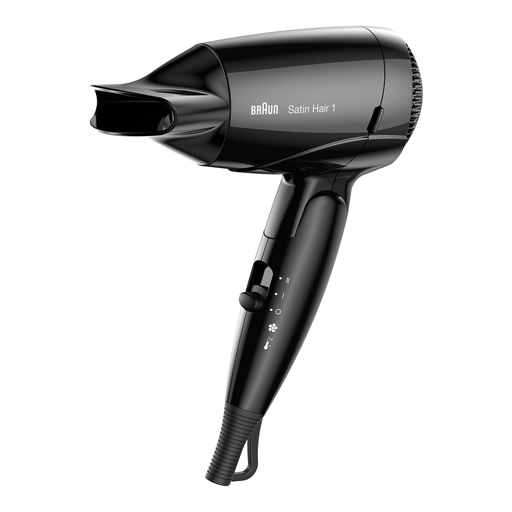
Why it suits this profile: This model combines 1200 watts, a folding handle and a weight of 257 grams. The multivoltage function is practical for travelling outside Europe.
The specifications list not only the power, but also the weight, two temperature settings and multivoltage.
257 grams, folding handle, 1.8-metre cord and styling nozzle included.
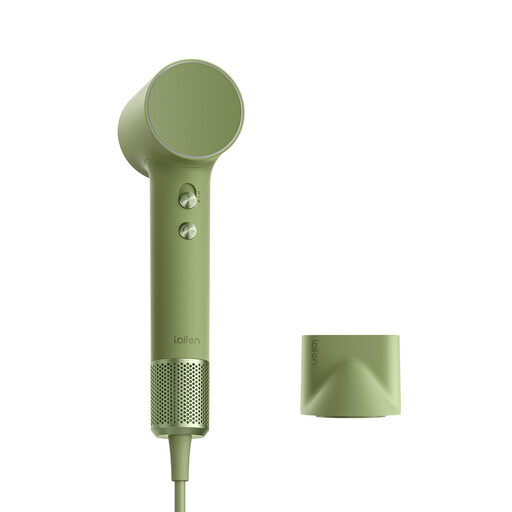
Why it suits this profile: The product description mentions a brushless motor running at 110,000 RPM, ionic technology and quiet operation. This makes it suitable for users who want to combine a compact design with modern motor technology.
The choice is based on clearly stated motor technology and an ionic function, rather than high wattage alone.
Mini format, brushless motor and, according to the product name, quiet operation.
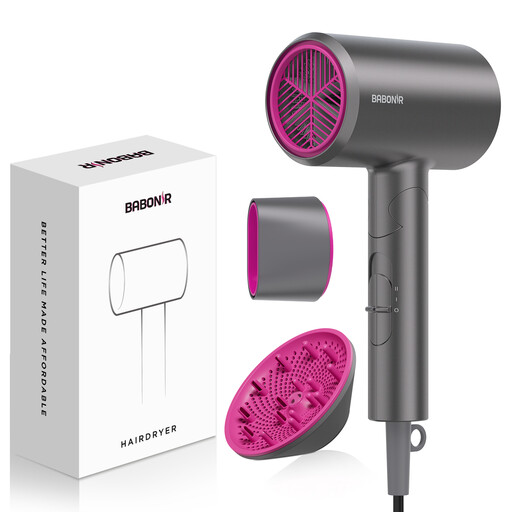
Why it suits this profile: This model is designed for use at home, short trips and curly or voluminous hair, thanks to its diffuser, concentrator and three heat settings.
At 330 grams, with a folding design and six heat-and-speed combinations, the choice is more specific than simply being described as “compact”.
1800 watts, approximately 330 grams, diffuser and concentrator included.
We have put together a complete, up-to-date list of products that fully meet these strict selection criteria and the applicable European safety requirements.
Never use a hairdryer in or near water. Keep the air intake and outlet clear, and unplug the device after use. Allow it to cool down completely before folding the handle or putting it in a bag. Clean a removable filter regularly; dust and hair can restrict the airflow and cause overheating.
When buying, check that the manual, voltage and safety information are clear. Electrical appliances in the European Union are covered by statutory consumer protection. In the event of a fault, repair, replacement or a refund may be available under the applicable rules.
That depends on your hair and drying routine. A compact 1200-watt hairdryer is often suitable for short or fine hair. For long, thick or curly hair, more power, several settings and a diffuser are more practical. A hairdryer for home and travel is particularly useful if you do not want to store two devices.
Only if the model supports the local mains voltage. Look for multivoltage or a voltage switch supporting 110–120 and 220–240 volts. An adapter only changes the shape of the plug, not the voltage. Always check the setting on the device and the instructions before use.
Consumption is mainly determined by the wattage and how long the device is used. A 1200-watt appliance running for ten minutes theoretically uses around 0.2 kWh. An 1800-watt model uses approximately 0.3 kWh in the same amount of time. The actual cost depends on your energy tariff and drying time. Powerful airflow can shorten the operating time, but do not look at wattage alone.
