
Vandaag of morgen in huis

Kwaliteit gegarandeerd

Welkomstaanbiedingen ontgrendelen: GRATIS bezorging | Tot 80% korting | Gratis 30 dagen JoyPlus-proefperiode
Download de app
A travel hairdryer needs to fit in your suitcase, be lightweight and deliver enough airflow to dry your hair within a reasonable amount of time. However, the differences between models can be significant. A folding hairdryer may be compact but leave little room for styling. A powerful hairdryer may dry your hair quickly, but weigh more or only be suitable for a particular voltage.
The Joybuy Product Recommendation Officer has listed the key points to check. This makes it easier to compare travel hairdryers based on verifiable features rather than marketing claims alone.
Higher wattage does not automatically mean that a hairdryer will dry your hair faster. Airflow, the motor and the shape of the nozzle also play a part. A compact 1200-watt hairdryer may be sufficient for short hair, while thick or long hair generally needs more airflow and several settings.
So do not look at wattage alone. Also check the number of speed and temperature settings, as well as whether the hairdryer has a cool-air button.
A hairdryer for use at home and while travelling cannot simply be plugged in everywhere. In the Netherlands, the standard voltage is generally 220–240 volts, while other countries may commonly use 110–120 volts. A model with dual voltage or a voltage selector switch is more practical in these situations.
Be aware of the difference between multivoltage and a simple travel plug adapter. An adapter only changes the connection; it does not automatically convert the voltage. With models that have a manual switch, you must select the correct setting before plugging the hairdryer in.
A folding handle saves space, but also check the dimensions when the hairdryer is folded. It is also worth looking at the accessories included. A concentrator is useful for directing the airflow and creating a smoother style. A diffuser may be more suitable for wavy or curly hair.
A hairdryer with a diffuser is often slightly bulkier than a basic travel model. Decide in advance whether you really need the accessory.
Every gram counts when you are flying or travelling for business. A lightweight hairdryer weighing around 250 to 450 grams is easier to take with you than a large home model. Check the weight of the appliance itself, not just the packaged weight.
A folding hairdryer is particularly useful when you have limited space in your hand luggage. Also consider the length of the cord and the position of the air inlet. A compact body is of little benefit if the cord or accessories take up a lot of space.
At least two speed and temperature settings give you more control than a single fixed setting. A lower setting can be more comfortable for fine or short hair. Thick hair usually requires stronger airflow, while a lower temperature may be more suitable for longer styling sessions.
A cool shot or cool-air button can be used at the end of the drying process. Manufacturers often describe this feature as helping to set a hairstyle. It is a product function, not a guarantee of a particular styling result.
According to brands’ own product information, an ionic hairdryer may help reduce static electricity and frizz. Results can vary depending on your hair type, styling products and how you use the hairdryer. Treat ionic technology as an additional feature, rather than a guaranteed benefit.
A hairdryer with a concentrator directs the airflow at a smaller area. This is useful when blow-drying with a brush. For a hairdryer for curly hair, a diffuser is often more relevant because it spreads the airflow. Always check whether the accessory is actually included; images do not always show the complete contents of the package.
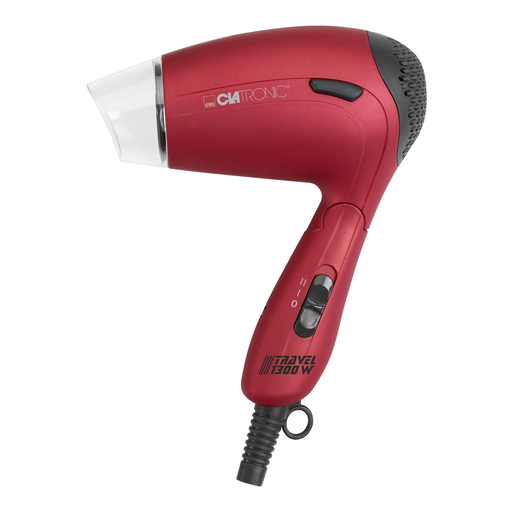
Why it suits this profile: This model combines a folding handle with two settings, a storage bag and switchable 110/230 V voltage. That makes it a straightforward choice for anyone buying a compact hairdryer for the first time.
The voltage selection is clearly stated. The diffuser and styling nozzle are also listed, so you know in advance which accessories you will receive.
1200 W, folding handle, two settings, diffuser, concentrator and a weight of 350 g.
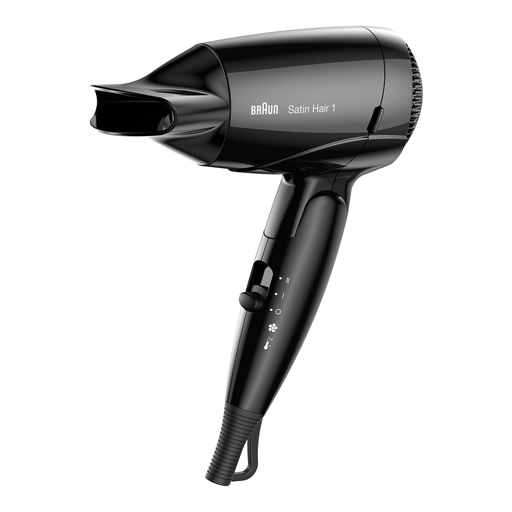
Why it suits this profile: The Braun HD130 is designed for travellers who want an exceptionally lightweight model. The product information states that it weighs 257 g and has a folding handle, multivoltage and a precision nozzle.
The weight and multivoltage function are clearly specified. This means you do not have to rely on the word “travel” alone.
1200 W, 257 g, 1,80 m cord, two temperature settings and multivoltage.
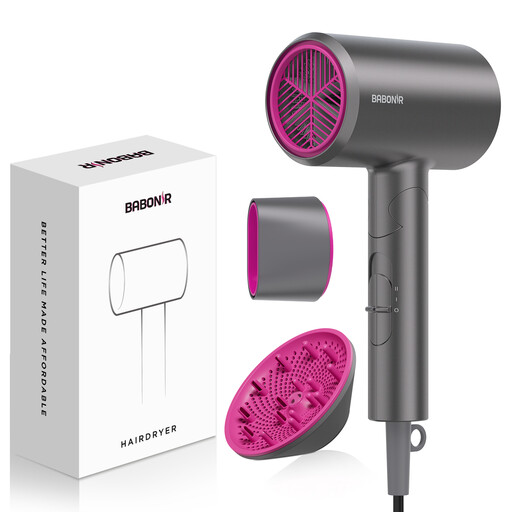
Why it suits this profile: The FZ201 is aimed at users who want several styling options both at home and on the go. The specifications list 1800 W, 330 g, three temperature settings, two speeds, a diffuser and a concentrator.
The model specifies both the weight and the available settings and accessories. According to the product information, the ionic function is intended to help reduce static electricity and frizz.
1800 W, 330 g, folding design, diffuser and concentrator, three temperature settings and two speeds.
Use a travel hairdryer only in accordance with the instructions. With dual-voltage models, always check the switch before plugging the appliance in. Keep the air inlet and outlet clear, and never use the appliance in or near water.
Allow the hairdryer to cool completely after use before folding the handle or storing it in a bag. Clean the air filter regularly if the instructions recommend doing so. A blocked air inlet can affect performance and cause additional heat to build up. Stop using the hairdryer if the cord is damaged or if you notice smoke, an unusual smell or overheating.
We have put together a complete, up-to-date list of products that fully meet these strict selection criteria and the applicable European safety regulations.
That depends on the model. A compact travel hairdryer with several settings and sufficient power can also be used at home. For very thick or long hair, a larger model with stronger airflow may be more practical. Pay particular attention to drying power, cord length and ergonomics.
Only if you are travelling to countries that use a different voltage from the Netherlands. Check your destination’s mains voltage in advance. If the hairdryer has a manual voltage selector, choose the correct setting before plugging it in. A travel plug adapter alone is not sufficient.
The cost depends on the wattage, how long you use it and your energy tariff. A 1600-watt hairdryer running for ten minutes uses approximately 0,267 kWh. Multiply this consumption by your current electricity tariff for an estimate. A fast hairdryer may reduce the time you use it, but actual consumption still depends on the power and the setting selected.
