
Livraison le jour même et le lendemain

Qualité garantie

Débloquez vos offres de bienvenue: Livraison GRATUITE | Jusqu'à -80 % | 30 jours d'essai gratuits à JoyPlus
Téléchargez l'application
Loose items in cupboards, open bags of flour in the pantry or shoes piling up in the hallway: storage boxes with lids can help keep household clutter organised. But not every box is right for every purpose. A low box for clothes needs different features from a food container for flour or leftovers.
Look out for these three common pitfalls:
First, measure the shelf, drawer, cupboard or space under your bed. Then check the external dimensions, not just the number of litres. For example, a 20-litre box may be too tall for a low cupboard.
A practical guide:
For narrow shelves, rectangular plastic storage boxes are often more space-efficient than round tubs. Also check that there’s enough clearance above the box to open the lid.
For clothes, toys and craft supplies, plastic storage boxes made from polypropylene (PP) or other sturdy plastics are a practical choice. Food storage requires more careful consideration. Look for a clear statement that the material is suitable for food contact.
For food storage containers, these features are worth checking:
Read a claim such as “airtight” as a product feature stated in the product description, not as a guarantee that food will stay fresh indefinitely. For example, the product information for Curver Fresh & Go containers mentions a snap-on lid with a seal and use from -40 °C to +100 °C. The same information states that the containers are suitable for the freezer, microwave and dishwasher; the lid must be removed before heating.
A sturdy lid helps keep out dust and makes stacking easier. Clips, handles or a wraparound closure are useful when carrying a box. For dry food, airtight storage containers with a continuous silicone seal and multiple clips are a better choice than ordinary storage boxes with lids.
Also consider how easy the box is to clean. A container that can only be washed by hand needs more care than a model that the product information says is dishwasher-safe. If you use a container for food, check the seal regularly for cracks, distortion or trapped food.
The choices below are based on verifiable information such as capacity, dimensions, material, closure and stated uses. Always check the current product page and availability before buying.
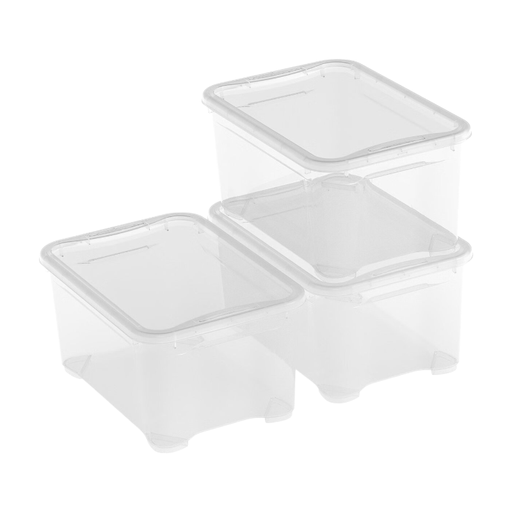
Why it suits this need: A well-organised set for anyone who wants to sort a range of small household items without buying large boxes straight away. The transparent design lets you see what’s inside.
You can see what’s inside, so you won’t need to open several boxes to find what you’re looking for. The product information mentions clip-on lids and stackability; just make sure to place them on a stable, level surface.
Set of three 14-litre boxes, made from transparent PP, and nestable without their lids, according to the product description.
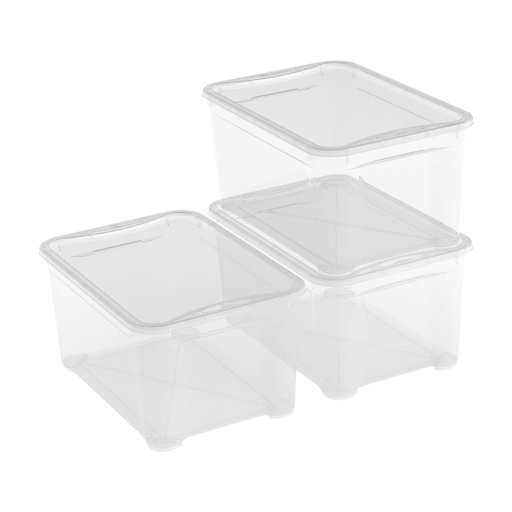
Why it suits this need: A good choice for households looking to store clothes, toys, sports equipment or larger items in matching boxes.
You can see what’s inside, and each box has a fixed capacity. The stated maximum load is 15 kg per box, so divide heavier items between several boxes.
47-litre capacity, dimensions of 55.5 × 39 × 28.5 cm and a clip-on lid; stackable with the lid on, according to the product information.
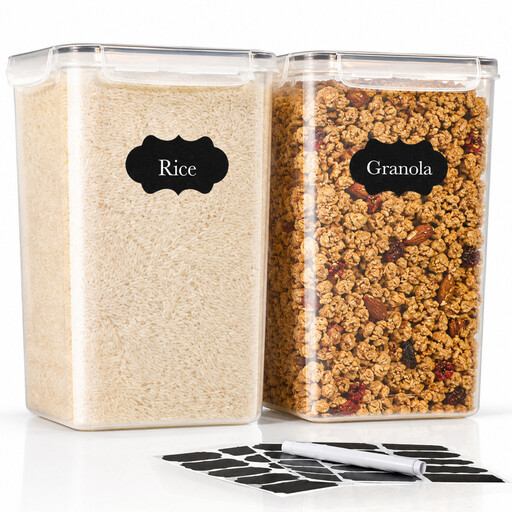
Why it suits this need: Handy for households that store larger quantities of flour, rice, sugar, pasta, oats or pet food.
The wide opening is designed to make filling and scooping easier. According to the product information, four clips and a silicone seal close the container all the way round.
Two 9.5-litre containers, BPA-free according to the product description, with a stackable design and labels and pen included.
Transparent shoe boxes are practical because you can identify the pair without opening every lid. Check the internal dimensions: a trainer box may, for example, fit shoes up to size 44, but this varies by model and shoe shape.
Larger transparent boxes are handy for clothes and toys. If you often need to retrieve items, it’s better to use several medium-sized boxes. A 70-litre box filled to capacity can be difficult to move. For toys, use labels for each category, such as building blocks, soft toys or dressing-up clothes.
A consistent system is useful in the kitchen too. Use small food storage containers for leftovers and portions, and larger storage containers for flour, rice or pasta. Only store hot food if the product information says it’s suitable, and follow the microwave instructions.
We’ve put together a complete, up-to-date list of products that meet these strict selection criteria and the applicable European safety regulations.
Yes, as long as the box is large enough and the clothes are stored dry. Transparent plastic boxes make it easier to find what you’re looking for. For long-term storage, it’s a good idea to make sure clothes are clean and completely dry before putting them in the box.
Their lifespan depends on the material, load, sunlight, temperature and how they’re used. Avoid overloading them, place stackable storage boxes on a flat surface and replace any box that’s cracked or warped. Always follow the maximum load stated in the product information.
It depends on what you’re storing. For flour, rice, sugar and pet food, a container with clips and a seal may be more practical than one with a loose-fitting lid. For toys or clothes, a simple clip-on lid is usually enough. So focus your spending on features that suit the way you’ll use the container, rather than just the word “airtight”.
