
Vandaag of morgen in huis

Kwaliteit gegarandeerd

Welkomstaanbiedingen ontgrendelen: GRATIS bezorging | Tot 80% korting | Gratis 30 dagen JoyPlus-proefperiode
Download de app
Choosing new travel luggage may seem straightforward. Yet many disappointing purchases come down to details that only become apparent during a trip: a suitcase that does not fit in the overhead compartment, wheels that are awkward to manoeuvre or a weekender bag in which clothes quickly become jumbled. With a few simple checks, you can avoid paying for features that offer little practical benefit.
The terms cabin luggage and hand luggage suitcase may sound clear, but airlines have different maximum dimensions and weight limits. Always check the conditions of the airline you are travelling with. A suitcase measuring 52 cm in height may be suitable for certain flights, but that does not guarantee it will be accepted by every airline.
Pay attention to all dimensions: height, width and depth. Wheels, handles and protruding zipped compartments may also be included in the measurements.
A trolley suitcase with an attractive pattern may look appealing, but the material also determines how practical the luggage is. ABS is a hard plastic that provides protection against knocks. Textile materials such as nylon are often flexible and lightweight. Synthetic leather can look smart, but it requires extra care when it comes to scratches, moisture and maintenance.
Think about where you will use the luggage: in an aircraft cabin, on the train, during a city break or at the gym. A hard suitcase is not necessarily more convenient than a soft travel bag in every situation.
A large main compartment does not automatically mean that your belongings will stay organised. Without compartments or luggage organisers, clothes, cables and toiletries can quickly become mixed together. An organiser set may therefore provide more practical value than a few extra litres of capacity.
Compare the stated dimensions with the purpose of your trip. A model with a capacity of 28 to 30 litres may be suitable for a short business trip or weekend away. Longer holidays generally require more space, but your luggage should still be comfortable to carry and transport.
Also check whether the stated capacity matches your packing list. A travel suitcase with a narrow shape may offer enough litres on paper, but be less efficient to pack than a wider model.
A lightweight travel suitcase leaves more room within any applicable weight limit. Do not look only at the product weight; also consider how you will transport the luggage:
Two wheels can be useful on uneven surfaces, while four spinner wheels are easy to manoeuvre in stations and airports. The right choice depends on your route and personal preference.
Check that the zips run smoothly and that the seams are securely finished. With an organiser set, zipped compartments are useful for keeping clothes and accessories separate. However, overpacking can place unnecessary strain on zips and fabric.
A combination lock can help keep your suitcase closed, but check that the type of lock is accepted by the carrier and that you can set the code easily. A lock will not prevent luggage from going missing and is not a substitute for a luggage tag.

Why it suits this profile: For anyone who already has a suitcase but wants to pack clothes, toiletries and accessories more neatly. The set can also be used for short trips or visits to the gym.
The seven separate bags tackle the problem of a disorganised main compartment. According to the product description, they feature zips and reinforced stitching. Overloading should be avoided.
7-piece nylon set, stated weight capacity of 5 pounds and easy cleaning with a damp cloth.

Why it suits this profile: An option for travellers looking for a compact hard-shell cabin suitcase with internal compartments and an extendable handle.
The stated dimensions are 34 x 22 x 52 cm. Nevertheless, check these measurements against your airline’s rules before booking.
ABS shell, 30-litre capacity, product weight of 2.5 kg, spinner wheels, internal compartments and a combination lock.
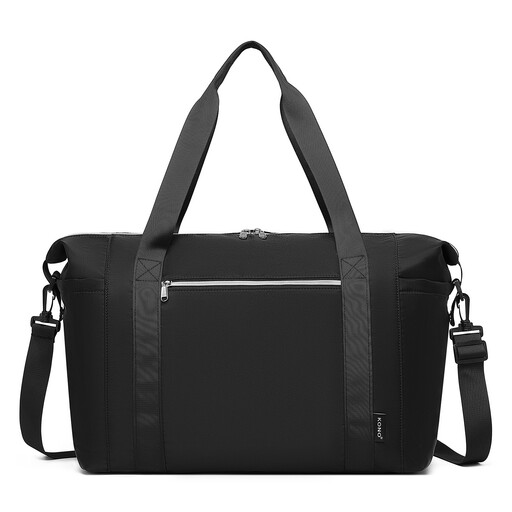
Why it suits this profile: Designed for weekends away, business trips, gym visits or situations where a flexible travel bag is more practical than a hard trolley case.
This bag is not an awkward hard suitcase and can be used as a carryable weekender. For cabin use, always check its packed dimensions.
According to the product name, this black bag has a large capacity, a removable shoulder strap and a lightweight design for easy transport.
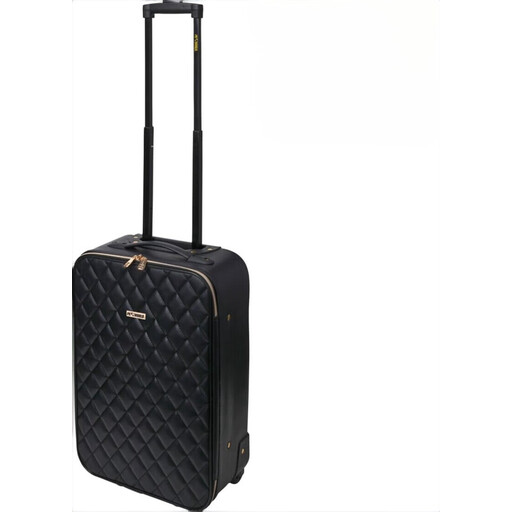
Why it suits this profile: Suitable for anyone looking for a compact black travel suitcase with a distinctive design for short trips and business visits.
The stated 28-litre capacity makes its intended use clearer than a vague description such as ‘spacious’. Bear in mind the limited depth of 17,5 cm when packing.
Synthetic leather exterior, telescopic handle, two wheels, 28-litre capacity and a product weight of 2,26 kg.
We have compiled a complete, up-to-date list of products that fully meet these strict selection criteria and the applicable European safety regulations.
For a short weekend away, 20 to 35 litres is often a practical range, depending on your clothes, shoes and toiletries. A soft weekender bag can be filled flexibly, while a suitcase retains its shape. Also consider carrying comfort and the storage space available at home.
Its lifespan depends on how it is used, the surfaces it travels over, how heavily it is packed and how well it is maintained. Wheels, zips and handles generally experience more wear than the shell. Avoid overpacking, do not pull a trolley over unnecessarily rough surfaces and clean the material according to the product instructions. For products from Koopman International included in this overview, a minimum statutory warranty of two years is stated; your statutory rights may extend further depending on the circumstances.
A hard suitcase protects its contents with its rigid shape and can be easy to roll. A travel bag is often more flexible, easier to store and suitable for sport, weekends away or transporting in a car. Choose based on your mode of transport, packing list and whether you mainly need protection or flexibility.
