
Student with a small desk
Wants a breeze by their seat without losing desk space. So check the floor space it needs, its base and the direction of the airflow.


Choose a tower fan if you have a stable spot on the floor next to your desk. Then decide whether you want a directed breeze or air that moves from side to side. A low noise rating doesn’t necessarily apply to higher settings. Before buying, check the exact model variant and the relevant safety information, including CE marking where required.
Wants a breeze by their seat without losing desk space. So check the floor space it needs, its base and the direction of the airflow.
If you study or sleep in the same room, check how noisy the fan is on the setting that gives you enough airflow.
Doesn’t want a directed breeze constantly blowing in one spot, so compares a fixed airflow with oscillation.
Start by checking the space available and the distance from your chair. Then assess the airflow and noise on the setting you plan to use while studying or sleeping.
| What to consider | What should you check? | Who should pay particular attention? |
|---|---|---|
| Airflow at your desk | Check the distance from your chair, the direction of the air outlet, the settings and whether the model oscillates. | If I want a breeze by my seat without always using the highest setting, useful airflow is my top priority; around 33% of consumers say this need comes first. |
| Noise while studying or sleeping | Compare the noise and airflow at the same setting and distance. The manufacturer’s stated figure applies to the specified version and test setting. | I want to study or sleep without the noise becoming intrusive; around 25% of consumers prioritise quiet operation on the setting they use. |
| Floor space | Measure the available space and check the base, where the cable will run and whether the fan will be stable in its intended position. | If there’s little room around my desk and walkway, the fan needs to fit securely without getting in the way; around 25% of consumers give suitable positioning top priority. |
| Use and controls | Compare the stated power with how long you expect to use it, and check whether the exact version has a timer or the controls you want. | I want to manage how long it runs easily and keep an eye on electricity use; around 17% of consumers prioritise controls and running costs. |
A noise rating may refer to the lowest setting, while you might need a different one at your desk.
Compare noise and useful airflow together at the setting and distance you expect to use.
A fan moves air and can make you feel cooler, but it doesn’t cool the room like an air conditioner or automatically remove polluted indoor air.
If the real issue is heat coming in or poor ventilation, tackle those separately.
The Philips CX5535/00 and CX5535/11 are different model variants. A similar series name doesn’t mean the versions are identical.
Check the full model number and the version intended for the Netherlands before comparing features.
The VE-5905 and VE-5864 are examples of Tristar tower fans that you can compare based on their individual features and specifications.
The Eole 3 VU6670 and Urban Cool VU6720 have different stated settings and airflow options.
The Philips CX5535/00 is a tower fan with several control features.
Duux’s Elevate range gives you another line of models to consider alongside other tower fans.
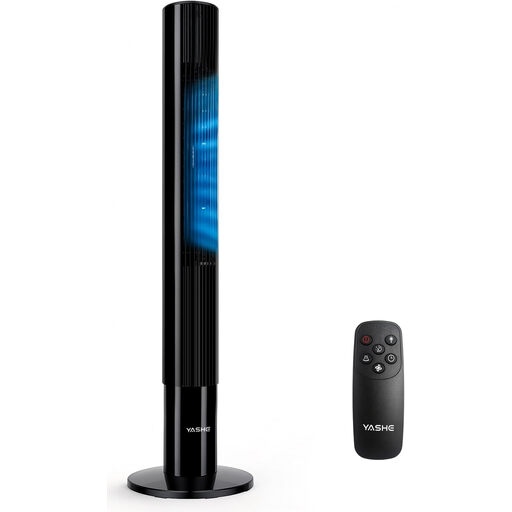
This Joybuy selection features a tower fan for circulating air around a desk.
 No image available
The stated oscillation and range of speeds suit anyone who wants to adjust or distribute the airflow around their seat.
The product title lists 3 speeds, 85° oscillation, 2 modes, a 12-hour timer, remote control and an LED display.
The stated 28 dB figure is not an independent measurement. Before buying, check whether this version carries the required CE marking.
No. A fan moves air and makes you feel cooler, but it doesn’t cool the room like an air conditioner. If the room stays hot, keeping heat out and ventilating it properly are separate steps.
Place it on a flat, stable surface where it’s unlikely to topple over, and keep it free of dust. Follow the instructions for the version you bought when assembling and cleaning it.
No. According to ACM ConsuWijzer, there’s no fixed term for statutory guarantees in the Netherlands. With normal use, it depends on what you can reasonably expect from the product. Contact the retailer if the product breaks down too soon.
According to the NVWA, electrical products covered by the applicable Dutch rules must carry CE marking. Check that the specific fan has the marking; the product requirement doesn’t automatically confirm that an individual model has been checked.