
Sharing the sofa
You often sit on the sofa with someone else and want to spread the airflow around, rather than having it blow directly at the same seat all the time.


In a student room with limited floor space, an oscillating tower fan could be a good choice if you want to circulate air around the sofa. If you want to adjust the airflow height or direction precisely, consider a pedestal fan too; it will generally take up more space. Compare noise levels at the setting you plan to use: Milieu Centraal points out that a fan moves air around but does not lower the air temperature.
You often sit on the sofa with someone else and want to spread the airflow around, rather than having it blow directly at the same seat all the time.
You’re looking for a spot beside the sofa without filling up the room. Remember to allow for both the fan’s footprint and the space it needs to oscillate.
You use the same room to relax or sleep and want to adjust the airflow without unnecessary noise or light. Check the setting you’ll use, not just the stated minimum value.
Start by considering airflow distribution and the floor space available. Then compare noise levels at your preferred setting and see which controls and features suit the way you’ll use it.
| What to consider | What to look for | Who is this important for? |
|---|---|---|
| Airflow from beside the sofa | Check the oscillation function and airflow height; see whether the airflow can reach the seats you want it to. | If I’m sitting on the sofa with someone else, I want the airflow to be shared rather than directed at one spot all the time. Around 31% of consumers say airflow distribution is their main concern when buying. |
| Space beside the sofa | Measure the space available and check the base dimensions and clearance around the appliance. | In a small room, I want to fit the fan in without obstructing the walkway or the space beside the sofa. Around 25% of consumers give floor space top priority. |
| Peace and quiet while relaxing or sleeping | Compare noise levels only when they’re measured under the same stated conditions, and check the timer and any display settings. | If I relax or sleep in the same room, I want useful airflow without unnecessary disturbance. Around 25% of consumers put peace and quiet first. |
| Running costs and controls | Check the power rating, how long you plan to use it for and whether a remote control is included. | If I use the fan often or want to control it from the sofa, I want to know which settings and controls I’ll actually get. Around 19% of consumers start by considering running costs or ease of use. |
Milieu Centraal distinguishes between moving air and lowering the air temperature: a fan can make the air feel cooler, but it won’t cool the room. Circulating air also doesn’t replace bringing in fresh air and removing stale air.
Choose a fan to circulate air around the sofa, and arrange ventilation separately where needed.
The base and the space needed for oscillation also have to fit. A tower fan takes up little space, but according to Consumentenbond’s buying advice, its height cannot be adjusted and it cannot be tilted.
Measure the space where you plan to put it, and compare the base dimensions and desired airflow height before choosing a type.
A stated minimum doesn’t automatically tell you how much noise the fan makes at other speeds or settings.
Compare figures only when the stated usage conditions match, and, if possible, assess the setting you plan to use beside the sofa.
The VE-5864 is an example of a tower fan with simple dial controls.
The Elevate No Wi-Fi offers plenty of speed settings for anyone who wants to fine-tune the airflow without app controls.
The 352370 DC is an option to compare if you’re looking for several settings and controls you can use from the sofa.
The 5000 Series includes several tower fan models, so check the exact model before comparing specifications.
The Eole 3 VU6670F0 is worth considering if you want a wide oscillation range and an adjustable shut-off timer.
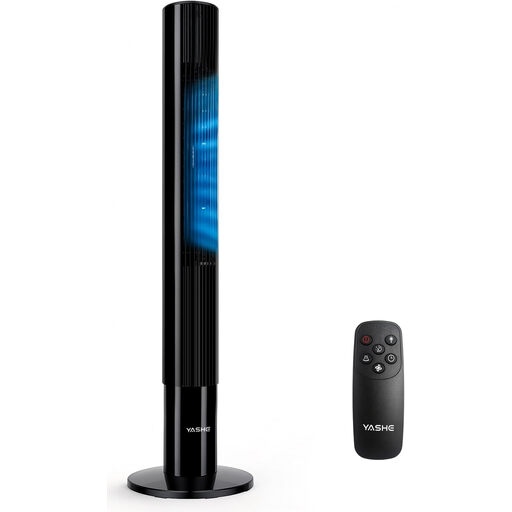
This product selection focuses on a tower fan with oscillation and controls you can use from the sofa.
 No image available
The stated remote control and oscillation could suit you if you want to control and distribute the airflow from the sofa.
Listed features: 85° oscillation, three speeds, two modes, a 12-hour timer and an LED display.
With a stated noise level of 28 dB, it’s worth checking the setting used and the measurement conditions before comparing it with other models.
No, a tower fan doesn’t lower the air temperature. The airflow can make you feel cooler, but you’ll also need ventilation for fresh air, as Milieu Centraal explains.
Choose a stable spot where the base fits and furniture won’t block the oscillation. Also check that the airflow height suits your seating position; according to Consumentenbond’s buying advice, a tower fan cannot be adjusted in height or tilted.
Follow the instructions for the exact model. Rowenta states that the VU6670F0 has a removable rear grille; don’t assume other models are built in the same way.
Multiply the power rating of the setting you use, in watts, by the number of hours you use it for, then divide by 1,000 to calculate consumption in kWh. The cost depends on your electricity tariff.
CE marking is compulsory for mains-powered tower fans covered by Dutch rules for electrical products; the Netherlands Food and Consumer Product Safety Authority (Nederlandse Voedsel- en Warenautoriteit) explains the applicable rules. Check the specifications and safety information for the model you choose. For a standard online consumer purchase, you’ll usually have a statutory cooling-off period of up to 14 days after delivery, subject to conditions and exceptions explained by ACM ConsuWijzer.