
Hobbyist with a regular seat
Wants to adjust the airflow and mainly chooses a fan based on how comfortable it feels at their usual seating distance. The Consumentenbond assesses airflow at different speeds and distances.


For one permanent seat, a simple tower fan may be all you need. Choose one with an airflow that feels comfortable at your usual seating distance, then consider its noise level, floor space and controls. A fan circulates air, but it does not replace fresh-air ventilation when your hobby creates dust or fumes; Milieu Centraal distinguishes between air circulation and ventilation.
Wants to adjust the airflow and mainly chooses a fan based on how comfortable it feels at their usual seating distance. The Consumentenbond assesses airflow at different speeds and distances.
Wants a useful setting that is not too distracting while reading, chatting or doing detailed work. Pay attention to the noise level of the setting you will actually use.
Needs to fit the base and any oscillation beside the chair without blocking the route through the room or the workspace. Check the dimensions of the specific model.
Start by thinking about the breeze you want to feel at your usual seating distance. Then check whether the noise, placement and controls suit the way you use the fan for your hobby.
| What to consider | What to look for | Who is this most important for? |
|---|---|---|
| Airflow at your seating distance | Compare the speed settings and assess the lowest one where you sit, both with and without oscillation. | I want a breeze beside my chair that feels comfortable at my seating distance, not just a high airflow figure on paper. Around 31% of consumers prioritise comfort at their usual seating distance. |
| Noise while you work on your hobby | Assess the noise alongside the airflow of the setting you intend to use. | When concentrating, I want a setting that is not too distracting but still provides useful airflow. Around 25% of consumers prioritise peace and quiet while working on their hobby. |
| Positioning beside the chair | Measure the available floor space and check the base, cable route and clearance needed for oscillation. | If my chair and materials take up most of the space, I want to keep the base and cable out of my way. Around 19% of consumers prioritise practical placement. |
| Controls within reach from your chair | Check whether a control dial will be within reach, or whether you would prefer a remote control and timer. | I want to adjust the setting while I work without having to get up each time. Around 13% of consumers consider uninterrupted control the most important factor. |
| Maintenance and energy use | Check how to clean the grille according to the instructions and compare the stated power rating in watts. | If I use the fan regularly, I want to know how to keep it clean and what its stated power rating is. Around 12% of consumers prioritise maintenance and energy use. |
How comfortable the airflow feels also depends on the setting you use and your distance from the fan. The Consumentenbond assesses fans at different speeds and distances.
Try to assess the setting you would choose at your usual seating distance.
A fan does not automatically remove polluted air or bring in fresh air from outside. Milieu Centraal distinguishes between air circulation and ventilation.
If your hobby creates dust or fumes, make sure there is also a suitable supply and extraction of air.
The base, cable and clearance for oscillation also determine whether a tower fan will fit practically beside your chair.
Check the dimensions and intended setup of the exact variant before ordering.
The VE-5905 is a simple tower fan worth considering for one regular seat, with controls via a dial on top.
According to Philips, the CX5535/11 from the 5000 Series has remote controls and a timer, making it suitable if you want to adjust settings from your chair.
According to Rowenta, the Eole 3 VU6670F0 is designed to direct airflow towards several areas.
According to Duux, the Elevate Smart has app controls and 26 speeds, making it a good option if you want plenty of adjustment options.
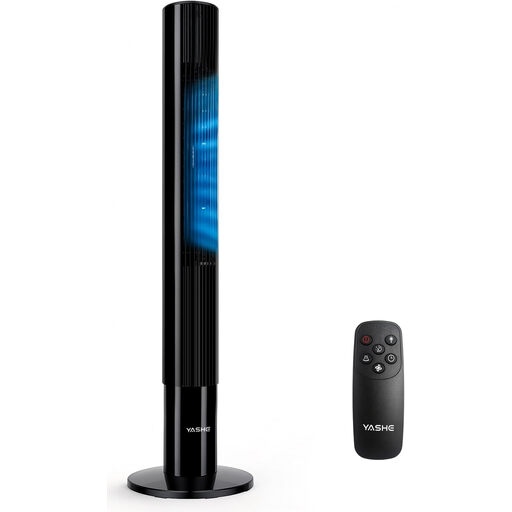
This selection focuses on tower fans for use beside a regular seat, with remote controls and a timer.
 No image available
The remote control and timer are useful if you want to adjust the settings from your chair or have the fan switch off automatically.
The product title lists three speeds, two modes, 85° oscillation, a 12-hour timer and an LED display.
The product title states 28 dB; check the product information to see which setting and measurement conditions this refers to.
A standard fan does not lower the room temperature like an air conditioner. The airflow may make you feel cooler, but a fan alone is not enough to lower the room temperature, according to Milieu Centraal.
No. Ventilation means bringing in fresh air and removing polluted air. Milieu Centraal recommends extra ventilation when carrying out DIY jobs; tailor your approach to the materials and activity involved.
Position the fan so that the base, cable and oscillation do not get in the way of your chair or the route through the room. Follow the instructions for cleaning the exact model; for example, Rowenta lists a removable rear grille for the VU6670F0.
For online purchases from a business, you will often have a 14-day cooling-off period in the Netherlands, according to the Dutch government. You also have statutory protection if the product is faulty; the seller is your point of contact. There is no fixed statutory guarantee period in the Netherlands.
According to the Netherlands Food and Consumer Product Safety Authority (NVWA), products covered by the Commodities Act Decree on Electrical Equipment must have a CE mark. The NVWA includes electrical equipment with a rated AC voltage of 50 to 1,000 V; check the power supply and product information for the exact model, as this requirement does not necessarily apply to every USB-powered variant.