Choose a tower fan based on where you need the airflow. Oscillation can help direct the breeze towards several seating areas in turn, while choosing a suitable adjustable setting is important for comfortable, peaceful sitting. According to Milieu Centraal, a fan can make you feel cooler, but it does not lower the air temperature, so tackle solar gain and ventilation separately. Before buying, also check the safety information for the exact model.
Who is a tower fan in the conservatory suitable for?
Conservatory users with several seating areas
Would you like to circulate a breeze among people who aren’t all sitting directly in front of the fan? Look at the oscillation, outlet height and placement. Consumentenbond points out that tower fans are generally neither height-adjustable nor tiltable.
Anyone who wants to relax in the conservatory
If you read, chat or work in the conservatory, compare the airflow and noise at the setting you actually plan to use. Consumentenbond notes that the number of speed settings alone says little about the fan’s maximum airflow.
Anyone who runs the fan for long periods
If you use the fan for a long time, power consumption and a timer may influence your choice. Milieu Centraal emphasises that a fan does not lower the air temperature.
What should you look for when choosing one?
For a conservatory in use, your choice mainly comes down to where you want to feel the breeze, how comfortable the fan is at the setting you’ll use, and how long it will run. The percentages below each refer to the main buying concern.
| Buying concern |
What to look for |
Who should give this more weight? |
| Airflow reaching several seating areas |
Check the oscillation function, outlet height and placement in relation to the chairs. |
If I’m sitting with others in different areas, I want the airflow to reach their seats too. For around 40% of consumers, distributing air across several seating areas is the top priority. |
| Quiet, adjustable use |
Compare the airflow and noise at the setting you plan to use; according to Consumentenbond, the number of speed settings says little about the fan’s maximum airflow. |
When I’m reading or chatting in the conservatory, I want a useful breeze that doesn’t drown out the conversation. Around 40% of consumers give quiet, adjustable use the highest priority. |
| Power consumption during extended use |
Check the stated power in watts and which settings you’ll use. To estimate consumption in kWh, multiply the power in kW by the number of hours of use. |
If the fan runs for a long time, I want to be able to estimate its power consumption at the setting I use. Around 20% of consumers put running costs first. |
Common buying mistakes
-
Assuming a fan will stop the conservatory from heating up
According to Milieu Centraal, the airflow can make you feel cooler, but it does not lower the air temperature.
First decide whether you mainly want a breeze where you’re sitting or want to tackle the conservatory heating up. Reduce solar gain separately, and let air flow through when it’s cooler outside than indoors.
-
Comparing only the number of settings or the lowest noise rating
According to Consumentenbond, the number of speed settings says little about the fan’s maximum airflow. A noise rating is only useful for comparison if you know which setting it applies to.
Compare airflow and noise at a setting you would actually use, and check the test conditions for any stated figures.
-
Assuming a product listing confirms that it is currently available to order
A product listing does not automatically mean that exact version is available to order at that time.
Before ordering, check the current product page for the model name, version and availability.
Relevant brands to consider
Philips
Philips lists the 5000 Series CX5535/11 as a tower fan with oscillation and a timer.
- The product information specifies 60° oscillation, a 1–7-hour timer and a stated power of 40 W.
- These are Philips product specifications; on their own, they don’t tell you how the airflow or noise will be in your conservatory.
Dyson
Dyson describes the Cool AM07 as a freestanding tower fan with oscillation and adjustable airflow.
- The manufacturer lists a remote control and ten airflow settings.
- The features listed by Dyson don’t, by themselves, tell you whether the airflow will feel comfortable where you sit.
Rowenta
Rowenta describes the Eole Silence Force VU7050 as a compact tower fan with several speed settings.
- The product description lists several speed settings.
- Claims about quiet operation and energy saving come from the manufacturer and do not, on their own, provide a basis for comparison.
Joybuy fan selection for moving air
This Joybuy selection features a tower fan with oscillation to circulate air around several seating areas in the conservatory.
 No image available
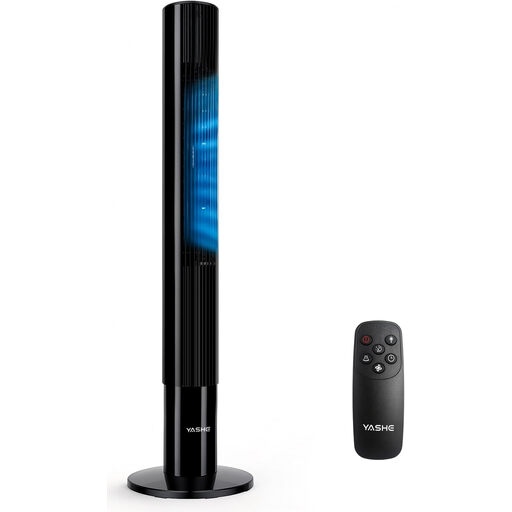
YASHE NDTFT17RH-S tower fan with remote control
The listed oscillation function may be useful if you want to distribute airflow across several seating areas; check that the outlet height suits your chairs.
The product name lists 85° oscillation, 3 speeds, 2 modes, a 12-hour timer and an LED display.
The product name lists 28 dB; check which setting and test conditions this figure applies to. Before buying, also check the applicable safety information for the exact model and version.
View at Joybuy
Frequently asked questions
Does a tower fan cool the air in my conservatory?
No. According to Milieu Centraal, the airflow can make you feel cooler, but it does not lower the air temperature. Reduce solar gain separately, and let outdoor air flow through the conservatory when it’s cooler outside than indoors.
Is circulating air the same as ventilating the conservatory?
No. As Milieu Centraal explains, ventilation means bringing in fresh air and removing stale indoor air. A standalone tower fan that only moves air around the conservatory does not automatically provide this air exchange.
What should I bear in mind when positioning and maintaining the fan?
Place the fan on a stable surface and keep its openings and surrounding area clear, following the model’s instructions. The Fire Service advises keeping electrical appliances free of dust and ensuring that heat can escape.
Which product safety rules apply in the Netherlands?
Check the applicable safety and usage information for the exact model. The NVWA describes the Low Voltage Directive as applying to electrical equipment with a rated AC voltage of 50–1000 V. The Dutch Government explains that many consumer products placed on the EU market must carry a CE marking. CE is not an independent performance label.
What are my rights if I buy online and the product is faulty?
For online consumer purchases, you generally have a statutory 14-day cooling-off period after delivery, according to ACM ConsuWijzer. The seller must also supply a product that, under normal use, meets what you are entitled to expect from it. This statutory guarantee is separate from any manufacturer’s guarantee.


