
Vandaag of morgen in huis

Kwaliteit gegarandeerd

Welkomstaanbiedingen ontgrendelen: GRATIS bezorging | Tot 80% korting | Gratis 30 dagen JoyPlus-proefperiode
Download de app
A torque wrench helps you tighten bolts and nuts to a set torque. This matters for tasks such as tightening wheel bolts, fitting handlebars, working on brake components, maintaining a motorbike and assembling machinery. However, not every wrench is suitable for every job.
Many buyers focus on the word “professional” or look for a high torque range. This can be misleading. A torque wrench with a range of up to 340 Nm isn’t automatically suitable for small bike components. An electric wrench can also be useful for loosening seized bolts, but may not be designed to set the final torque accurately.
A torque wrench generally works most reliably within the range it was designed for. Bike components and small fasteners often require a lower range, such as 1.5–30 Nm. For car and motorbike maintenance, a 3/8 inch torque wrench with a range of around 4–85 Nm may be more practical. A 1/2 inch torque wrench is a better choice for larger bolts.
Avoid using a wrench regularly outside its stated range. Also check whether the specifications apply to clockwise rotation, anti-clockwise rotation or both.
A 1/4 inch, 3/8 inch or 1/2 inch drive determines which sockets and accessories will fit. This is different from the size of the bolt or nut.
A ratchet spanner or ratchet wrench without a measuring mechanism isn’t the same as a torque wrench. A ratchet makes it easier to change direction and tighten or loosen fasteners, but it won’t tell you when the set torque has been reached.
An electric torque wrench or electric ratchet wrench can save time when you have a lot of repetitive work. An impact wrench is mainly designed to loosen or tighten bolts quickly. However, its impact action can apply too much force to delicate fasteners.
When tightening a component to a specified torque, it’s best to use a torque wrench for the final check. Also check that any accessories are impact-rated if you’re using them with an impact wrench. A standard socket can be damaged by the impact action.
Check whether the product displays values in Nm, the unit commonly used in Dutch workshop manuals. Some digital models also show ft.lb, in.lb or kgf.cm. This is useful if a vehicle, motorbike or component manufacturer specifies torque in another unit.
A digital model with a display may let you set a target value and alert you with a sound, light or vibration. According to the product information for various MoveCrab models, the stated margin of error is, for example, ±2%. This is a specification from the manufacturer’s product description, not a general guarantee for every real-world situation.
A mechanical torque wrench usually has a scale and a click mechanism. This makes it straightforward to use and means it doesn’t rely on batteries. A digital torque wrench with a display, on the other hand, may offer several units of measurement, memory settings and alerts.
For digital models, check:
A model that, according to the product information, stores up to 500 readings may be useful for keeping maintenance records. Always check the manual and the specifications for the component you’re working on.
A torque wrench with a ratchet function is easier to use in tight spaces because you don’t need to reposition the wrench completely after every turn. Check the return angle too. A smaller return angle is useful when there’s little room to move the handle back and forth.
If the wrench has interchangeable heads, check that the fitting and size are compatible. A 9x12 mm or 14x18 mm fitting is not the same as a 1/4, 3/8 or 1/2 inch square drive.
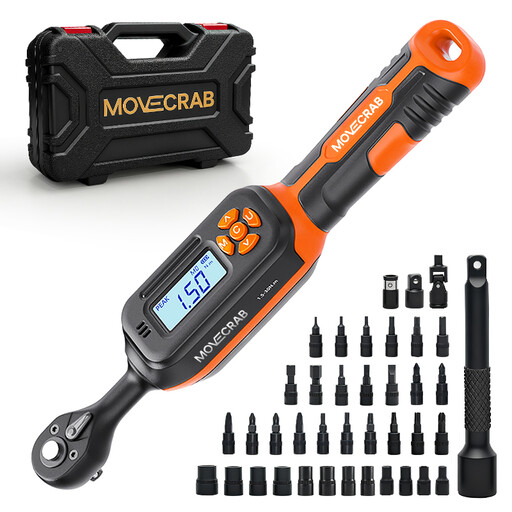
Why it suits this user: The 1/4 inch drive and 1.5–30 Nm range are well suited to light jobs on bikes, motorbikes and smaller fasteners. The included bits and sockets mean you’re less likely to need to buy extra accessories straight away.
The lower range means you won’t have to choose a heavy-duty model with an impractically high range for small jobs. The product information states that it has a digital readout and a margin of error of ±2%.
1/4 inch drive, 1.5–30 Nm range, digital operation and a 40-piece set.
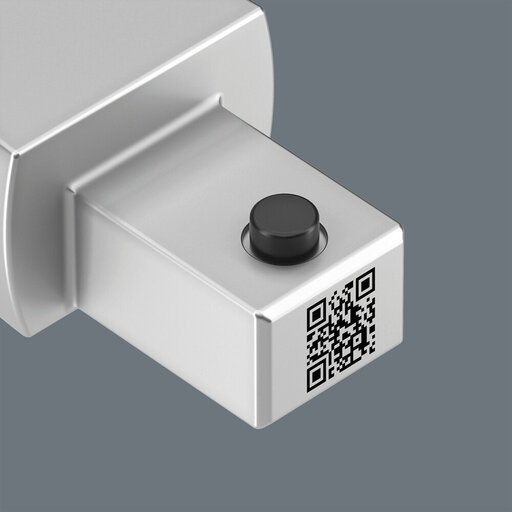
Why it suits this user: This self-adjusting wrench is designed for use with Click-Torque X and XP torque wrenches. It’s a relevant option if you use a compatible system and want to cover a range of wrench sizes.
The adjustable, parallel-guided jaw means you don’t need a separate wrench for every size. However, check in advance that your torque wrench accepts a 14x18 mm fitting.
Adjustable jaw, ratchet function, 30° return angle and 14x18 mm fitting.

Why it suits this user: This electric ratchet wrench is designed for maintenance in tight spaces, such as around motorbike components, machinery and cars. It has a 3/8 inch fitting, a stated maximum torque of 45 Nm and a rechargeable battery.
The compact 3 cm head and built-in LED light are designed for working in confined spaces. Don’t use this electric ratchet wrench instead of a calibrated torque wrench when a specific final torque is required.
12 V power, 45 Nm according to the product information, 3/8 inch fitting, LED light and forward/reverse switch.
We’ve put together a complete, up-to-date list of products that meet these strict selection criteria and applicable European safety regulations.
For bike repairs, a 1/4 inch torque wrench with a low range is often a good choice. Pay particular attention to the minimum torque. A model that only starts at 17 Nm is less suitable for delicate carbon or aluminium components, which may require a lower torque setting.
A digital torque wrench can show the torque clearly on a display and alert you with a sound, light or vibration. This makes it easier to set. The stated accuracy depends on the specific model, how it’s used and how well it’s maintained. A mechanical wrench may be simpler if you’d rather not use batteries.
An electric ratchet wrench is mainly designed to tighten or loosen bolts more quickly. For the final torque, use a torque wrench with a suitable measuring mechanism, unless the electric wrench is specifically designed for controlled torque use and its manual confirms this.
