
Living with a cramped alcove
You’ll need to check that the width, depth and height are suitable, and that there’s enough room to open the machine. Consumentenbond also points out that you need to allow space for the hoses, door and ventilation.


First, measure the space needed for the machine, hoses and opening the door or lid. Then weigh a typical load of cotton towels to work out the capacity you need. A top-loader may suit you if there’s little room in front of the machine, while a shallow front-loader is worth considering if depth is your main constraint. Choose a washer-dryer only if you also want to tumble-dry your towels and don’t have space for a separate tumble dryer.
You’ll need to check that the width, depth and height are suitable, and that there’s enough room to open the machine. Consumentenbond also points out that you need to allow space for the hoses, door and ventilation.
You’ll want to match the drum capacity to the cotton towels you usually wash together. Consumentenbond recommends weighing a typical load, while Milieu Centraal advises against choosing a machine that’s larger than you need.
You’ll also need to decide how to dry your towels after washing. Milieu Centraal highlights the importance of ventilation at home. A washer-dryer is another option if you want to tumble-dry your towels.
First, measure the available space. Then choose a drum capacity to suit your usual towel load. Only factor in noise, energy use and drying options if they’re relevant to your situation.
A good fit if: there’s little space in front of the machine or the alcove is too narrow for a suitable front-loader, and the lid can open fully above it.
Bear in mind: you’ll need enough clearance above the machine to open the lid. Also check that the drum is large enough for your usual load.
A good fit if: depth is your main constraint and there’s enough room to open the front door.
Bear in mind: the stated depth alone won’t tell you whether there’s enough room in your laundry nook for the hoses and door.
A good fit if: the machine’s full dimensions and door clearance are suitable, and the drum capacity matches your usual towel load.
Bear in mind: extra capacity won’t necessarily be useful if you usually wash small loads.
Consumentenbond recommends weighing a typical laundry load. Energielabel.nl says that the energy label includes information such as energy use and noise during the spin cycle.
| What to consider | What to look for | Who should pay particular attention? |
|---|---|---|
| Space and opening | Measure the alcove and check the machine’s dimensions, space for the hoses and the door’s swing, or the clearance needed to open the lid. | If the alcove is cramped, I need to be able to fit the machine in and open the door or lid fully. Around 36% of consumers prioritise finding a machine that fits. |
| Drum capacity | Weigh a typical sorted load and compare it with the cotton capacity; also check the size of the opening. | I want my usual towel load to fit in the drum, rather than choosing based only on the number of people in my household. Around 29% of consumers focus mainly on their towel load. |
| Drying towels | Decide whether you can hang your towels up or will use a tumble dryer. For a washer-dryer, compare the washing and drying capacities separately. | If I can’t hang my towels up easily, I need to know how I’ll dry them after washing. Around 21% of consumers are primarily concerned with how they’ll dry their laundry. |
| Energy use and noise | For the exact model, compare energy use, water consumption and spin noise using the same label basis. | If my laundry nook is close to a living area, I’ll want to consider noise and running costs. Around 14% of consumers focus mainly on these factors. |
A machine may fit in the alcove but leave too little room for the hoses, ventilation or opening the door or lid.
Before choosing, check the full installation dimensions, connection space and loading direction.
If you usually wash small loads, extra capacity won’t automatically give you a better or more energy-efficient wash.
First, weigh a typical sorted load and choose a suitable cotton capacity.
A continuous wash-and-dry cycle can only dry a load that’s within the drying capacity.
Compare the washing and drying capacities separately, and choose a drying function only if you need one.
If the wash load exceeds the drying capacity, you may need to run a second drying cycle.
The label comparison is based on eco 40-60 and doesn’t automatically describe the energy use of every short, hot or other programme.
Compare labels on the same basis, and check the manual for the exact model if you’re considering other programmes.
Consumentenbond describes the AEG LTR8ULM as a top-loader, making it one to compare if you’re considering this type of machine.
The Indesit BTW L60400 B is another top-loader to compare if there’s little room in front of the machine.
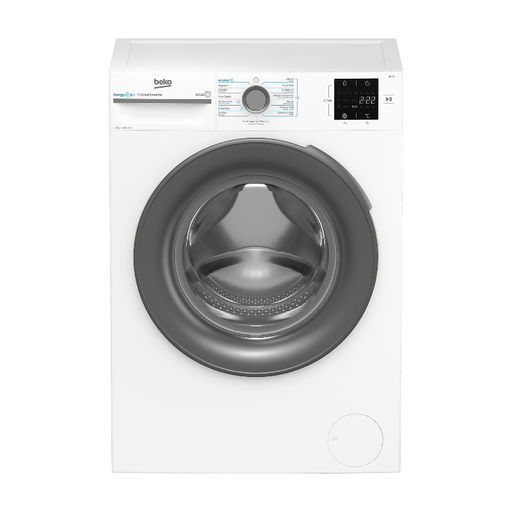
The Beko BM3WFU3741W is a 7 kg front-loader to compare if a front-loader will fit in your laundry nook.
The Bosch Serie 2 WGE02406NL is another 7 kg front-loader to compare if you have enough space.
The Joybuy product page describes the TCL FF1006WB0 as a shallow front-loader for a laundry nook where depth is the main constraint.
This selection at Joybuy includes front-loaders with different drum capacities, plus a washer-dryer for anyone who also wants to tumble-dry their laundry.
 No image available
An option if you also want to tumble-dry your towels.
Washing capacity: 9 kg; drying capacity: 5 kg.
Spin speed: 1400 rpm. The drying capacity is lower than the washing capacity, so a larger load won’t fit entirely into one drying cycle.
 No image available
An option for a typical towel load that falls within the stated capacity.
Capacity: 7 kg; spin speed: 1400 rpm.
Energy class A; stated energy use: 99 kWh per 100 cycles.
 No image available
A front-loader to consider if it and its door will fit in your laundry nook.
Capacity: 7 kg; spin speed: 1400 rpm.
Energy class C; includes, among other features, a cotton programme and 15 programmes.
 No image available
An option if the capacity suits your usual load of cotton towels.
Capacity: 7 kg; spin speed: 1200 rpm.
The product information describes sensors that adjust the settings to suit the load.
 No image available
An option if depth is the main constraint in your laundry nook and there’s room to open the door.
Capacity: 6 kg; stated depth: 45 cm; energy class B.
As well as the stated machine dimensions, allow room for the hoses and door.
Weigh a typical sorted load and compare it with the stated cotton capacity. Consumentenbond recommends adding around 2 kg to the weight of that load. Also check that the machine will physically fit.
Check that you have a stable floor, water supply and drainage, a suitable earthed socket, and enough space for the hoses and door to open. Remove the transit bolts before use. If your laundry nook is in a bathroom, ask someone to check that the electrical connection is suitable for that particular location.
Make sure there’s suitable airflow in and out of your home, and ventilate the room where you dry your laundry. Milieu Centraal highlights the importance of ventilation. Also consider whether hanging your towels up, using a separate tumble dryer or choosing a washer-dryer will work in your space.
No, the programme name doesn’t guarantee a wash temperature of 60 °C. The European Commission describes eco 40-60 as being for normally soiled cotton that can be washed at 40 or 60 °C according to its care label. Check the care label and manual if you need a specific temperature.
When you buy as a consumer, you’re entitled to a product that meets the required standards. According to the Dutch government, the Netherlands has no fixed statutory warranty period. If something is wrong with your machine, contact the seller. Paying for an extended warranty doesn’t replace your statutory rights.