If width is limited, a top-loader may fit. If depth is the main constraint and you have around 60 cm of width, a shallow front-loader could be an option. Then match the capacity and programmes to your usual pyjama load and the care label, and allow for the hoses and the lid or door opening.
Who are these options relevant to?
People with a narrow alcove
If width is the main constraint and there is room above the machine, compare top-loaders by their full external dimensions and the clearance needed to open the lid. The Consumers' Association also advises allowing for hoses, the door and ventilation when measuring.
People with a shallow space
If you have enough width but limited depth, compare shallow front-loaders and allow for the hoses and the door swinging open. The space required depends on the installation and the model you choose.
People with small pyjama loads
If you want the capacity to suit the load you usually build up, compare the drum capacity and cotton programmes with the care label. The Consumers' Association advises matching programmes and capacity to how you use the machine.
What should you consider in a small laundry space?
Top-loader
Choose one when: width is limited and you have room above the machine to open the lid.
Bear in mind: the lid needs clearance; measure the height and depth too.
Shallow front-loader
Choose one when: you have around 60 cm of width available, but depth is limited.
Bear in mind: hoses and a door that swings open need extra space; this type won't solve the problem of an alcove that's too narrow.
Standard front-loader
Choose one when: the measured space, including connections and door clearance, is sufficient.
Bear in mind: depth can be a deciding factor in a small laundry space; check the dimensions of the exact model.
The Consumers' Association advises allowing for hoses, the door and ventilation. Milieu Centraal and the Consumers' Association also recommend matching capacity, programmes and usage figures to the way you use your machine.
| Consideration |
What to look for when buying |
Who is it most important for? |
| Dimensions and opening |
Measure the width, height and depth; check the lid or door opening and allow room for the hoses. |
If I need to fit a machine into a tight alcove, I want to be sure the opening and connections will fit too. Around 36% of consumers prioritise the available space. |
| Capacity and programme |
Compare the drum capacity with your usual load and check that the cotton programme and temperature are suitable for the care label. |
If I mainly wash pyjamas, I want the capacity and wash treatment to suit my load and the care label. Around 29% of consumers prioritise this combination. |
| Energy use and noise |
Compare the energy label, kWh per 100 eco cycles, water per cycle and spin noise for each model. |
If energy use or noise is the deciding factor for me, I want to compare those figures for the exact model. Around 21% of consumers start by looking at energy use or spin noise. |
| Purchase and installation |
Check what delivery and installation include, and whether the water supply, drain and earthed socket are accessible. |
If I need to arrange installation or connection myself, I want to know what is required in advance. Around 14% of consumers prioritise purchase and installation. |
Buying considerations that are easy to overlook
-
Assuming ‘shallow’ means a small machine overall
A shallow front-loader can still be around 60 cm wide, while a top-loader needs room above it to open the lid.
First, measure which dimension is limited in your space, then compare the full external dimensions and the clearance needed to open the machine.
A machine that doesn't fit could mean extra installation work.
-
Measuring only the appliance body
Hoses and the space needed for the door or lid also affect where the machine can go. The tap, drain and socket must be accessible too.
Check the installation diagram and connection points for the exact model. Follow the installation instructions and use an earthed socket.
-
Mistaking Eco 40-60 for a temperature you can set precisely
The programme name doesn't mean you can set it to exactly 40 or 60°C. It is intended for normally soiled cotton that the care label says can be washed at 40 or 60°C.
Follow the pyjamas' care label and choose a programme to suit how soiled they are and the wash treatment you want.
-
Mixing up details for different versions
Beko's specifications for the BM3WFU3741S list white and energy label A, while a Joybuy retailer listing describes it as silver with energy label C. These details don't confirm that they refer to the same version.
Before buying, compare the full model code, the version and the product information sheet.
Washing machine brands worth comparing
AEG
The AEG LTR6162K is a top-loader worth comparing when width is the main constraint.
- AEG lists external dimensions of 903 × 397 × 599 mm, a capacity of 6 kg and energy label B for the LTR6162K.
- Measure the space above the machine for the lid; these specifications apply to this model, not all AEG machines.
Whirlpool
The Whirlpool TW 622S FRESHCARE BE is another top-loader to compare for size and capacity.
- Whirlpool's technical specifications list dimensions of 40 × 60 × 90 cm and a capacity of 6 kg.
- Check the capacity in the product details for the exact version before basing your choice on it.
Beko
The Beko BM3WFU3741S is a shallow front-loader worth comparing if you have around 60 cm of width available.
- Beko lists dimensions of 84,5 × 60 × 49,6 cm, a capacity of 7 kg, energy label A and spin noise of 76 dBA for this model.
- The Joybuy listings mentioned differ on colour and energy label; check the version before matching specifications to a product variant.
Bosch
The Bosch WGE02406NL is a front-loader worth comparing if your available space is deep enough.
- Bosch lists dimensions of 848 × 598 × 588 mm and a capacity of 7 kg for this model.
- Its stated depth could be a deciding factor in a small laundry space; the difference in dimensions says nothing about washing performance.
Washing machines to compare with your laundry space
These Joybuy products offer models you can compare with your own laundry space and usual pyjama loads for capacity, listed features and available installation space.
 No image available
AEG LF61R840 6000 Series, 8 kg
The listed capacity of 8 kg gives you a specific figure to compare with your usual loads.
According to the product name: 8 kg, 1400 rpm and energy label A.
View at Joybuy
 No image available
Beko BM3WFU38412CW, 8 kg
The product name lists a capacity of 8 kg; compare this with the load you usually build up for your pyjamas.
According to the product name: 8 kg, 1400 rpm and energy label A.
View at Joybuy
 No image available
TCL FF1006WB0, 6 kg
The product name lists a depth of 45 cm and a capacity of 6 kg; compare both figures with your available space and usual load.
According to the product name: 6 kg, 45 cm deep and energy label B.
View at Joybuy
 No image available
Coocaa Galaxy A3 Series F702A3AВC0, 7 kg
The product name lists a 7 kg front-loader; use the model code and product details to compare the version.
According to the product name: 7 kg and 15 programmes.
View at Joybuy
 No image available
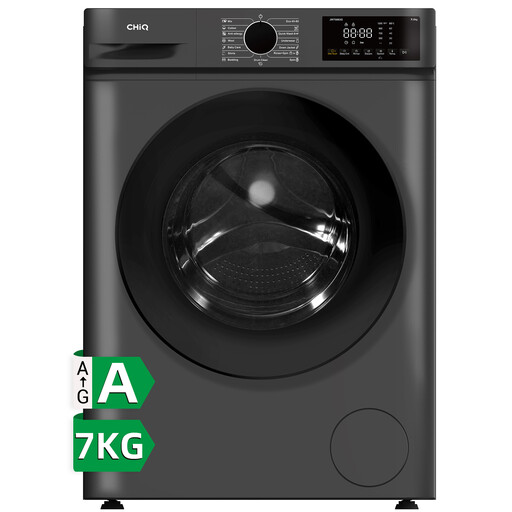
CHiQ JW75883G, 7 kg
The product name lists a capacity of 7 kg; compare this with your usual pyjama load and check the dimensions for installation.
According to the product name: 7 kg, 1200 rpm, 16 programmes, dark grey and energy label A.
View at Joybuy
Frequently asked questions
Can I wash cotton pyjamas on Eco 40-60?
You can if the care label allows washing at 40 or 60°C and the pyjamas are normally soiled. The Consumers' Association describes Eco 40-60 as intended for cotton that the care label says can be washed at those temperatures. Follow the care label and choose a suitable programme.
Which dimensions should I measure for a small laundry space?
Measure the available width, height and depth, and allow for the hoses and the space needed for the lid or door. The Consumers' Association also advises allowing for ventilation; check the installation diagram for the exact model.
What should I check before the first wash?
Make sure the machine is on a stable surface, the water supply and drain are accessible, and there is an earthed socket. Follow the installation instructions for the model you bought and remove the transit bolts before use.
Does a new washing machine in the Netherlands have to have energy label A?
No, the applicable EU rules don't require buyers to choose a machine with energy label A. According to the European Commission, household washing machines within the scope of the rules must meet energy labelling and ecodesign requirements, including programme requirements for Eco 40-60 and 20°C.
Who should I contact in the Netherlands if my machine develops a fault after purchase?
Report the fault to the seller. According to the Dutch government, they can't simply send you to the manufacturer; the appropriate solution depends on the fault and the circumstances.


