
Hikers with a narrow laundry area
Work out whether width, depth or opening clearance is the main constraint. A top-loader needs space above the machine; a front-loader needs enough room for the door to open freely.


First, measure what is tight on space in your laundry area: a top-loader may work well if width is limited, provided the lid can open freely. A shallow front-loader can suit a space with limited depth, as long as there is room for the door. Then choose a drum capacity that suits your usual loads and a programme that is suitable for your socks’ care label. Gently brush off loose, dried mud; a steam or quick programme is not a proven alternative to washing heavily soiled socks.
Work out whether width, depth or opening clearance is the main constraint. A top-loader needs space above the machine; a front-loader needs enough room for the door to open freely.
If you also wash merino or other delicate socks, follow the care label and check whether the machine has a suitable wool or delicates programme.
If you use one machine for hiking socks and everyday laundry, choose a drum capacity that suits your usual load and bear the available space in mind.
Best for: a laundry area where width is the main constraint, provided the lid can open freely above the machine.
Trade-off: the top of the machine needs to stay clear, and the lid requires room to open. The Consumers’ Association reports that the top-loaders it tested wash less effectively than standard front-loaders; this is not a judgement on every model.
Best for: a laundry area where depth is the main constraint and there is room for the door to open at the front.
Trade-off: less depth does not mean less width; check the space needed for connections and the door too.
Best for: a laundry area with enough room for the machine’s full external dimensions, especially if you wash larger everyday loads as well as socks.
Trade-off: a larger drum is not automatically practical if you usually wash small loads.
| What to consider | What to look for | Who should pay particular attention? |
|---|---|---|
| Space and opening clearance | Measure the width, depth and height, as well as the clearance needed for the lid or door and the connections. Compare these measurements with the exact model. | If my laundry area is tight, I want to know whether I’ll still be able to open the machine once it’s in place. This is the top buying priority for around 30% of consumers. |
| Removing mud | Check which wash and rinse settings are available and follow the socks’ care label. Gently brush off loose, dried dirt. | I want to wash muddy socks without relying on a special programme alone. Around 30% of consumers say removing dirt is their top priority. |
| Delicate fibres | Read the care label and check whether the machine has a suitable wool or delicates programme. | If my socks are made from merino or other delicate fibres, I want to be able to follow the care instructions. This is the most important selection criterion for around 20% of consumers. |
| Everyday laundry and energy use | Compare your usual load with the machine’s capacity. Use the EU energy label for the standardised eco cycle, not as a prediction of energy use for every wash. | I’m looking for one machine for socks and the rest of my household laundry, and want to choose a capacity that suits both. This is the main consideration for around 20% of consumers. |
A top-loader needs clear space above the lid; a shallow front-loader can still be 60 cm wide.
Measure your laundry area and the clearance needed to open the machine, then compare these with the exact model’s full external dimensions.
Freshened-up socks are not necessarily free from dried mud stains. A programme name alone is no proof that it removes stains.
Gently brush off loose mud, follow the socks’ care label and check for stains before drying them, if appropriate.
Label values are based on the standardised eco 40-60 cycle; other washes may use a different amount of energy.
Compare label values on the same basis and choose a capacity that suits your usual household laundry.
A different full code may indicate a different version. Conflicting product information can also make it unclear which version is being offered.
Before buying, check the full model code and the product information sheet for the version on offer.
According to AEG Netherlands, the AEG LTR7573A is a top-loader measuring 397 mm wide, with a 7 kg capacity and programmes including Outdoor and Wool/Silk.
According to Beko Netherlands, the BM3WFU3741S is a front-loader measuring 60 cm wide and 49,6 cm deep, with a 7 kg capacity and programmes including prewash, wool and rinse.
Bosch Netherlands lists the WAN2827BNL as a standard 8 kg front-loader with external dimensions of 845 × 598 × 590 mm.
The Consumers’ Association describes the TDLRBX 6252BS BE top-loader as a 6 kg model with a spin speed of 1200 rpm.
This selection features freestanding AEG front-loaders for anyone who washes hiking socks alongside everyday household laundry. Before choosing, check that the external dimensions fit your laundry area and that the programme is suitable for the socks’ care label.
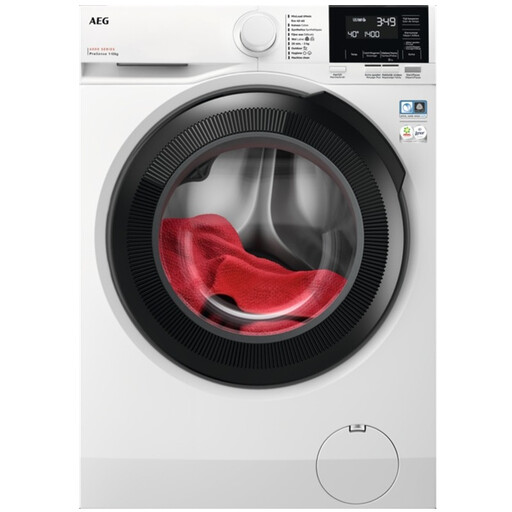 Image unavailable
May suit a household that washes larger everyday loads as well as hiking socks; choose a capacity that matches your usual laundry.
The product information lists a wool programme and a 10 kg capacity. Stated external dimensions: 847 × 597 × 660 mm.
 Image unavailable
May suit you if you want one machine for socks and everyday laundry; compare its capacity with your usual load.
The product information lists a wool programme and an 8 kg capacity. Stated external dimensions: 847 × 596 × 602 mm.
 Image unavailable
May suit a household looking to wash socks alongside everyday laundry; measure the available depth and width before choosing.
The product information lists an 8 kg capacity. Stated external dimensions: 84,7 × 59,6 × 57,2 cm.
 Image unavailable
May suit anyone wanting to wash hiking socks and everyday laundry in the same machine; check that the wool programme matches the socks’ care label.
The product information lists an 8 kg capacity and a wool programme. Stated external dimensions: 847 × 596 × 577 mm.
Image unavailable
May suit a household looking to wash hiking socks alongside everyday laundry; compare the capacity with your usual load.
The product information lists an 8 kg capacity and a spin speed of 1600 rpm. Stated external dimensions: 847 × 596 × 602 mm.
Gently brush off loose dirt before washing the socks. Persil recommends letting dried mud dry completely first, then brushing off loose soil. After that, follow the socks’ care label, especially for wool, and check for stains before drying them, if appropriate.
Not based on the programme name alone. The European Commission describes eco 40-60 as being for normally soiled cotton items suitable for that programme. Smartwool recommends a gentle cycle for its machine-washable merino products; always follow the care label on your socks.
Measure the width, depth and height, and check the clearance needed for the lid or door. Allow for connections and a stable surface; the Consumers’ Association highlights stable positioning as important for reducing noise and disturbance.
Brush loose, dried dirt off the socks beforehand and clean the filter according to the machine’s instructions. An extra rinse can wash away dirt and detergent, but it uses more water.
The label gives comparison values for the standardised eco 40-60 cycle, not the energy used for every wash you choose. Since 1 March 2021, the European Commission has used the A to G scale for household washing machines.