Who is this guide for?

People with a narrow laundry space

If width is the main constraint and there’s room above the machine, a top-loader may be worth considering. The Consumers' Association gives around 40 cm as the typical width for top-loaders, compared with about 60 cm for standard front-loaders.

People with a shallow alcove

If you have enough width but limited depth, compare shallow front-loaders. Remember to leave space for hoses and the open door, as recommended by the Consumers' Association.

People who regularly wash stained napkins

Check the care label and choose a drum capacity that suits both your napkins and the rest of your laundry. Milieu Centraal recommends choosing a load capacity that matches the amount of laundry you usually wash.

What should you look for when buying?

Narrow top-loader

A good fit when: width is limited, but you can fully open the lid above the machine.

Bear in mind: the space above the machine; a top-loader isn’t suitable if a worktop prevents you from opening the lid.

Shallow front-loader

A good fit when: you have around 60 cm of width but less depth, and the door can open outwards.

Bear in mind: the space in front of the door and for connections; a short cycle alone doesn’t prove that a particular napkin will come out clean.

What to consider What should you check? Who should pay particular attention?
Width and opening Measure the width, height and depth of the space; also check that the top lid can open freely. If the alcove is narrow, you’ll want to know whether the machine will fit without blocking the opening. Around 33% of consumers considering this choice prioritise width.
Depth and door Compare the machine’s depth and allow room for hoses and a fully open door. If the machine can’t protrude far into the room, depth matters more than a general description such as ‘compact’. Around 27% of consumers prioritise this.
Load capacity and wash programme Choose a drum capacity that suits the total amount of laundry you usually wash, and follow the napkins’ care label. If you want to wash napkins with other laundry, look for a suitable combination of load capacity and programme. Around 20% of consumers put their laundry needs first.
Installation and consumption Check the floor, connections and the model-specific energy and water consumption. If several sizes will fit your space, the connections and running costs could be the deciding factors. Around 20% of consumers look at these first.

Common buying mistakes

  • Assuming ‘compact’ means both narrow and shallow

    A shallow front-loader can still be around 60 cm wide, while a top-loader needs clear space above the lid.

    Measure the width, depth and height separately. Also check the space needed for hoses and to open the door or lid.

  • Assuming a large drum or short programme guarantees clean napkins

    The stated load capacity or programme duration alone doesn’t tell you how well a programme will suit your fabric and stains. The Consumers' Association also warns that cotton won’t be cleaned properly if the drum isn’t actually full.

    Choose a load capacity that suits the total amount of laundry you usually wash, follow the care label and pre-treat stubborn stains where necessary.

  • Assuming Eco 40-60 is a guaranteed hot wash

    The Consumers' Association doesn’t recommend the eco 40-60 programme as a replacement for a proper hot maintenance wash.

    Check the care label and the manual. Only use a separate hot programme if it’s suitable for the fabric and the machine’s maintenance requirements.

Brands to consider

AEG

AEG’s top-loader range in the Netherlands includes models for spaces where width is a key constraint.

  • AEG lists the LTR6363A as measuring 397 × 599 × 903 mm (w × d × h), with a 6 kg load capacity and an Eco 40-60 programme.
  • AEG attributes load adjustment to ProSense. This is a manufacturer claim, not an independent test of napkin washing.
  • Keep the space above the model clear so you can open the lid.

Whirlpool

Whirlpool’s top-loader range in the Netherlands offers an example for anyone looking to save width above all.

  • The specifications table for the TW 622S FRESHCARE BE lists dimensions of 40 × 60 × 90 cm (w × d × h) and a 6 kg load capacity.
  • The product title also states 6.5 kg. Before buying, check the information sheet for the specific product, and don’t assume other models have the same capacity.

Candy

Candy’s range in the Netherlands includes shallow front-loaders for situations where depth is more limited than width.

  • Candy lists the CO4474TWM6/1-S as measuring 600 × 454 × 850 mm (w × d × h), with a 7 kg load capacity and energy rating A.
  • The machine is 600 mm wide and needs space in front of the door. Candy’s claims about quick programmes aren’t an independent guarantee that specific food stains will be removed.

Washing machines at Joybuy

This selection at Joybuy includes front-loaders for household laundry. Compare the dimensions and load capacity with your available space and the amount of laundry you usually wash; product names don’t always give the same information about the installation space required.

AEG LR73S840 washing machine, 7000 Series

AEG LR73S840, 7000 Series, 8 kg

An 8 kg load capacity may suit washing napkins with other household laundry; compare it with the amount you usually wash.

Load capacity: 8 kg. Spin speed: 1400 rpm.

View at Joybuy

AEG LF61R840 washing machine, 6000 Series

AEG LF61R840, 6000 Series, 8 kg

An 8 kg load capacity may be suitable if you wash napkins with other laundry; check whether it suits the load you usually wash.

Load capacity: 8 kg. Spin speed: 1400 rpm.

View at Joybuy

TCL FF1006WB0 washing machine, 6 kg, 45 cm deep

TCL FF1006WB0, 6 kg, 45 cm deep

The stated depth may be important if you have little space in front of the machine; also check that the width and door opening will fit.

Load capacity: 6 kg. Stated depth: 45 cm; stated width: 60 cm.

View at Joybuy
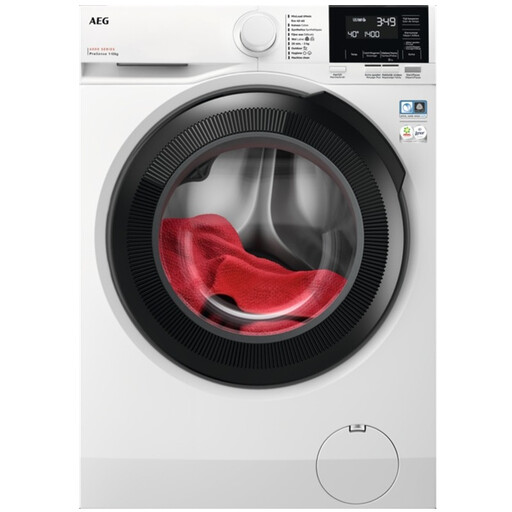
AEG LR63R144 washing machine, 10 kg

AEG LR63R144, 10 kg

A 10 kg load capacity is most relevant if you regularly wash larger loads; make sure you have enough space for the machine.

Load capacity: 10 kg. Spin speed: 1400 rpm. Stated depth: 660 mm.

View at Joybuy

AEG LR73R862 washing machine, 8 kg

AEG LR73R862, 8 kg

An 8 kg load capacity may suit mixed household laundry; measure the space carefully if room is limited.

Load capacity: 8 kg. Spin speed: 1600 rpm. Stated depth: 602 mm.

View at Joybuy

Frequently asked questions

Should a fabric napkin be washed at 60 °C?

Not automatically. Follow the maximum temperature and gentle-wash instructions on the care label. Milieu Centraal mentions a proper 60 °C wash for certain hygiene requirements, but this isn’t a general rule for all table napkins.

Can you put a top-loader under a worktop?

Not if the worktop prevents you from opening the lid. The Consumers' Association says top-loaders aren’t suitable for fitting under a worktop; measure the clear space above the model you choose.

What should I check before installation?

Check the route into the room, the space needed for the door or lid and hoses, and whether the machine will stand on a level, solid surface. Also check the water, drainage and electrical connection requirements in the manual for your chosen model.

Is eco 40-60 the same as a hot maintenance wash?

No, don’t assume it is. The Consumers' Association doesn’t recommend eco 40-60 as a replacement for a proper hot maintenance wash. Check the manual, and choose a hot programme only if it’s suitable for maintenance and the fabric.

What information is shown on a washing machine’s energy label?

The label includes information about energy and water consumption, among other things. The European Commission says that, since 1 March 2021, EU labels for household washing machines have used a scale from A to G; compare models using the same labelling basis.
