
Gardeners with a narrow laundry area
You want to know whether the machine, its lid or door, and the connections will actually fit in the available space.


First, measure the entire alcove and the space needed to open the door or lid. Then choose a capacity that suits your usual sorted wash. According to the Consumentenbond, a narrow top-loader may fit where width is limited, while a shallow front-loader can save depth. Check the care label, the load capacity for each programme and the space needed for connections too.
You want to know whether the machine, its lid or door, and the connections will actually fit in the available space.
You want to tackle mud and grass stains without assuming that a special programme makes pre-treatment unnecessary.
You’re looking for a capacity that suits your usual sorted wash, rather than choosing a large drum just for the occasional bulky item.
For washable gardening clothes in a small laundry area, the key factors are the total space available, stain pre-treatment and choosing the right capacity.
Choose this if: the alcove is too narrow for a standard front-loader and there’s enough space above the machine to open the lid.
Bear in mind: you’ll need to keep the space above the machine clear, and it can’t be installed under a worktop.
Choose this if: there’s enough width and room for the door to open, but depth is limited.
Bear in mind: the door, hoses and installation all need extra space beyond the stated cabinet depth.
Choose this if: your laundry area can accommodate a machine around 60 cm wide, with enough room for the door.
Bear in mind: a larger drum isn’t automatically the best choice for small, everyday loads.
Choose this if: you only have space for one appliance and want to machine-dry as well as wash your clothes.
Bear in mind: to run a continuous wash-and-dry cycle, the load must be within the drying capacity.
| What to consider | What should you check? | Who should pay particular attention? |
|---|---|---|
| Fitting and opening | Measure the width, depth and height. Allow for hoses, connections and the space needed for the door or lid. The Consumentenbond recommends allowing for the full space required. | If my laundry area is tight, I want to know whether the machine will not only fit but also open properly. Around 36% of consumers put finding a suitable fit first. |
| Mud and grass | Check the care label and programmes. The American Cleaning Institute recommends letting mud dry first and brushing off loose dirt; pre-treat grass stains. | If my gardening clothes have mud or grass stains, I want to know which pre-treatment is suitable for the fabric. Around 29% of consumers prioritise stain treatment. |
| Capacity | Compare your usual sorted load with the machine’s capacity and the load limit for your chosen programme. The Consumentenbond explains that the maximum capacity refers to cotton; Milieu Centraal recommends choosing a drum to suit your household. | If my laundry loads vary from one wash to the next, I want a drum that suits my usual wash. Around 21% of consumers say choosing the right load size is their main concern. |
| Use and maintenance | Compare energy figures using the same labelling basis and check the installation and maintenance instructions. Keep access to connections and the filter clear. The European Commission explains the measurement basis for the eco 40-60 programme. | If you also care about energy use, maintenance and ease of access, you’ll want to know what the machine requires in everyday use. Around 14% of consumers put ease of use and aftercare first. |
The door or lid, hoses and connections need room too. A machine may look as though it fits on paper, but still be difficult to access in use.
Measure the full space needed to use the machine and check the installation diagram for the exact model.
The maximum capacity applies to cotton; the suitable load may be smaller for other fabrics or programmes.
Weigh a typical sorted load and check the load limit for the programme you plan to use.
The right treatment depends on the stain and the care label. A programme name alone doesn’t prove that it will remove mud or grass stains.
Let mud dry, brush off loose dirt and pre-treat grass stains before washing, following the garment’s care label.
If a load exceeds the drying capacity, it can’t be washed and dried in one cycle without removing some of the laundry partway through.
Compare the wash and drying capacities separately, and choose this option only if you need the drying function.
According to AEG, the Dutch AEG LTR6363A is a 6 kg top-loader measuring 903 × 397 × 599 mm (h × w × d).
According to Whirlpool, the Dutch TW 622S FRESHCARE BE is a 6 kg freestanding top-loader measuring 40 × 60 × 90 cm (w × d × h).
According to Haier, the Dutch Haier HW70-BP14357TU1 is a 7 kg front-loader with cabinet dimensions of 595 × 468 × 850 mm (w × d × h).
According to Bosch, the Dutch Bosch WGE02404NL is a 7 kg front-loader measuring 848 × 598 × 588 mm (h × w × d).
The Joybuy products below are AEG front-loaders. Compare their capacity with your usual laundry load, and measure the space needed for the door and connections for each model.
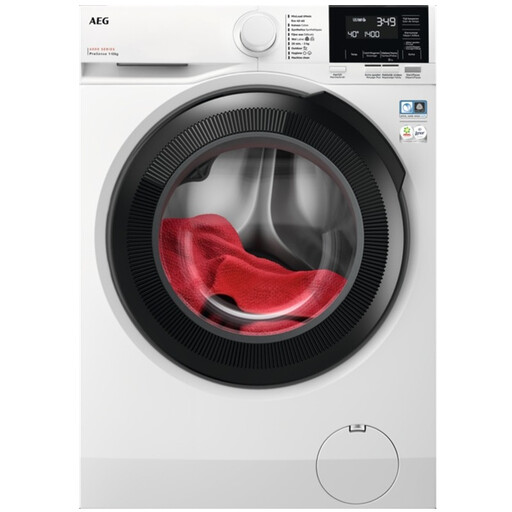 No image available
For anyone looking to wash a larger load in one go: the product name lists 10 kg, 1400 rpm and energy class A. Check the space needed for the door and connections; the installation information calls for a stable floor and an earthed socket.
 No image available
For anyone looking for an 8 kg front-loader: the product name lists 1600 rpm. Also measure the space needed for the door and connections; the installation information calls for a stable floor and an earthed socket.
 No image available
For anyone looking for an 8 kg front-loader: the product name lists 1400 rpm. Check that the machine, including its door and connections, will fit in the available space; the installation information calls for a stable floor and an earthed socket.
 No image available
For anyone looking for an 8 kg front-loader: the product name lists 1400 rpm. Allow for the door and connections as well as the cabinet dimensions; the installation information calls for a stable floor and an earthed socket.
No image available
For anyone looking for an 8 kg front-loader: the product name lists 1600 rpm. Check the full installation space, including room for the door and connections; the installation information calls for a stable floor and an earthed socket.
Let the mud dry first, then brush off as much loose dirt as possible. Pre-treat grass stains and wash according to the garment’s care label; these steps can’t guarantee that every stain will come out.
Check the model’s manual, the stability of the surface, the water supply and drain, hose lengths, and whether there’s an earthed socket. Remove the transit bolts before first use, following the manual. Bosch lists these installation points, but whether the machine is suitable depends on your home.
Choose a capacity that suits your usual sorted wash and check the load limit for your chosen programme. The maximum capacity applies to cotton; a smaller load may be more suitable for delicate or synthetic fabrics.
No. ACM ConsuWijzer explains that statutory consumer rights exist alongside any manufacturer’s or retailer’s guarantee, and depend on what you could reasonably expect from the product. If a fault occurs despite normal use, contact the retailer. There’s no single fixed statutory guarantee period for every washing machine.
Only if the load is within the drying capacity of the model you’ve chosen. Compare the wash and drying capacities separately if you also want to machine-dry because space is limited.