
Someone with a narrow laundry space
Your main question is whether the machine will fit, including the hoses and the space needed to open the lid or door. The Dutch Consumers’ Association also recommends allowing for this clearance.


A slim top-loader may fit if width is your main constraint and there’s enough room to open the lid. A front-loader is an option if the door, hoses and machine will all fit in the available space. Then choose a capacity that suits your usual laundry and a programme that matches the care label. According to the Dutch Consumers’ Association, Eco 40-60 does not mean the washing actually reaches 60 °C. To compare noise levels, check the spin noise rating on the EU energy label.
Your main question is whether the machine will fit, including the hoses and the space needed to open the lid or door. The Dutch Consumers’ Association also recommends allowing for this clearance.
You want to wash cotton underwear using a programme that suits the care label, and only choose a warmer programme when the label and your specific needs allow it. The Dutch Consumers’ Association explains the limitations of Eco 40-60 and the importance of following the care label.
You want to compare the stated spin noise level and minimise unnecessary vibration by installing the machine correctly and levelling it. The Dutch Consumers’ Association discusses the space needed around the machine, while the European Commission explains the noise information on the energy label.
First, measure the entire space and check how the machine opens. Then compare the programme, spin noise and capacity with your own laundry needs.
Suitable when: available width is your main constraint and the top lid can open fully.
Keep in mind: the lid needs clear space above the machine, so you can’t use the top as a work surface. The Dutch Consumers’ Association gives approximate widths of 40 cm for top-loaders and around 60 cm for standard front-loaders; check the measurements of the exact model.
Suitable when: the measured width and depth, space for the hoses and the door’s swing all fit within the available space, for example when installing it under a worktop.
Keep in mind: a standard front-loader generally needs more width than a top-loader, and the door needs room to open in front of the machine.
| What to consider | What to look for when buying | Who is this most relevant to? |
|---|---|---|
| Will the machine fit in my flat? | Measure the width, height and depth, the route to the space, and the room needed for the hoses and to open the exact model. | If I have limited space, I want to know in advance whether the hoses and lid or door will fit. Around 33% of consumers rank physical fit as their top buying priority. |
| Does the programme suit cotton underwear? | Check the care label and the cotton and temperature settings listed in the manual for the exact model. | I want to choose a programme that suits the care label and only wash at a higher temperature when the label and my specific needs allow it. Around 27% of consumers give suitable wash programmes top priority. |
| How noisy and stable is the machine? | Compare the spin-cycle dB rating on the EU energy label and check that the machine can be levelled. | If the machine is close to my living space, I want to take spin noise into account and minimise vibration. Around 20% of consumers prioritise noise and vibration. |
| Is the capacity right for my usual washes? | Compare the capacity with a typical mixed load, and check the kWh per 100 cycles and water per cycle on the same label basis. | I want a drum that suits my usual laundry, without choosing a capacity I’ll rarely use. Around 20% of consumers rank suitable capacity and consumption as their top priority. |
Hoses, the room needed to open a door or lid, and the route to the laundry area can all affect whether the machine can be installed and used properly. The Dutch Consumers’ Association points out that extra space is needed for these.
Measure the entire space and check the installation and opening clearance required for the exact model.
According to the Dutch Consumers’ Association, the name refers to the type of laundry; the programme does not guarantee that the wash actually reaches 60 °C.
Let the care label and your specific laundry needs determine which programme you choose. Check the manual if you need a separate, warmer programme.
The Dutch Consumers’ Association says a top-loader is not automatically quieter than a front-loader.
Compare the stated spin noise levels of the exact models and follow the installation instructions to level the machine.
A larger capacity isn’t automatically useful if your usual loads are small. The Dutch Consumers’ Association recommends choosing a capacity that you can make use of with your laundry.
Compare the capacity with a typical mixed load and check consumption figures on the same label basis.
AEG Netherlands describes the LTR6363A as a top-loader with a 6 kg capacity, making it relevant if you have a narrow laundry space.
Whirlpool Netherlands lists the TDLR 6261BS BE as a top-loader with a 6 kg capacity and a spin speed of 1200 revolutions per minute.
Beko Netherlands describes the BM3WFU3741W as a freestanding front-loader with a 7 kg capacity.
Siemens Netherlands lists the WM14N075NL as a front-loader with a drum that holds up to 7 kg of laundry.
Bosch lists features for the WAN28242NL including a drum-cleaning programme with a reminder function.
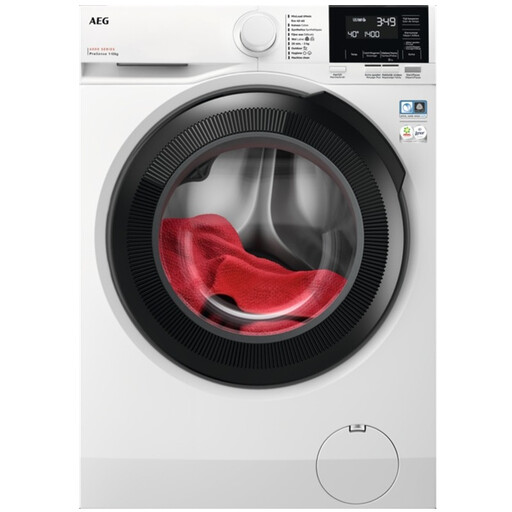
This selection consists of freestanding AEG front-loaders. Compare the capacity with your usual laundry load and check that the stated dimensions and space for the door suit your available space before buying.
 No image available
Consider this model if a front-loader with a 10 kg capacity suits your usual laundry load and available space.
Capacity: 10 kg; spin speed: 1400 rpm; energy consumption: 51 kWh per 100 Eco 40-60 cycles; dimensions: 847 × 597 × 660 mm.
The product description mentions ProSense load detection, which adjusts the time, water and energy use.
 No image available
This model may suit you if a front-loader with an 8 kg capacity matches your usual laundry and there’s enough room for it.
Capacity: 8 kg; spin speed: 1600 rpm; energy consumption: 42 kWh per 100 Eco 40-60 cycles; dimensions: 847 × 596 × 602 mm.
The product description mentions load sensing, Steam Refresh and MixLoad 69 min.
 No image available
Consider this model if a front-loader with an 8 kg capacity suits your usual loads and available space.
Capacity: 8 kg; spin speed: 1400 rpm; energy consumption: 42 kWh per 100 Eco 40-60 cycles; dimensions: 84,7 × 59,6 × 57,2 cm.
The product description mentions ProSense load detection and ProSteam to refresh clothes.
 No image available
This model is an option if a front-loader with an 8 kg capacity suits your usual laundry and available space.
Capacity: 8 kg; spin speed: 1400 rpm; energy consumption: 47 kWh per 100 Eco 40-60 cycles; dimensions: 847 × 596 × 577 mm.
The product description mentions ProSense load detection.
No image available
Consider this model if a front-loader with an 8 kg capacity suits your usual laundry load and there’s enough room for it.
Capacity: 8 kg; spin speed: 1600 rpm; energy consumption: 42 kWh per 100 Eco 40-60 cycles; dimensions: 847 × 596 × 602 mm.
The product description mentions PreciseWash load detection, Steam Refresh and MixLoad 69 min.
No. According to the Dutch Consumers’ Association, Eco 40-60 is designed for normally soiled cotton that can be washed at 40 or 60 °C according to its care label; the actual temperature may be lower. Check the care label and, if you specifically need a warmer wash, choose a suitable separate programme.
Follow the installation instructions for your chosen model and use the adjustable feet to level the machine. When measuring the space, also allow for the hoses and room to open the door or lid.
The EU energy label includes information such as energy consumption in kWh per 100 cycles and water consumption per cycle, based on the stated label settings. Your actual usage will also depend on the programmes you choose, how often you wash and your tariffs.
According to the Dutch government, the retailer is your point of contact for your statutory guarantee. Any manufacturer’s or extended guarantee does not replace this right.