
Vandaag of morgen in huis

Kwaliteit gegarandeerd

Welkomstaanbiedingen ontgrendelen: GRATIS bezorging | Tot 80% korting | Gratis 30 dagen JoyPlus-proefperiode
Download de app
Whether you're a seasoned DIYer who wrenches on cars or just looking for a reliable set for jobs around the house, the search for the right tool set can be frustrating. The market is flooded with sets that promise a lot but don't always deliver. As a Product Recommendation Officer at Joybuy, I see the challenges buyers face every day. Let's cut through the marketing hype and focus on what really matters.
Before you open your wallet, it's crucial to recognise the most common pitfalls. A shiny case full of tools is no guarantee of quality.
toolbox keeps everything in its place. Unfortunately, many cases are poorly designed. Tools fall out of their holders as soon as you stand the case upright, leading to a chaotic mess and frustration with every job.To avoid these traps, you need to pay attention to a few technical specifications. These determine the durability and usability of your tools.
The material is perhaps the most important factor. For hand tools like wrenches and sockets, CR-V (Chrome Vanadium) steel is the industry standard. This material offers a good balance between hardness and resistance to rust and wear. For tools that need to withstand heavy impacts, like the drive head of an impact wrench, CR-MO (Chrome Molybdenum) steel is an even better choice due to its superior impact resistance.
A ratchet and its corresponding socket set come in different drive sizes, expressed in inches. The size determines what type of job the tool is suited for.
auto repair tools, and most jobs in and around the house.For power tools like an impact wrench, the maximum torque, expressed in Newton-metres (Nm), is the most important specification. This number indicates how much rotational force the device can deliver. For changing car tyres, for example, you need an impact wrench that can deliver at least 120-150 Nm to loosen the lug nuts. For heavier vehicles or rusted-on bolts, a model with 500 Nm or more is no luxury.
Not everyone has the same needs. That's why we've highlighted a few options that fit specific user profiles, based on objective specifications.
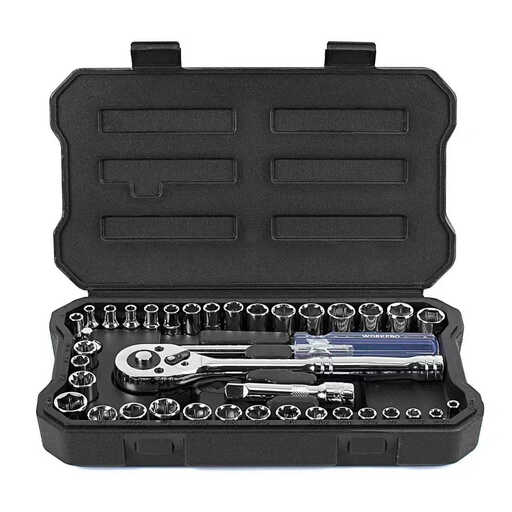
Why This Fits Their Persona: Ideal for those seeking a reliable starter set for general home maintenance and minor repairs on a bike or car. Compact and easy to store.
This set focuses on the most-used metric and imperial sockets without being padded with useless bits. The quality of the CR-V steel is consistent.
Includes both 1/4" and 3/8" drives for versatility. The compact case keeps the tools securely in place.
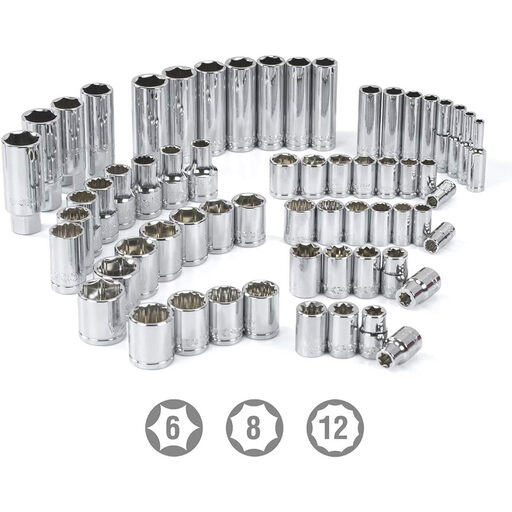
Why This Fits Their Persona: For the hobbyist or professional who refuses to compromise. This set is designed to handle virtually any mechanical job, from engines to cars.
This is the ultimate solution to the "incomplete set" pitfall. With sockets, wrenches, and bits in all common sizes (both metric and imperial), you'll rarely be left searching.
All three drive sizes (1/4", 3/8", 1/2") are included. The sturdy four-drawer case keeps all the CR-V tools organised.
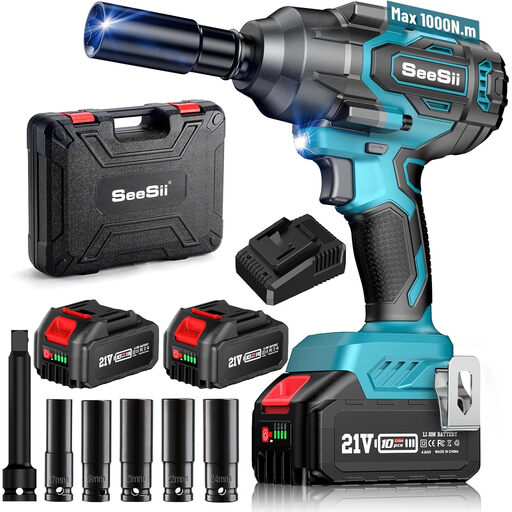
Why This Fits Their Persona: For those who need efficiency and pure power. Ideal for quickly changing car or truck tyres, or for construction work and breaking loose rusted bolts.
This device bypasses the trap of being underpowered. Where hand tools or weaker electric wrenches fail, this model delivers the necessary force with 1000 Nm of breakaway torque.
Comes as a complete kit with two 4.0Ah batteries, a fast charger, and five sockets. The brushless motor ensures a longer lifespan and greater efficiency.
We've compiled a complete, up-to-date list of products that fully meet these strict selection criteria and safety regulations.
Question: How much torque (Nm) does an impact wrench need for car wheels? Answer: For a standard passenger car, an impact wrench that can deliver a minimum of 150 Nm of torque is usually sufficient to loosen lug nuts. These are typically tightened to 110-130 Nm. For SUVs, vans, or stubborn nuts, a model with 300 Nm or more is a safer bet.
Question: Is a tool set with hundreds of pieces always the best choice? Answer: Not necessarily. Quality trumps quantity. A smaller set with high-quality CR-V steel and the right sizes is more valuable than a giant case full of soft metal. Consider which tasks you perform most often and choose a set that is tailored to them. A comprehensive set is primarily useful for professional or highly varied use.
Question: What is the difference between a 72-tooth and a 90-tooth ratchet? Answer: The number of teeth in a ratchet determines the "swing arc," or the angle you need to engage the next tooth. A 72-tooth ratchet has a 5-degree swing angle, while a 90-tooth ratchet only needs 4 degrees. A higher tooth count is therefore more useful in very tight spaces where you have limited room to move. For most jobs, however, a 72-tooth ratchet is perfectly adequate.
