If you’re looking for quick porridge for a toddler, choose a wholegrain oat product with no added sugar or salt, and check the portion size, preparation instructions and allergens. Toddler porridge with an age recommendation, plain portion sachets and loose oats each offer a different kind of convenience. However, the Netherlands Nutrition Centre recommends oats mainly as an alternative at breakfast or lunch, rather than as an automatic replacement for a varied evening meal.
Who is this choice relevant to?
Parents looking to avoid added sugar
If you’re after a simple oat base, the front of the pack isn’t enough to tell you what’s in it. The ingredients list shows what has been added, while the nutrition table also lists sugars that are naturally present.
Parents short on time at mealtimes
When breakfast or another mealtime is rushed, it matters how quickly the porridge is ready and how much you need to measure out yourself. Sachets make portioning easier, while loose oats let you decide how much to use.
Families who need to check allergens
Even a product with oats as its only main ingredient may carry a warning about other cereals. If your child has coeliac disease, the Netherlands Nutrition Centre specifically advises looking for the official Crossed Grain symbol.
What should you look for when choosing?
Start by choosing a suitable oat base, then decide whether an age recommendation, easy portioning or allergen information matters most for your child. A quick cooking time alone isn’t a reason to treat porridge as a complete replacement for an evening meal.
| What to consider |
What to check before buying |
Who it matters to |
| Added sugar and salt |
Read the ingredients list and compare the nutrition information per 100 g. Don’t confuse ‘of which sugars’ with added sugars. |
If I want to make simple porridge for my toddler, I want to know what it contains besides oats. Around 33% of consumers give the highest priority to avoiding added sugar and salt. |
| Age, texture and portion size |
Check any minimum age and preparation instructions; adjust the thickness, amount and temperature to suit your child. |
If my toddler is still getting used to different textures, I want to be able to adjust the porridge and portion. Around 27% of consumers prioritise this suitability. |
| Ease of preparation |
Compare the preparation methods and consider whether pre-measured sachets would make a difference to how you prepare porridge at home. |
When mealtimes are rushed, I don’t want to have to weigh out oats every time. Quick, easy-to-portion preparation is the main consideration for around 20% of consumers. |
| Allergens and gluten |
Read the current allergen information. If your child has coeliac disease, check that the pack displays the official Crossed Grain symbol. |
If my child needs to avoid a relevant allergen, I can’t rely on ‘plain’ or a short ingredients list alone. This check is the top priority for around 20% of consumers. |
Common mistakes
-
Comparing an oat biscuit with plain oats
A biscuit, bar and pack of oats are different product categories. The word ‘oat’ doesn’t tell you what other ingredients a product contains.
When choosing porridge, compare oat products with one another and check the ingredients list for added sugar and salt.
-
Assuming ‘no added sugars’ means ‘sugar-free’
A product with no added sugars may still list naturally occurring sugars in its nutrition table.
Before comparing two products, check both the ingredients and the ‘of which sugars’ figure per 100 g.
-
Assuming ordinary oats are suitable for coeliac disease
According to the Netherlands Nutrition Centre, oats can become contaminated with gluten during processing. Regular oat products may also warn of the possible presence of wheat, barley or rye.
If your child has coeliac disease, check for the official Crossed Grain symbol and read the current allergen information on the pack.
-
Giving porridge instead of bread every day
The Netherlands Nutrition Centre recommends porridge as an alternative at breakfast or lunch, not as a regular replacement for bread. Bread also provides added iodine.
Use porridge as an alternative and follow the dietary guidance for children aged 1 to 3 at other mealtimes.
Brands compared
Quaker
Offers regular wholegrain oats and Oats Express Naturel in portion sachets.
- According to the product information, Oats Express Naturel contains 100% wholegrain oats, has no added sugars and takes 2 minutes to prepare.
- Check the allergen information; a portion sachet isn’t automatically a toddler product.
Brinta
Sells porridge oats alongside its separate Volkoren Graanontbijt product.
- According to the ingredients listed by Albert Heijn, Brinta Havermout consists of oat flakes.
- Brinta Volkoren Graanontbijt is a wheat-based product. Check the product name and allergens, not just the brand.
Albert Heijn
Offers both regular organic porridge oats and a porridge with an age recommendation of 24 months and over.
- AH Biologisch Ontbijtpap havermout 24m+ lists 0 g of added sugars and added salt per 100 g.
- The age recommendation for the toddler porridge doesn’t apply to the regular organic oats; check the allergens in both products.
Jumbo
Offers organic wholegrain oats and fine wholegrain oat flakes.
- Jumbo’s product information lists oats as the ingredient in both varieties.
- That doesn’t automatically make an oat product gluten-free; read the allergen information on the pack.
Lidl
Crownfield Biologisch Havermout is an oat product in a 500 g pack.
- The product listing clearly identifies the brand, product type and pack size.
- Before choosing it for a toddler, check the ingredients, nutrition information and allergens on the pack.
Aldi
Stocks Golden Bridge Fijne volkoren havermout in a 500 g pack.
- The product name distinguishes this fine wholegrain variety from other breakfast products.
- Check the current label for added sugar, salt and allergens.
Oat products on Joybuy
These are quick-to-prepare oat products. Consider them as possible porridge for a mealtime, rather than treating this selection as a complete evening meal for a toddler. If using one for a toddler, check the current ingredients, allergens and preparation instructions.
 Image unavailable
Quaker Express Oatmeal 324 g
Worth considering if you want to quickly prepare oat porridge with no added sugar as an alternative at breakfast or lunch. The product information mentions portion packs; check what amount and preparation method are right for your child.
The allergen information warns of possible traces of soya, barley and wheat. If your child has coeliac disease, don’t assume it’s suitable without checking for the official Crossed Grain symbol on the current pack.
View on Joybuy
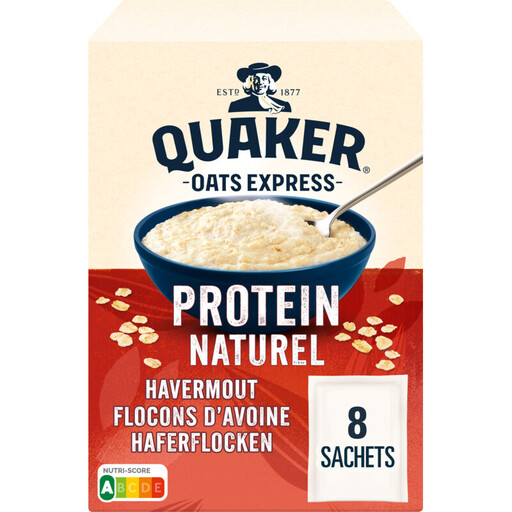 Image unavailable
Quaker Oats Express Protein 302 g
A quick-to-prepare oat option to compare if you want porridge with no added sugar. Adjust the portion and temperature to suit your child; the name ‘Protein’ doesn’t mean this product is specifically suitable as a toddler meal.
According to the product information, this variety contains soya protein and may contain wheat or barley. Check the current allergen information and, if your child has coeliac disease, don’t assume it’s suitable without the official Crossed Grain symbol.
View on Joybuy
Frequently asked questions
Can a toddler eat porridge with no added sugar?
Yes. The Netherlands Nutrition Centre recommends wholegrain porridge with no added sugar or salt as an alternative at breakfast or lunch for children aged 1 to 3. Don’t automatically use it as a replacement for a varied evening meal, and consider what your child eats at other mealtimes too.
Does ‘no added sugars’ mean a product contains no sugar?
No. Sugars naturally present in the ingredients may still appear in the nutrition table. So, as well as checking the claim, read the ingredients list and nutrition information per 100 g.
Can you use regular porridge oats instead of toddler porridge?
Regular wholegrain porridge oats with no added sugar or salt can be a suitable alternative at breakfast or lunch. Toddler porridge may specify a minimum age and preparation instructions. With regular oats, you’ll need to decide and check the portion, texture, temperature and allergens yourself.
Are regular porridge oats gluten-free?
Not automatically. According to the Netherlands Nutrition Centre, oats can become contaminated with gluten during processing. If your child has coeliac disease, checking for the official Crossed Grain symbol on the pack is essential.
Does ‘reduced sugar’ mean the same as ‘no added sugars’?
No. ‘No added sugars’ refers to what has been added to the product; ‘reduced sugar’ compares its sugar content with that of a similar product. Under EU Regulation (EC) No 1924/2006, the latter claim requires a reduction of at least 30%.


