
Vandaag of morgen in huis

Kwaliteit gegarandeerd

Welkomstaanbiedingen ontgrendelen: GRATIS bezorging | Tot 80% korting | Gratis 30 dagen JoyPlus-proefperiode
Download de app
A toaster may seem like a simple kitchen appliance, but the differences between models become especially noticeable with everyday use. A slot that is too narrow, unclear browning settings or a crumb tray that is difficult to remove can quickly become frustrating. If you only look at colour, wattage or a low price, you often overlook the specifications that determine how the toaster performs.
This guide explains what to look for when choosing a toaster for a household, family, student accommodation or busy kitchen. The recommendations are based on verifiable product details such as the number of slots, functions, dimensions and materials.
A 2-slice toaster is generally suitable for one or two people. A 4-slice toaster may be more convenient for a family, but check whether the appliance really has four separate slots. Some models have two extra-long slots that can hold several slices of bread side by side. This works differently from four individual slots and may affect both operation and evenness.
A toaster with wide slots is useful for thick slices, bagels, bread rolls and artisan bread. Do not rely solely on the marketing term: check whether the manufacturer specifies the slot width or maximum bread size. For example, the Rommelsbacher TO 850 is described as having extra-wide slots for toast measuring up to 12 × 12 cm. With other models, the exact size is sometimes not provided.
A toaster with a defrost function can be useful when you use bread straight from the freezer. A toaster with a reheat function warms already toasted bread without browning it further. These functions save an extra step, but they do not replace supervision. Bread and rolls can burn, especially when using a bun warmer or a longer defrost cycle.
First, determine how much bread you usually toast at the same time:
Also measure the available space next to your kitchen cupboards. A long model may take up more worktop space than a standard 2-slice toaster.
A toaster with variable browning settings gives you more control than an appliance with a single fixed cycle. Six to nine settings offer useful flexibility for lightly toasted bread, wholemeal bread and thicker slices. However, the number on the dial is not universal: setting 5 on one model does not necessarily produce the same result as setting 5 on another.
An automatic centring function keeps the slice between the heating elements. This can help produce more even results. Also look for a high-lift function when using small slices or bagels. It raises the bread so you can remove it without bringing your fingers close to hot parts.
A removable crumb tray makes regular cleaning easier. Otherwise, crumbs can accumulate inside the housing. Also check whether the cable can be stored away and whether the feet are non-slip.
Useful features include:
Never use a metal object to remove stuck bread. Unplug the toaster first and allow it to cool down. Place the toaster on a flat surface, away from curtains and other flammable materials. Do not immerse the appliance, plug or cable in water. Always follow the manufacturer’s instructions and safety warnings.
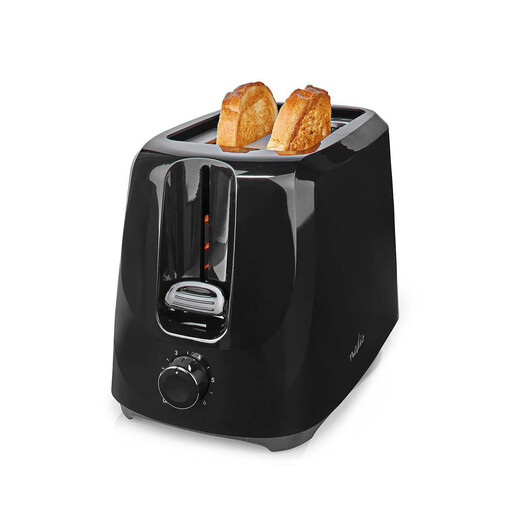
Why it suits this profile: This model has two slots, six browning settings and a compact size of 14.7 × 25 × 16.5 cm. That makes it straightforward to use for a first purchase or in a smaller kitchen.
The key features are clearly specified: six settings, a removable crumb tray and non-slip feet. It does not suggest a large capacity that would not match its two slots.
700 W power, six browning settings, cable storage and a removable crumb tray.
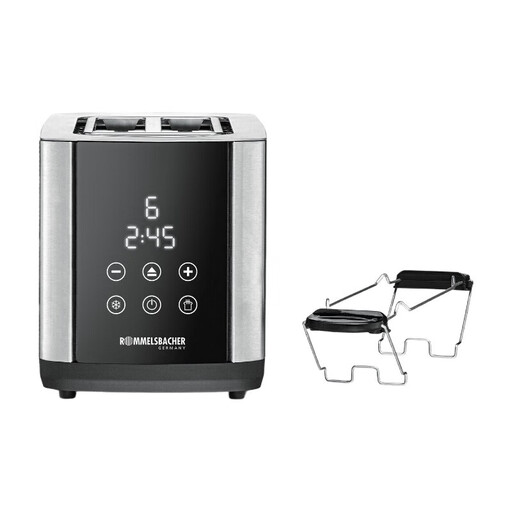
Why it suits this profile: This stainless-steel toaster combines extra-wide slots, nine browning settings and an LED countdown timer. It is well suited to users who prepare different types of bread and want precise control over the settings.
The specified maximum bread size of 12 × 12 cm makes its suitability for larger slices easy to verify. The bun tray and crumb tray are also removable.
850 W, nine settings, defrost and reheat functions, automatic centring and a stainless-steel housing.
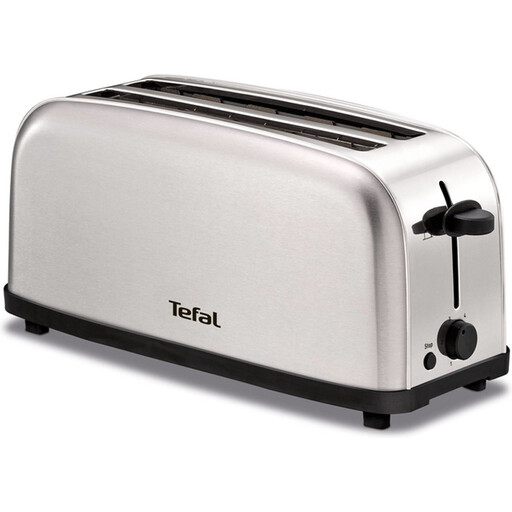
Why it suits this profile: According to the product description, this model uses two long slots to toast four slices at the same time. This is practical for families looking for extra capacity without a traditional wide four-slot model.
The capacity is linked to two long slots rather than four separate chambers. Check in advance whether this layout is suitable for the size of bread you use.
1400 W, six browning settings, stainless-steel housing, crumb tray and bun warmer.
We have put together a complete, up-to-date list of products that fully meet these strict selection criteria and the applicable European safety regulations.
The power ratings of the models mentioned range from approximately 700 to 1400 W. More watts do not automatically mean more even results. Capacity, slot design and browning control also play a part. Higher power may be suitable for a 4-slice model or one with long slots. If you use the toaster frequently, check that the socket and circuit can handle the total power of appliances operating at the same time.
Unplug the toaster and allow it to cool down completely. Remove the crumb tray and empty it over the bin. Wipe the exterior with a slightly damp cloth. Do not shake the toaster vigorously to loosen crumbs, and do not use water in the slots. Only remove stuck bread after unplugging the appliance.
Its lifespan depends on how often it is used, how well it is cleaned and the quality of its components. Emptying the crumb tray regularly helps prevent build-up. Use the appliance according to the instructions and stop using it if it is damaged, produces an unusual smell or behaves abnormally. Many models on offer come with a manufacturer’s warranty or are covered by at least the statutory guarantee under the applicable EU consumer rules. Check the terms on the product page.
