
Vandaag of morgen in huis

Kwaliteit gegarandeerd

Welkomstaanbiedingen ontgrendelen: GRATIS bezorging | Tot 80% korting | Gratis 30 dagen JoyPlus-proefperiode
Download de app
A toaster may seem like a simple kitchen appliance, but small differences determine how much convenience it offers every day. For example, a model with slots that are too narrow may not suit thick farmhouse bread, while an appliance with lots of features could be unnecessarily large for one user. If you only consider colour or wattage, you may end up buying a toaster that does not meet your needs for long.
Joybuy Product Recommendation Officer filters the most important product information based on verifiable specifications. This allows you to compare a black toaster, a toaster with wide slots, or a model for 2 or 4 slices based on practical points rather than marketing language.
The power rating indicates how much electrical energy the appliance uses at most, but it does not by itself show how evenly the bread will be toasted. A toaster rated at 800 to 1,150 watts may be suitable for two slices, while a 4-slice toaster often needs more power to heat several slots at the same time.
Therefore, consider the combination of:
A higher wattage can also increase electricity consumption per use. For short, everyday toasting, the difference is usually limited, but it matters with intensive use.
The description toaster with wide slots is useful, but it is not always enough. Check whether the product information also states what the slots are designed for. Thick slices of bread, bagels, bread rolls and sourdough require more space than standard sliced bread.
A long slot may be suitable for a slice of baguette, as with the Tefal TL365ETR. Extra-wide slots are particularly practical for thicker slices. Also check the external dimensions, as a toaster with wide slots often takes up more space on the worktop.
A toaster with 7 settings sounds versatile, but not every household needs that much variety. Functions such as defrosting, reheating and cancelling are useful when you regularly use bread from the freezer.
Also consider maintenance. A toaster with a crumb tray is easier to clean than a model where crumbs collect inside the housing. A cord storage compartment can also help keep your worktop tidy.
A 2-slice toaster is usually a good fit for one or two people. This type takes up less space and is often sufficient for everyday breakfast. For a family, a 4-slice toaster can save time, especially when several people eat at the same time.
With four slots, pay attention to the controls. Some models have one shared control, while others can be adjusted by pair or by individual slot. Independent controls are useful when not everyone wants the same level of browning, but this is not stated for every model.
A toaster with 7 settings provides a defined adjustment range from light to dark. However, the actual colour may vary depending on the type, thickness and moisture content of the bread. Use a low setting for thin white bread and start at a medium setting for thicker or wholemeal bread. Then adjust gradually.
A thermostat or dial is generally easy to operate. Touch controls and memory functions can be convenient, but first check that the controls remain clear to use when the appliance is hot.
A toaster with a defrost function is designed to warm frozen bread first and then toast it according to the product settings. According to the product descriptions for models including Melissa and Tefal, these models offer defrosting and reheating. This is a product specification, not a guarantee that every type of bread will produce the same result.
A high-lift function is useful for small slices. It allows you to remove bread from the slot more easily without putting your fingers close to hot components.
A stainless steel toaster often has a metal finish and matches other appliances in the kitchen. Check, however, whether only the exterior is made from stainless steel or whether other parts are metal too. A black finish may be made from plastic, metal or a combination of both.
More important than appearance are:
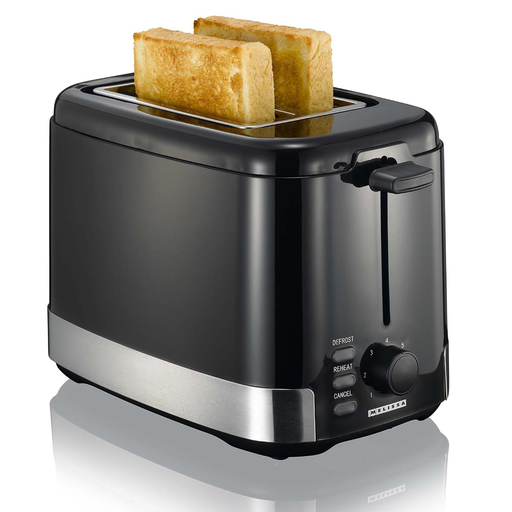
Why it suits this profile: For everyday breakfast for two, this model offers a straightforward setup with 800 W and two slices.
The product information specifically lists seven browning settings, a defrost function and a removable crumb tray. You are not paying for appearance alone.
Two slices, 800 W, seven settings, automatic shut-off and a bun warmer included.
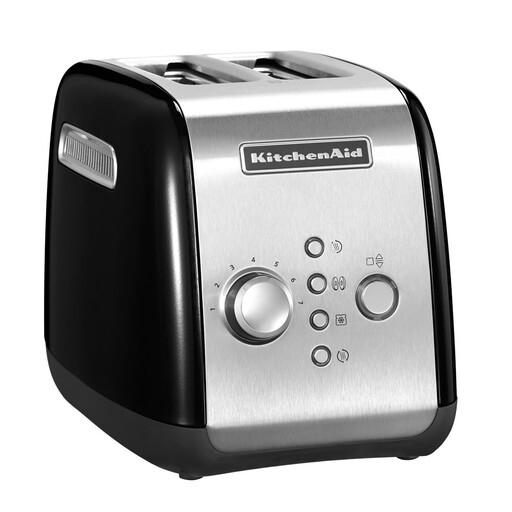
Why it suits this profile: This black toaster is for anyone who values a metal look, wide slots and dedicated controls for two slices.
The specifications list both extra-wide slots and seven browning settings. This makes it clear which features you get.
Capacity for two slices, extra-wide slots, seven settings and a black metal finish.
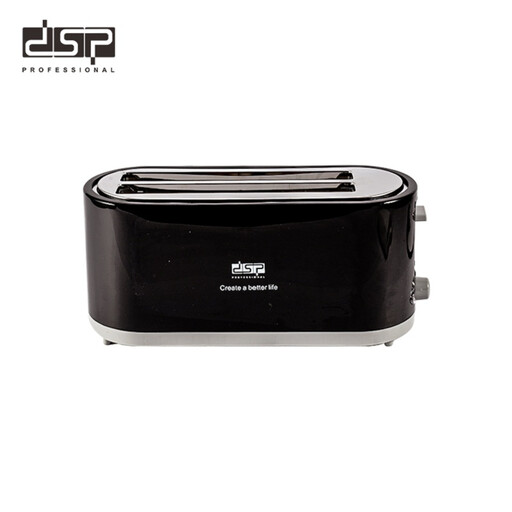
Why it suits this profile: A household with several bread lovers can toast four slices at once and benefit from a higher stated power rating.
The product description lists four slots, seven settings, a crumb tray and cord storage. This makes the capacity and maintenance requirements verifiable.
Four slices, 1,400 W, seven settings, non-slip feet and a removable crumb tray.
We have put together a complete, up-to-date list of products that fully meet these strict selection criteria and the applicable European safety regulations.
Place an electric toaster on a flat, dry and heat-resistant surface. Keep curtains, kitchen cupboards and other flammable materials away from it. Do not use a metal fork or knife to remove stuck bread. Unplug the appliance first and allow it to cool down.
Empty the crumb tray regularly. Never immerse the toaster, plug or cord in water. Also avoid using bread with liquid toppings, butter or icing in a standard toaster; these ingredients may melt inside the appliance.
For two slices, you will often see around 800 to 1,150 watts. Four slices generally require more power. Wattage is useful for comparison, but always assess it alongside the capacity and available features.
Not automatically. Wide slots are practical for thicker slices, bagels and bread rolls, but check the product description and dimensions. A long slot is particularly useful for long pieces of bread.
Its lifespan depends on usage, cleaning and the quality of its components. Empty the crumb tray, avoid moisture and do not force out stuck bread. When buying, check the warranty and your statutory conformity rights. In the EU, the products mentioned come with a minimum two-year legal guarantee, although additional rights may apply under the relevant national law.
