
Vandaag of morgen in huis

Kwaliteit gegarandeerd

Welkomstaanbiedingen ontgrendelen: GRATIS bezorging | Tot 80% korting | Gratis 30 dagen JoyPlus-proefperiode
Download de app
A toaster may seem like a simple kitchen appliance, but you quickly notice the differences between models in everyday use. A slot that is too narrow will not accommodate thick farmhouse bread, a crumb tray that is difficult to empty creates mess, and a large number of settings does not automatically mean the toaster is easy to use.
If you are looking to buy a toaster, it is therefore worth considering how you will use it first. Do you usually toast two slices, do you often use frozen bread, or does the appliance need to keep up with a family of several people? Below, you will find the key points to consider, along with some suitable options.
A 2-slot toaster is suitable for two slices per cycle, but the dimensions of the slots are at least as important. With a long-slot toaster, you may be able to fit one long slice or a larger piece of bread. Always check the product specifications, though: some product titles mention long slots, while the technical information gives a different configuration.
A 4-slot toaster can be useful for families, but it generally takes up more worktop space. So do not just look at capacity; consider the available width and depth as well.
A toaster with adjustable browning settings gives you more control, but the scale varies from one brand to another. Setting 7 on one model is not necessarily as dark as setting 7 on another. According to the product description, an automatic centring function helps keep slices more centrally positioned. Even so, the type, thickness and moisture content of the bread can affect the result.
A toaster with a defrost function is practical for bread from the freezer. A toaster with a reheat function is designed to warm toast up again without giving it a completely new browning cycle. These functions save you a few steps, but they do not make the appliance suitable for every type of food.
Only use a bun warmer in accordance with the instructions. Never leave a toaster unattended while it is in use, and do not put metal objects or oversized food items into the slots.
As well as the number of slots, check the maximum bread thickness. For the WMF Stelio, for example, the product information states a maximum thickness of 2.6 cm. Other models only refer to wide or variable-width slots.
An adjustable browning control is useful when people in the same household have different preferences. The range includes models with 6, 7, 8 or 9 settings. A simple dial is often easy to understand, while a digital display or touch controls can provide extra information, such as a countdown timer.
Also check whether the appliance has a stop or cancel button. This allows you to interrupt a cycle when the bread is ready sooner than expected.
A toaster with a crumb tray is easier to clean than a model where crumbs can only be removed through the base. Empty the tray regularly, and always unplug the appliance before cleaning it or removing stuck bread.
Also look out for:
A stainless-steel toaster may have a sturdy, easy-to-wipe exterior, but the material alone says nothing about its overall lifespan. Hinges, controls, slots and ease of cleaning are also relevant.
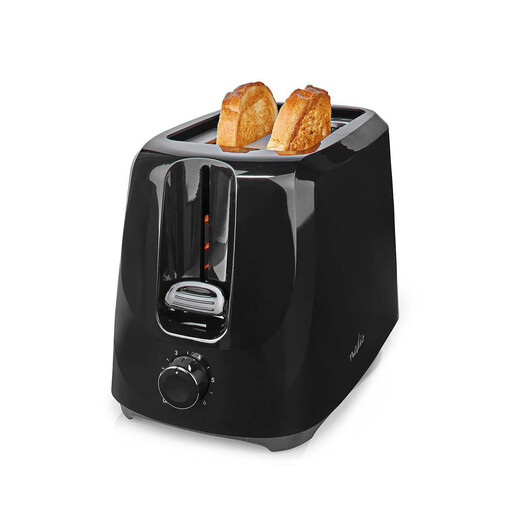
Why it suits this profile: This compact 2-slot model has simple controls and, according to the stated dimensions, takes up very little space. That makes it a good fit for a student room or small kitchen.
The six browning settings make it easier to choose the right level than with a model without adjustable control. The removable crumb tray helps prevent crumbs from being left behind.
Two slots, 700 W, non-slip feet, cord storage and a weight of approximately 0.88 kg according to the product details.
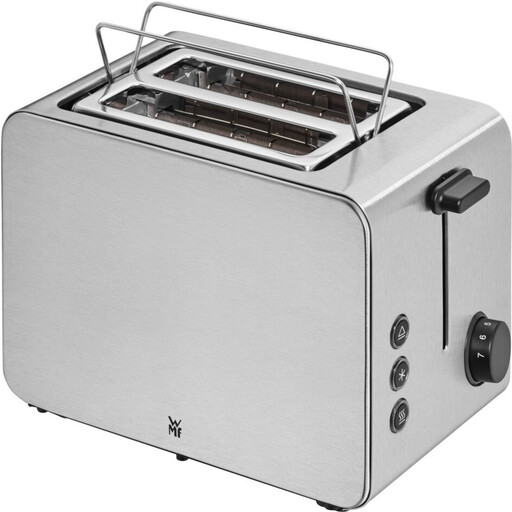
Why it suits this profile: The stainless-steel casing, automatic bread centring and integrated bun warmer make it well suited to everyday use with different types of bread.
The crumb tray and cord storage address two common practical frustrations. The product specifications state that it has 14 cm slots and seven browning levels.
According to the product description, it includes defrost, reheat and stop functions, a high-lift feature and a rack for buns and croissants.
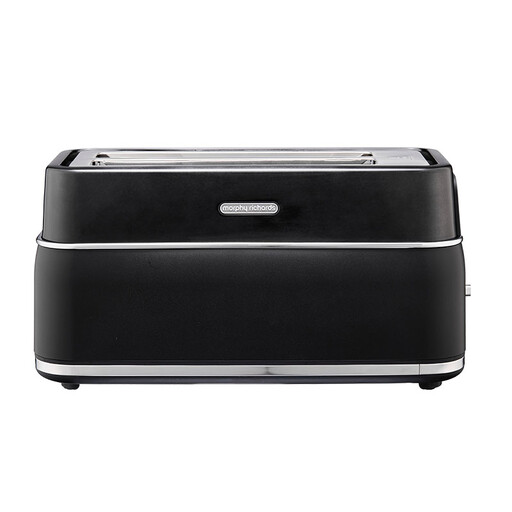
Why it suits this profile: The extra-long slots are designed for households that want to toast several slices or larger pieces of bread one after another.
The variable slot width means you are not limited to standard thin slices. The crumb tray also makes regular maintenance easier.
According to the product information, it offers seven settings, defrost and reheat functions, automatic switch-off and a power rating of 1800 W.
We have put together a complete, up-to-date list of products that fully meet these strict selection criteria and the applicable European safety regulations.
Its lifespan depends on how often it is used, how well it is cleaned and the condition of mechanical parts such as the lever and automatic lift. There is no fixed service life that applies to every model. Empty the crumb tray regularly, do not use the appliance with bread stuck inside it, and follow the instructions. The product information for several of the models mentioned states a statutory warranty of at least two years; check the terms for the specific product.
Energy consumption depends on the power rating and how long the toaster is used. For example, the models in this overview range from 700 to 1800 W. A higher wattage does not automatically mean that one cycle will take proportionally longer or shorter. For a practical comparison, consider both the power rating and how often you use the appliance. Unplug it after use if the instructions require this, or if you want to take extra precautions.
You can with a model that has a defrost function, provided the manufacturer supports its use with bread. First select the desired browning setting, then use the defrost function as instructed. Do not put packaged products, aluminium foil or oversized pieces of bread into the slots. Never leave the appliance unattended while it is in use.
