
If you’re looking for a wholegrain lunch base
You want something crunchy to serve as the base for your lunch. The wholegrain label, nutritional information and toppings can help you decide whether a product is right for your meal.


Looking for a crunchy base for lunch? Start with a product clearly labelled as wholegrain, then choose toppings to suit your meal. Small melba toasts call for a little thought about your total portion and salt intake. A digestive is a biscuit, so it isn’t automatically a substitute for a wholegrain lunch base.
You want something crunchy to serve as the base for your lunch. The wholegrain label, nutritional information and toppings can help you decide whether a product is right for your meal.
You’re mainly choosing melba toast for its size and crisp texture. Check how many pieces you eat, and assess the toast and toppings together rather than looking at each piece in isolation.
You want to know what the name or a wholegrain claim on a biscuit tells you about its ingredients. For the AH product described, added sugars and other types of flour are also worth considering.
First decide whether you’re looking for a grain-based lunch, small pieces of toast to top, or a sweet biscuit. Then compare the packaging of the specific product you’re considering.
| What to consider | What to check when buying | Who it matters to |
|---|---|---|
| Wholegrain base | Look for an explicit wholegrain label and check the ingredients and fibre per 100 g. | I want the crunchy product to be the base of my lunch, not just an extra. Around 36% of consumers would put this need first. |
| Small, crunchy portions | Check the weight per piece and compare fibre and salt for the portion you eat. | I like topping small pieces of toast, but I usually eat more than one. This would be the main consideration for around 29% of consumers. |
| Availability and packaging | Check the current product and pack size. Plain, multigrain and seeded do not mean the same as wholegrain. | I want to choose a crunchy product that’s available at my usual shop, without confusing different varieties. This practical need would come first for around 21% of consumers. |
| Digestives as a sweet option | Check which types of flour are used and look for information about added sugars. | I’m deliberately choosing a sweet biscuit and don’t want to confuse it with my usual lunch base. Around 14% of consumers would consider this the most important choice. |
According to Albert Heijn, the AH Digestive described contains 19 g of added sugars per 100 g. So the mention of wholemeal flour alone doesn’t tell you what role the biscuit can play in your lunch.
If you’re looking for a grain-based lunch, compare the ingredients in a digestive with those in crispbread or toast, rather than relying on the product name.
The Voedingscentrum lists, among other things, 0.2 g of fibre and 0.07 g of salt for one 4 g piece of melba toast. If you eat several pieces, the toppings also contribute to the meal as a whole.
Base your choice on the number of pieces you eat, and compare varieties per 100 g as well.
A reference to several types of grain or seeds, or a dark colour, doesn’t tell you how much wholemeal flour a product contains.
Look for an explicit wholegrain label, then check the ingredients and nutritional information on the packaging.
The Netherlands Food and Consumer Product Safety Authority says that iodine compounds may be present in bakery products. This doesn’t mean they’re in every piece of toast or biscuit.
If this matters to your choice, check the packaging or ask the manufacturer which ingredients are used.
Worth considering if you’re specifically looking for wholegrain crispbread.
A brand to explore if you’re looking for different varieties of melba toast.
The AH Digestive shows why you should assess a biscuit separately from a crunchy lunch base.
Worth considering if you want to compare different types of toast, crackers and crispbread.
These Joybuy products are crispbreads and crackers you could consider as a crunchy base. Choose between the varieties labelled wholegrain and other crackers according to the current packaging, your portion and your toppings. This isn’t a selection of digestives or melba toast.
 No image available
An option if you want to top rye crackers and use them as a crunchy base. Check the ingredients, salt and allergens on the packaging for the portion you plan to eat.
 No image available
A good fit if you’re looking for a crunchy lunch base labelled as wholegrain. Before choosing a variety, check the ingredients, nutritional information and allergens on this pack.
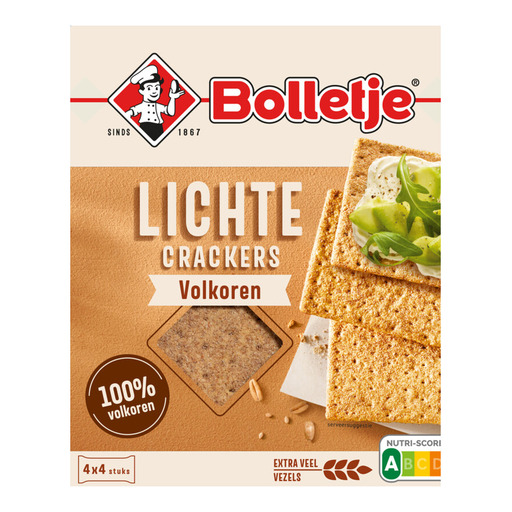 No image available
A cracker option if you’re looking for a crunchy base for toppings. Don’t let the name Light replace a comparison of portion size, nutritional information and ingredients.
 No image available
A cracker option if you want to include fibre in your comparison. Check the ingredients and the exact wholegrain label on the packaging; the product name alone doesn’t tell you everything about its ingredients.
 No image available
A crispbread option if you want a crunchy base for toppings. Before choosing this variety as a wholegrain option, check the types of flour, nutritional information and allergens on the packaging.
A digestive isn’t automatically a substitute for a wholegrain base. According to Albert Heijn, the AH Digestive described contains 19 g of added sugars per 100 g. Check the ingredients of the specific biscuit and consider the rest of your lunch, too.
No, these descriptions don’t tell you how much wholemeal flour has been used. Look for an explicit wholegrain label and check the ingredients of the toast or cracker you choose.
No, don’t assume this is the case for every product. The Netherlands Food and Consumer Product Safety Authority says that iodine compounds may be present in bakery products. Check the packaging or ask the manufacturer what is used in the variety you’ve chosen.
Read the allergen information on the packaging of the exact variety you want to eat. The Bolletje wholegrain crispbread described lists, among other things, cereals containing gluten and sesame. Other products may have different ingredients.
Use the information on the current packaging to make your final choice. Ingredients, nutritional values and allergens can vary between varieties or change when a recipe is updated.