
A holiday home group with different tastes
You want to serve toast that works with mild toppings as well as savoury snacks, without committing everyone to a strongly flavoured wholemeal option.


For a holiday home with a range of preferences, serve plain toast alongside a clearly wholemeal option. If you’d rather buy just one type, check whether it contains both wheat flour and wholemeal flour, but don’t automatically assume it’s fully wholemeal. Compare the nutritional information and check the packaging of each product for allergy information.
You want to serve toast that works with mild toppings as well as savoury snacks, without committing everyone to a strongly flavoured wholemeal option.
You want to be able to choose a product with a clear wholemeal base for breakfast or lunch, and compare the fibre per 100 g.
You need to check the ingredients and allergen information on each specific pack. A plain flavour or wholemeal label doesn’t tell you whether it’s suitable.
First, decide whether one type of toast will suit the group or whether it’s more practical to serve both plain and wholemeal. Then compare the labels of the specific products you’re planning to take.
| What to consider | What to check when buying | Who it matters to |
|---|---|---|
| Plain and wholemeal options | Choose two varieties, or check whether a single product lists both wheat flour and wholemeal flour among its ingredients. | When I’m serving toast to people with different tastes, I don’t want everyone to be stuck with one strong grain flavour. This compromise matters most to around 45% of consumers. |
| Wholemeal base and fibre | Look for a clear wholemeal claim and compare the fibre per 100 g in the nutritional information. | At breakfast, I want to be able to choose a recognisably wholemeal product rather than judging by the colour of the toast. Around 33% of consumers give this wholemeal option priority. |
| Ingredients and allergens | Read the allergen information on each pack. Also compare salt per 100 g if it’s relevant to your choice. | When I’m buying for guests with an allergy, I need to know what’s in the specific pack. This check comes first for around 22% of consumers. |
A toast product may contain both wheat flour and wholemeal wheat flour. Simply listing wholemeal flour doesn’t tell you how much of it the product contains.
Check the order of the ingredients, the wholemeal claim for the specific variety and the fibre per 100 g.
Even mild-tasting toast can contain relevant allergens. Ingredients also vary from product to product.
If you have an allergy or coeliac disease, check the current packaging of every pack and don’t rely on the product name alone.
Moisture can make toast less crisp, especially if a pack is left open after serving.
Follow the storage instructions on the packaging. Small individual packs can be useful if you’re serving the toast over several days.
Melba toast in a range of varieties, including plain and wholemeal, for anyone looking specifically for thin toast.
A toast option for anyone looking for a product explicitly labelled as wholemeal.
A plain Melba toast option for a group wanting to serve toast with a range of toppings.
A range where you can browse toast options from different brands side by side.
A brand to consider if a light wholemeal cracker would also suit the meal.
A retailer and product range to consider for classic toast or Melba toast.
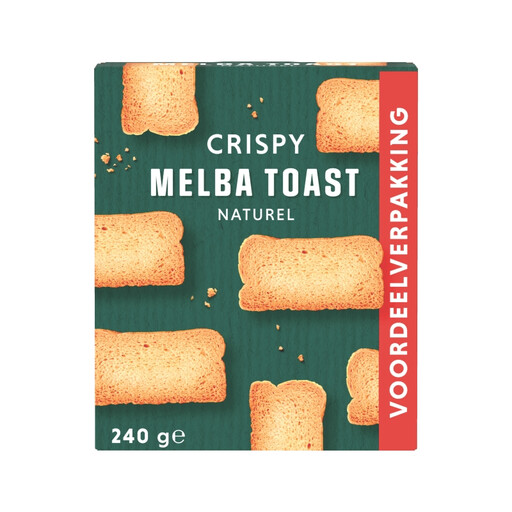
This Melba toast suits the plain option for anyone who prefers a mild-tasting toast. If your group also wants wholemeal toast, this product alone won’t cover everyone’s needs.
 No image available
Melba toast for anyone wanting to serve a plain option at their holiday home.
240 g pack. If you have allergies, check the current label: the product information about ingredients and allergens is contradictory.
No. The presence of wholemeal flour alone doesn’t make a toast product fully wholemeal. The ingredients for Haust Krokant Toast list both types of flour, while Van der Meulen describes its wholemeal Melba toast as made from 100% wholemeal bread. Check the claim on the specific packaging to make the right choice for you.
Yes, especially if you’re buying for someone with an allergy. ‘Plain’ describes the variety, not the allergens, so check the current ingredients and allergen information on every pack.
Follow the storage instructions on the packaging and seal opened toast tightly. Albert Heijn recommends keeping its Plain Melba Toast in a sealed tin after opening. Smaller individual packs can be useful if you’re not serving everything at once.