
Party organiser keeping an eye on sugar
You're looking for toast to use as a base for party snacks and want to compare similar products by their ‘of which sugars’ value per 100 g, rather than relying only on a claim on the front of the pack.


For a children's party, compare the sugars per 100 g in similar toast products; a claim such as ‘light’ does not, by itself, mean the toast contains less sugar. According to Jumbo's product information, Van der Meulen Melba Wholemeal and Multigrain both contain 3.2 g of sugars per 100 g, while the wholemeal variety contains more fibre and more salt. Also check the allergens on the packaging and assess the toppings separately.
You're looking for toast to use as a base for party snacks and want to compare similar products by their ‘of which sugars’ value per 100 g, rather than relying only on a claim on the front of the pack.
You want to consider fibre and salt as well as sugars, for example when comparing wholemeal and multigrain melba toast.
You want to check in advance which allergens are relevant to the children and whether the treats meet the rules at the school, childcare setting or party venue.
Start with the nutritional information per 100 g for similar toast products. Then check the fibre, salt and ingredients in both the toast and the toppings you plan to use.
| What to consider | What to check when buying | Who it matters to |
|---|---|---|
| Sugars | Compare the ‘of which sugars’ value per 100 g in similar toast products. Check what any claim about a reduction refers to. | When I'm making party snacks, I want to know the sugar content of the toast before choosing toppings. For around 40% of consumers, this comparison would be the top priority. |
| Fibre and salt | Read both values per 100 g; the same sugar content doesn't mean these values are the same too. | For savoury snacks, I want to weigh up sugars, fibre and salt together, as these can vary between toast products. This would be the main consideration for around 30% of consumers. |
| Allergens and venue rules | Read the current packaging and ask in advance about any relevant allergies and venue rules. | If children with food allergies are coming, or the venue has rules about party treats, I want to know what I can serve first. This would be the main concern for around 30% of consumers. |
According to the Netherlands Nutrition Centre, ‘light’ can refer to energy, fat or sugar. So the term doesn't necessarily tell you how the sugar content of two toast products compares.
Check what the claim refers to, then compare the ‘of which sugars’ value per 100 g in similar products.
According to Jumbo, Van der Meulen Melba Wholemeal and Multigrain each contain 3.2 g of sugars per 100 g. The wholemeal variety lists 9.7 g of fibre and 1.9 g of salt per 100 g; the multigrain variety contains 7.5 g of fibre and 1.5 g of salt.
After checking the sugar content, also look at fibre, salt and the toppings you plan to use.
Ingredients and allergen information can change. If a child has a relevant allergy, check the current product information when choosing a snack.
Ask about allergies in advance, read the packaging before buying and serving, and discuss a suitable alternative if needed.
A brand name doesn't tell you which toast contains less sugar. Compare the current nutritional values of specific products, and keep toast, crackers and rusks as separate product types.
Plain, multigrain and wholemeal varieties offer different options for small topped toasts.
Albert Heijn lists products including AH Melba Toast Plain and Van der Meulen Melba Toast Wholemeal in its product information.
Jumbo lists its own toasts and Van der Meulen Melba varieties in its toast range.
The Bolletje products mentioned are crackers, not toast varieties assessed in this comparison.
This rice toast is an option as a base for topped party snacks. Before choosing based on sugar content, compare its current nutritional information with that of other toast products.
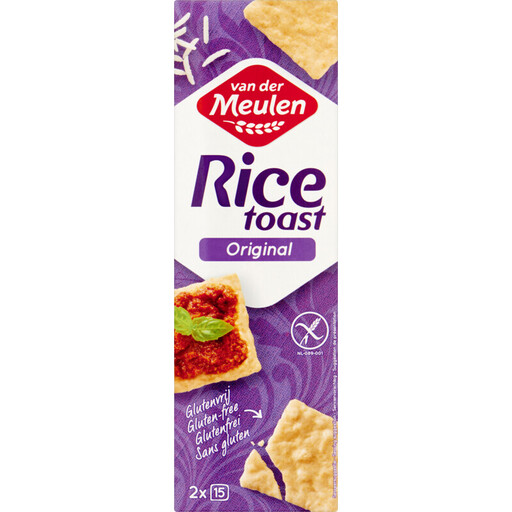 Image unavailable
If you're considering rice toast for topped party snacks, compare the sugars per 100 g on the current packaging with those of similar toast products. If there are any allergies, also check the packaging for sesame and soya.
No, not necessarily: according to the Netherlands Nutrition Centre, ‘light’ can refer to energy, fat or sugar. Check what the term refers to and compare sugars per 100 g in similar toast products.
Neither has a lower sugar content based on the values given: according to Jumbo, Van der Meulen Melba Wholemeal and Multigrain each contain 3.2 g of sugars per 100 g. For your final choice, also compare fibre, salt and the current packaging.
Ask which allergens are relevant to your guests, then read the packaging for both the toast and the toppings. According to the Netherlands Nutrition Centre, common allergens must be clearly listed on the label; use the current packaging when making your choice.
Add the toppings shortly before serving if you want to stop them making the toast soggy. Until then, store the toast according to the instructions on the packaging.
Ask in advance what rules the school or childcare setting has for party treats. The Netherlands Nutrition Centre points out that these rules may determine what children can bring in to celebrate a birthday.