
Barbecue hosts comparing sugars
You’re looking for toast to serve with drinks and want to compare products by ‘of which sugars’ per 100 g, rather than relying on a term such as ‘light’.


When comparing toast for a barbecue, start by checking ‘of which sugars’ per 100 g, then look at salt, fibre, allergens and toppings. Of the melba toasts compared here, Van der Meulen Organic Sesame Toast has the lowest sugar content, at 2.8 g per 100 g, but also contains 2.1 g of salt per 100 g. If you’d prefer a wholemeal option with more fibre, Van der Meulen Melba Wholemeal Toast is another option to consider: according to Jumbo, it contains 3.2 g of sugars and 9.7 g of fibre per 100 g.
You’re looking for toast to serve with drinks and want to compare products by ‘of which sugars’ per 100 g, rather than relying on a term such as ‘light’.
You want toast to serve with savoury toppings and, when sugar levels are similar, you also compare the fibre content. Jumbo lists 9.7 g of fibre per 100 g for Van der Meulen Melba Wholemeal Toast.
You’re serving toast to several guests and want to check the declared allergens and salt content of each variety.
Start with the nutritional information per 100 g, so different pack sizes don’t skew your comparison. Then consider whether the ingredients and toppings are suitable for your guests.
| What to consider | What to check when buying | Who should pay particular attention? |
|---|---|---|
| Total sugars | Compare ‘of which sugars’ per 100 g across similar types of toast; check dips and toppings separately. | If I want toast that’s low in sugars, I want to compare the figures without pack size influencing my choice. Around 29% of consumers prioritise comparing sugar content. |
| Allergens and ingredients | Read the ingredients and allergen information on the current packaging, including for different varieties from the same brand. | When putting together a sharing platter, I want to know which toast I can serve to my guests. Allergens and ingredients are a top priority for around 24% of consumers. |
| Fibre | Compare fibre and sugars per 100 g, and check the ingredients of wholemeal varieties. | When sugar levels are similar, I’d also prefer to check the fibre content of the toast. This is the main consideration for around 18% of consumers. |
| Salt | Check the salt content per 100 g and take your toppings into account when choosing. | If I’m serving toast with savoury toppings, I want to know how much salt the toast itself contains. That’s why around 17% of consumers prioritise salt. |
| Packaging and storage | Check the pack weight and storage instructions, both before and after opening. | When serving a group, I want to have enough toast ready and be able to store an opened pack properly. Pack size and storage are the most important factors for around 12% of consumers. |
‘Reduced sugar’ refers to a comparison with a similar product, while ‘low sugar’ describes the amount of sugars in the product itself. Voedingscentrum sets a limit of no more than 5 g of sugars per 100 g for a ‘low sugar’ claim on solid foods.
Check ‘of which sugars’ per 100 g and, if a reduced-sugar claim is made, see what comparison it refers to.
Choosing toast based on the toast alone doesn’t tell you how much sugar the toppings contain. This can make a difference to the finished bite, particularly with dips, chutneys and other toppings.
Before choosing combinations for your sharing platter, also compare the nutritional information for the toppings per 100 g.
The Van der Meulen varieties listed by Jumbo in this comparison range from 1.3 g to 2.1 g of salt per 100 g. Declared allergens also vary between varieties.
Check the current packaging and keep toast containing relevant allergens separate when serving several guests.
The RIVM describes the addition of iodine to baker’s salt, but also notes that not all bread is made with iodised salt. So the product category alone doesn’t tell you which type of salt has been used in a particular toast.
If you want to know which type of salt has been used, check the packaging or ask the manufacturer.
Makes melba toast in a range of varieties, including plain, wholemeal and organic sesame.
Offers AH Melba Toast Natural in a 240 g pack.
A retailer of various Van der Meulen melba toasts and its own toast varieties.
The product listed by ALDI, Melba Toast Natural, comes in a 240 g pack.
Offers crackers and crispbread, among other products, if you’d like to consider alternatives to melba toast as a base for toppings.
This rice toast is an option if you’re looking for a base for savoury toppings. To compare sugar content and cater for guests with allergies, check the nutritional information and ingredients on the current packaging.
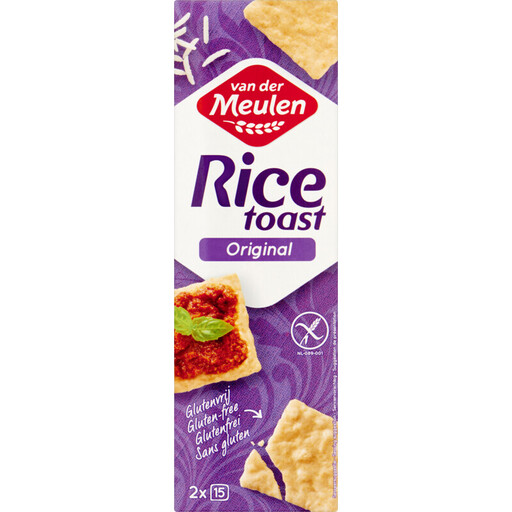 Image unavailable
Rice toast to consider as a base for savoury toppings.
Pack size: 65 g. Check the current packaging for sugars per 100 g and for sesame and soya information before serving the toast to guests with allergies.
‘Low sugar’ refers to the absolute amount of sugars; for solid foods, Voedingscentrum sets a limit of no more than 5 g per 100 g. ‘Reduced sugar’ requires a comparison with a similar product. So check both the nutritional information and the explanation accompanying the claim.
Of the product pages compared here, Van der Meulen Melba Organic Sesame Toast lists the lowest amount: 2.8 g of sugars per 100 g, according to Jumbo. According to Albert Heijn, AH Melba Toast Natural contains 3.2 g per 100 g; Jumbo lists the same sugar content for Van der Meulen Melba Wholemeal Toast. This is a comparison of these products, not of every toast available.
Store toast according to the instructions on the packaging. For its Krokante Melba Toast, Joybuy recommends storing it in a cool, dry place, away from moisture, heat and direct sunlight, and resealing the pack securely after opening.
No, don’t assume this is the case for every type of toast. The RIVM explains that iodine is added to baker’s salt, but also notes that not all bread is made with iodised salt. For a specific product, check the packaging or ask the manufacturer which type of salt has been used.
Always check the current packaging of your chosen toast before serving it. Ingredients and allergens can vary between varieties; use the product description to narrow down your options, not as a substitute for the label on the pack.