Who is this choice relevant to?

Parents of a baby getting used to different textures

You want to know whether crunchy toast is suitable for what your child can already chew and swallow. The Netherlands Nutrition Centre also says that children should be able to sit upright before being given larger pieces.

Families looking to share a food cupboard staple

You’re looking for toast for adults or older children, without assuming that the same toast is also a suitable first bread food for your baby. The pack format and storage instructions matter too.

Families with allergy requirements

Check the ingredients and allergens for the exact product variant. If you want to pack toast for your child, also check the requirements at their school, nursery or with their childminder.

What should you look for when choosing?

Soft bread without the crust

When: your baby is still getting used to bread and you want to soften its texture if needed with breast or formula milk, as described by the Netherlands Nutrition Centre.

Trade-off: this is a different store-cupboard choice from long-lasting, dry toast.

Crunchy toast

When: the pack is mainly for other family members, or your child can already sit upright and chew and swallow well before being given larger pieces.

Trade-off: crunchy toast is not the same as soft bread. Check the salt and allergens for each product variant.

What to consider What to check when buying Who it matters to
Texture and eating skills Before offering larger pieces, check whether your child can sit upright and chew and swallow well. If not, soft bread without the crust is a better choice. If my baby is still practising chewing and swallowing, I want to know whether crunchy toast is suitable yet. The right texture is the top priority for around 46% of consumers.
Salt and allergens Read the salt content per 100 g, ingredients, allergens and any statements about possible traces on the packaging of the exact product variant. I want to know what’s in the toast before giving it to my child or packing it for them, especially if allergens are a concern. An estimated 36% of consumers put label information first.
Family food cupboard Compare the net weight, any individual packs and the storage instructions after opening. If other family members will be eating it too, I want to choose a pack we can use without unnecessary leftovers. For around 18% of consumers, the family food cupboard is a priority.

Common mistakes

  • Assuming a large pack is suitable as a first bread food

    The size of the pack doesn’t change the requirements for offering larger pieces. According to the Netherlands Nutrition Centre, a child should be able to sit upright and chew and swallow well before being given them. If your child often chokes or has difficulty chewing, wait before offering larger pieces.

    If your baby is still getting used to different textures, soft bread without the crust is a better choice; soften it if needed. Stay with your child while they eat.

  • Assuming ‘plain’ tells you what’s in the toast

    ‘Plain’ doesn’t tell you anything about the salt content or allergens. Albert Heijn lists both salt and cereals containing gluten and soya in AH Melba Toast plain.

    Check the current ingredients, nutritional information and allergen details for the exact product variant you’re buying.

  • Using a product range overview as a substitute for the label

    Information about a product category or freshly baked bread doesn’t necessarily describe the ingredients in a specific toast product.

    Check the packaging for that product variant. If you need information for allergy requirements, ask specifically about the product using its correct name and packaging.

Brands to consider

Albert Heijn

According to Albert Heijn, AH Melba Toast plain is a 240 g multipack containing 12 packs of 6 pieces of toast.

  • For this product variant, Albert Heijn provides the ingredients, allergens, nutritional information and storage instructions.
  • Check the packaging too: product information can change, and these details don’t automatically apply to other variants.

Bolletje

Bolletje offers rusks, crackers and snacks. These aren’t necessarily the same products as Melba toast.

  • The range includes other dry bread products that you can consider separately.
  • Compare the ingredients, salt content and packaging of a specific product variant rather than assuming products in different categories are the same.

Lidl

Lidl sells products including crackers and rusks, and publishes ingredient information for freshly baked bread.

  • The freshly baked bread overview can help you assess products in that range.
  • For toast, use the information on the packaging of the product variant you’ve chosen, not information for a different bread product.

Toast for sharing with the family

You could consider this crunchy Melba toast as a store-cupboard staple for other family members. For a baby who is still getting used to larger pieces, the choice between toast and soft bread depends on their eating skills.
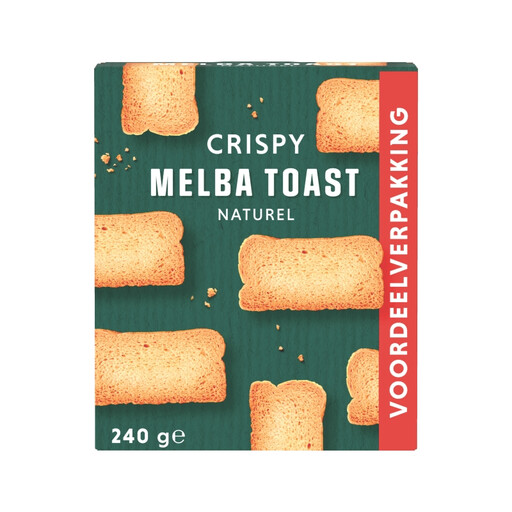
Crispy Melba Toast, 240 g pack

Crispy Melba Toast, 240 g

This crunchy Melba toast can be a store-cupboard staple for other family members, but it isn’t necessarily a suitable first bread food for a baby.

The product description states that it contains 1.9 g of salt per 100 g. The ingredients list mentions wheat, barley and soya, while a separate allergen statement contradicts this. So check the current packaging before using the toast, especially if allergies are a concern.

If you want individual portions, check the packaging to see whether the toast comes in separate packs.

View at Joybuy

Frequently asked questions

Is toast a suitable first bread food for baby-led weaning?

Crunchy toast isn’t an obvious first choice: the Netherlands Nutrition Centre recommends bread without the crust as a starting option, which you can soften with breast or formula milk if needed. Before giving your child larger pieces, they should be able to sit upright and chew and swallow well.

Should I check the salt content of toast for a baby?

Yes. The Netherlands Nutrition Centre advises avoiding salty foods for babies aged 4 months to 1 year. So check the nutritional information for the product variant you’ve chosen; Albert Heijn lists 1.93 g of salt per 100 g for AH Melba Toast plain.

Is Melba toast a brand?

No, Melba toast is a type of product. Compare the full product name, variant, ingredients, nutritional information and packaging to identify the toast you’re looking at.

Does all toast contain iodine?

You can’t tell from the product type alone. To find out whether baker’s salt was used in a specific toast product, or to get information about its iodine content, check the packaging or ask the manufacturer.
