
Cleaning large tiled walls
If you’ve moved house and mainly need to clean a large area of tiles, compare a wide brush head with the reach offered by a pole. RYOBI lists a 15 cm head for the R18TPS-0 and R18CPS-0.


For grout, corners and short stretches of wall, a compact brush with a suitable detail head is the more practical choice. For large or high walls, a pole scrubber gives you greater reach. Match the brush head to the tile finish, and check the water instructions and which battery and attachments are included with the specific version. This advice is based on manufacturers’ specifications and care guidance, not an independent performance test.
If you’ve moved house and mainly need to clean a large area of tiles, compare a wide brush head with the reach offered by a pole. RYOBI lists a 15 cm head for the R18TPS-0 and R18CPS-0.
If you mainly want to tackle dirt along grout lines, edges and around obstacles, check the shape and width of the head and which detail attachments are included. Bosch DIY describes brushes for grout and detailed cleaning; RYOBI lists a 5 cm head for the RSCR4-0.
If the top of the wall is hard to reach, compare the pole length, the angle of the head and how much room you have to move the device. RYOBI lists a telescopic pole that extends from 97 cm to 1,4 m for the R18TPS-0.
First, work out which part of the job is most challenging: the large wall area, the grout or the top of the wall. Then choose a brush that suits the finish and check what’s included with the exact version.
| What to consider | What should you check? | Who is this important for? |
|---|---|---|
| Large wall areas | Compare the width of the head with the available working space. According to RYOBI, the R18TPS-0 and R18CPS-0 have a 15 cm head. | If you’ve moved house and mainly need to clean a large, unobstructed area of tiles, a wider head could be practical. Around 29% of consumers prioritise large wall areas. |
| Grout and edges | Check the shape and width of the detail head, whether it’s compatible and whether it’s included in the set. | If you want to tackle dirt in grout lines, corners or around obstacles, choose a head that’s designed to reach them. Around 22% of consumers prioritise grout and edges. |
| Extra reach | Measure the wall height and available room to move; compare the adjustable pole length and the head positions. | If the top of a tiled wall is hard to reach, a pole can extend your working range, but you’ll still need room to move the scrubber. Around 21% of consumers prioritise extra reach. |
| Tile finish and moisture | Follow the care advice for your tiles and the water and charging instructions for the exact device. Carefully test a suitable head on an inconspicuous area. | If you want to protect a delicate finish and follow the usage instructions, take care to match the head to the device’s water-resistance rating. Around 14% of consumers make this their top priority. |
| Complete set | Check the full model code and whether the battery, charger, charging cable and any attachments you need are included. | If you want to know in advance which parts you’ll still need, compare the box contents rather than just the device name. Around 14% of consumers prioritise a complete set. |
A 15 cm head is designed for a different kind of surface than a small detail head. It won’t automatically reach narrow grout lines or edges.
Before you buy, check which head can reach the awkward grout lines and whether it’s included with the version you’ve chosen.
Atlas Concorde advises against using stiff brushes on polished porcelain because they could scratch it. This advice applies specifically to that finish.
Identify your tile type, follow the relevant care advice and start carefully with a suitable soft head on an inconspicuous area.
Bosch DIY lists IPX5 splash protection for the UniversalBrush; RYOBI lists IPX7 for the R18TPS-0. These ratings are not general instructions to get a device or charging components wet.
Follow the water and charging instructions for the exact version, and don’t apply a claim for one model to another.
The UniversalBrush is a handheld model for cleaning tiles, grout and hard-to-reach details.
The R18TPS-0, R18CPS-0 and RSCR4-0 models differ in reach and head size.
The Household System is designed for handheld detail cleaning with a range of brush heads.
The Versa is included only as a reference for detail brushes used on grout, not as an obvious choice for a new purchase.
These product choices are suited to cleaning tiles, with versions offering extra reach and a range of included brush heads. Check that each head is suitable for your grout and tile finish, and find out which parts are included.
 No image available
The telescopic pole is useful if you need extra reach; the product information lists tile and bathroom grout cleaning as suitable uses.
The product name lists seven interchangeable brush heads, two speeds and an LED charging indicator. Check which head is suitable for your grout and tile finish.
 No image available
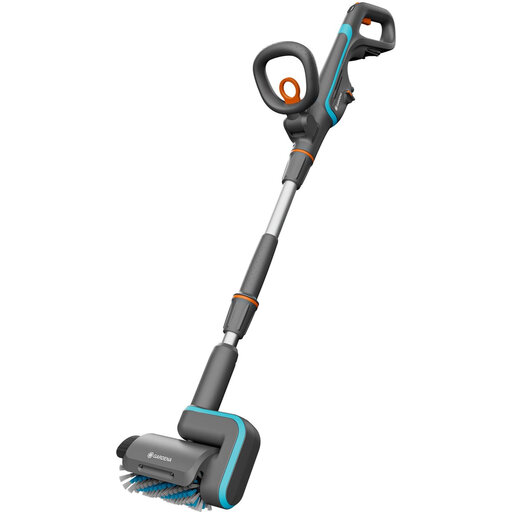
The rotating brush and telescopic extension tube are suited to cleaning jobs where you need extra reach.
The product name identifies this as a battery-powered model. Battery and charger are not included.
 No image available
The product name lists tiles as a suitable use and seven brush heads for different cleaning jobs. Check which head is right for your tiles.
The product information lists three speeds and an LCD screen. Do not immerse the main unit.
Don’t assume that a brush can be immersed just because it’s suitable for wet cleaning. Bosch DIY lists IPX5 splash protection for the UniversalBrush, while RYOBI lists IPX7 for the R18TPS-0. Follow the water and charging instructions for the exact version.
Follow the care instructions for the specific head. Bosch DIY says its standard and precision brushes are reusable and can be cleaned in a dishwasher at up to 50 °C. This doesn’t automatically apply to the motor, other parts or brushes from other brands.
Check that the CE marking and product information apply to the specific device and any mains charger. The Netherlands Food and Consumer Product Safety Authority explains that the Low Voltage Directive applies within certain voltage limits, and that other safety legislation may apply to products outside those limits. A CE marking doesn’t mean a brush can be immersed or is suitable for every type of tile.
Report the problem to the retailer. According to the Government of the Netherlands, there is no fixed statutory guarantee period in the Netherlands; if a product develops a problem, the retailer must provide a solution. Any manufacturer’s guarantee is in addition to this. Normal wear and tear or damage caused by misuse doesn’t automatically entitle you to a free repair.
For many online purchases from a business, the Government of the Netherlands says you have a 14-day cooling-off period. Check whether these rules apply to your purchase; according to the Government of the Netherlands, buying online from a private seller isn’t the same as a distance purchase.