
Hosts serving generously topped bites
You’re looking for a rusk that looks large enough to carry savoury or international toppings. Whether it can hold your topping is something you’ll need to judge from the product itself.


When choosing generously topped bites, don’t rely on the ‘thick cut’ label alone: without a thickness per piece or information about firmness, it tells you little about how well the rusk will hold your topping. Rusks described as large or robust are worth considering based on their shape; then choose according to the grain type, ingredients and allergens you want. Even a large rusk isn’t automatically suitable for heavy or wet toppings.
You’re looking for a rusk that looks large enough to carry savoury or international toppings. Whether it can hold your topping is something you’ll need to judge from the product itself.
You also want to choose based on grain type, seeds or fibre, without assuming that any of these make the rusk thicker.
Ingredients and allergens help determine which variety you can serve. So check the packaging of the exact rusk you choose.
First decide which feature matters most for your spread: the shape under the topping, the composition or the ingredients of the specific variety.
| What to consider | What to check when buying | Who is this most important for? |
|---|---|---|
| Shape for generous toppings | Look at the size and shape of the rusk. Don’t treat ‘large’ or ‘robust’ as a measure of thickness or firmness. | If I want to serve generously topped bites, the base needs to suit my topping and I don’t want to rely on the name alone. This question about the rusk base comes first for around 50% of consumers. |
| Grain type and seeds | Compare the ingredients and nutritional information per 100 g; assess the shape separately from the composition. | If you want to serve wholegrains or seeds, you may choose a variety for its composition. This takes priority for around 30% of consumers. |
| Ingredients and allergens | Read the current packaging for the variety you’ve chosen, including the allergen information and any ‘may contain’ statement. | If I need to take an allergen into account, the label is essential before I serve a rusk. This is the first concern for an estimated 20% of consumers. |
PLUS describes a seed variety as large and crisp, while Jumbo uses ‘Robust’ in a product name. On their own, these words don’t tell you the thickness of each piece or how well it will hold your topping.
Use the description to find options, then take a look at the rusk itself, especially if you’re planning to serve heavy or wet toppings.
Choosing seeds, wholegrains or fibre is about the composition; it doesn’t automatically tell you how easily the rusk will break.
Compare the composition if it matters to you, but assess the size and topping combination separately.
Seed varieties may contain ingredients such as wheat, sesame or egg. Albert Heijn points out that product information, including allergen information, can change.
Before buying and serving, check the ingredients and allergens on the packaging of the exact variety.
The product category alone won’t tell you which type of salt was used in the rusk you’re holding.
If this matters to your choice, check the ingredients list for the specific product.
Bolletje’s range includes Bakkers Beschuit, Echte Beschuit and varieties with seeds.
The own-label range includes plain, wholegrain and multiseed rusks, making it easy to compare different varieties.
As well as plain rusks, Jumbo’s range includes Robuust Beschuit Meergranen.
PLUS offers plain rusks and a luxury variety with seeds.
Goud Gebakken offers plain and wholegrain rusks as two easy-to-identify varieties.
These options include multiseed, wholegrain and classic rusks as possible bases for your spread. Assess each product individually to see whether its shape suits your toppings.
 Image unavailable
An option if you’re looking for rusks with seeds for your spread; decide for yourself whether the shape suits your topping.
Pack of 10. Check the ingredients and allergens on the packaging.
 Image unavailable
An option if you want to serve wholegrain rusks and decide for yourself which toppings will work best.
Pack of 13. The ‘wholegrain’ label doesn’t tell you anything about the thickness of each piece.
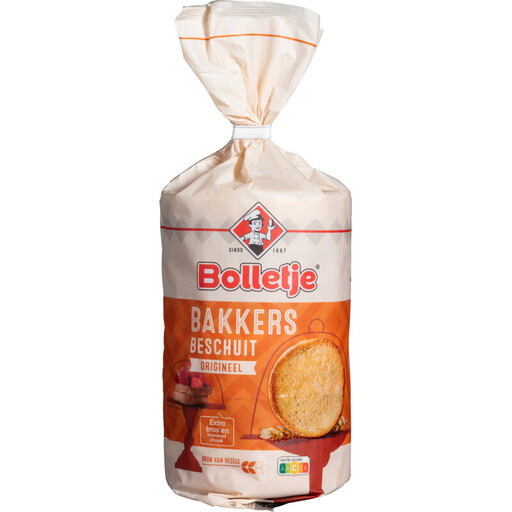 Image unavailable
A classic rusk variety if choosing the toppings is your priority; check the shape before serving it with heavy or wet toppings.
Pack of 10. Check the label on the packaging you choose for ingredients and allergens.
Check the allergens for the exact variety: wheat and sesame are relevant for the Bolletje multiseed variety described here, while the PLUS seed variety described here also contains egg. The Netherlands Food and Consumer Product Safety Authority says allergens must be clearly stated on the label, so read the current packaging, including any ‘may contain’ statement.
Store rusks in a dry place according to the instructions on the packaging, and add wet toppings shortly before serving. PLUS says its plain rusks should be protected from moisture and heat; always follow the packaging for your variety.