
If you want to purée straight in the pan
You’re making several portions of peas and want to purée them in the pan without transferring them first. The Consumentenbond recommends a stick blender for thicker mixtures.


For thick pea purée made in several batches straight in the pan, a stick blender is the most straightforward choice. A jug blender is better for a mixture with enough liquid that fits within the jug’s usable capacity, according to the Consumentenbond and Tefal. Always check the instructions for the exact model when blending hot purée. A soup maker is mainly worth considering if you also want to make soup; a thick soup programme doesn’t prove that it’s suitable for purée with almost no liquid.
You’re making several portions of peas and want to purée them in the pan without transferring them first. The Consumentenbond recommends a stick blender for thicker mixtures.
You’re making a runnier pea mixture and want to match the batch size to the jug’s usable capacity. The Consumentenbond says blenders are best suited to mixtures with enough liquid.
You’re looking for an appliance with soup programmes and want to know whether it can also handle your pea purée. Check the recipe and filling instructions for the exact model.
Best for: puréeing cooked peas straight in the pan, especially when the purée is thick.
Bear in mind: you operate the blender yourself and need to follow the model’s instructions.
Best for: a mixture with enough liquid and a batch that fits within the jug’s usable capacity.
Bear in mind: transferring the mixture and cleaning the jug are extra steps. Also check the instructions for using hot ingredients.
Best for: making soup as well as purée, using the programmes on your chosen appliance.
Bear in mind: a thick soup programme doesn’t confirm that the appliance is suitable for purée with almost no liquid.
| What to consider | What should you check? | Who is this important for? |
|---|---|---|
| Thick purée | Check whether you can purée straight in a suitable pan and what the manual recommends. The Consumentenbond considers a stick blender more suitable than a jug blender for thicker ingredients. | I want to purée the cooked peas in the pan rather than transfer them first. Around 36% of consumers who give pan puréeing as their main reason for buying are in this group. |
| Portions per batch | Compare your batch size with the usable capacity, not just the jug’s total capacity. Tefal states that the PerfectMix+ BL871D31 has a 2-litre jug with a usable capacity of 1.5 litres. | When making several portions, I want to know how much mixture will actually fit in the jug at a time. Around 29% of consumers who mainly consider portion size are in this group. |
| Texture and liquid | Decide whether your recipe is runny enough for a jug blender. Follow the instructions for the exact model when using hot ingredients. | If a smooth texture matters to me, the amount of liquid in my recipe is also a factor. Around 21% of consumers who prioritise smoothness with a runnier mixture are in this group. |
| Making soup | Check that the appliance and filling instructions suit your recipe. A thick soup programme doesn’t confirm that the appliance is suitable for purée with almost no liquid. | I want to combine soup-making with puréeing, so I check what the appliance can do. Around 14% of consumers who give making soup as their main reason for buying are in this group. |
According to Tefal, the PerfectMix+ BL871D31 has a 2-litre jug, of which 1.5 litres is usable. If you only consider the total capacity, your batch may not fit all at once.
Compare the amount you want to blend at a time with the usable capacity of the exact jug.
A smaller usable capacity may mean extra blending batches and more frequent washing-up.
Permitted ingredients and temperatures can vary from model to model. A heat-resistance claim for one appliance doesn’t tell you what another model can handle.
Before blending hot purée, check the manual for the full model number.
A thick soup programme doesn’t confirm that the appliance can handle pea purée with almost no liquid.
Check your pea recipe against the appliance’s ingredient and filling instructions.
The ErgoMaster Serie 4 MSM4B610 is a stick blender for anyone who wants to blend straight in a pan.
The PerfectMix+ BL871D31 is a jug blender for larger mixtures with enough liquid.
The MultiQuick 9 MQ 9187XLI combines a stick blender with a purée attachment and food processor accessories.
The SoupMaker HR2203/80 is an option if making soup is just as important as blending.
These product picks include stick blenders for making pea purée straight in the pan, plus a jug blender for a runnier mixture.
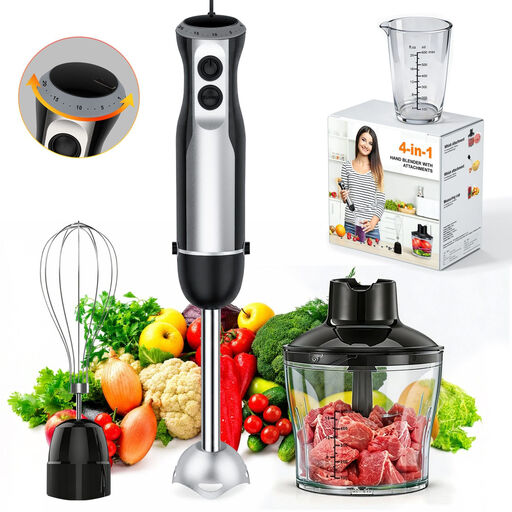 No image available
A stick blender for anyone who wants to purée cooked peas straight in a suitable pan, without transferring them to a jug.
The product name lists 1000 W, four functions, 20 speeds and a turbo setting. The product description also mentions a chopper and measuring beaker.
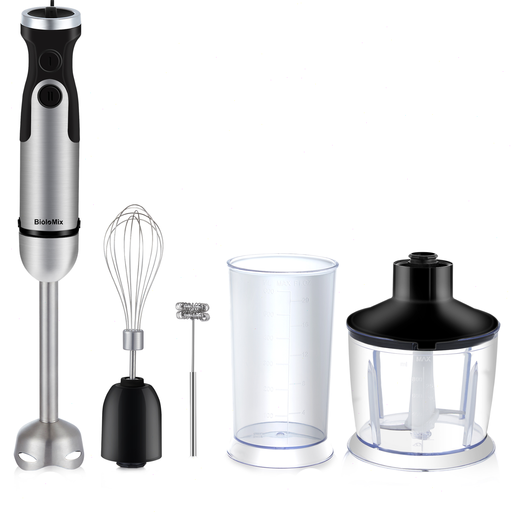 No image available
A hand blender for anyone who wants to purée peas in a suitable pan and use the other included attachments too.
The product name lists 1200 W, six speeds and a turbo setting. The product description also mentions blending, whisking and chopping.
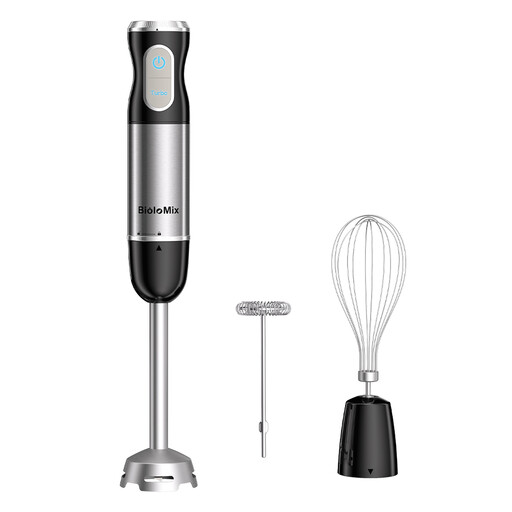 No image available
A hand blender for anyone who wants to purée peas in a suitable pan and detach the blending foot after use.
The product name lists a detachable design, splash protection and use with different types of bowls and containers.
 No image available
A stick blender for puréeing straight in the pan, without transferring the mixture, with attachments for a range of tasks.
The product description lists up to 1200 W, 15,000 rpm, a 700 ml beaker, a 500 ml chopper and a whisk. The instructions say to use the appliance for no more than 1 minute at a time, followed by a 1-minute rest.
 No image available
A jug blender for a pea mixture with enough liquid. Bear in mind that you’ll need to transfer the mixture and follow the instructions for ingredients.
The product description lists a working capacity of 1.5 litres, three speeds, a pulse function and removable blades. The instructions say to add liquid first and not to process ingredients hotter than 80 °C.
No. Check the instructions for the exact model before blending hot purée. The Consumentenbond mentions a heat-resistant jug for soup; Philips specifies cold or room-temperature ingredients for certain vacuum blenders. That Philips instruction applies to the models named, not to every Philips blender.
Don’t leave leftovers out of the fridge for more than 2 hours. This is the advice given by the Voedingscentrum for leftovers.
If a product doesn’t do what you can reasonably expect when used normally, the retailer is responsible for providing a suitable solution. Under Dutch consumer law, the legal guarantee applies alongside any manufacturer’s guarantee and has no fixed, general time limit, according to ACM ConsuWijzer and the Netherlands Authority for Consumers and Markets.
No. Electrical appliances covered by European rules must meet the relevant conformity requirements to be sold in the Netherlands, which includes CE marking. Business.gov.nl stresses that CE is not a quality mark. So the mark doesn’t tell you how smooth an appliance will make your pea purée.