
Vandaag of morgen in huis

Kwaliteit gegarandeerd

Welkomstaanbiedingen ontgrendelen: GRATIS bezorging | Tot 80% korting | Gratis 30 dagen JoyPlus-proefperiode
Download de app
A gilet may seem simple: choose a colour, select your usual size and place your order. Yet many disappointing purchases are caused by an unsuitable fit, insufficient protection from the wind or an insulation layer that is not suitable for active use. Anyone searching for a The North Face Thermoball men's gilet will usually want warmth without a bulky coat, along with enough freedom of movement for walking, travelling or everyday wear.
So do not focus solely on the brand name. Pay particular attention to the construction, sizing and protection against moisture. Below, you will find what to look out for and which variants suit different situations.
A DWR finish can help light rain or moisture bead off the surface. That does not automatically mean that a gilet is suitable for prolonged rain. The NF0A8DY6 is listed as having a Non-PFC DWR finish. According to the product description, this is intended to provide protection against light moisture.
For heavy rain, you will still need a separate waterproof outer layer. For example, wear the Thermoball gilet under a rain jacket when the weather changes.
A fully padded gilet can be warm, but may also start to feel too hot quickly during brisk walking or training. According to the product description, the NF0A8DY6 combines Thermoball synthetic insulation on the chest and back with breathable side panels. This is a hybrid construction: extra warmth around the body and greater flexibility at the sides.
So check where the insulation is located. An insulated gilet with breathable panels may be more practical for changing activities than a model with one thick layer of insulation across the entire surface.
Sizes vary between brands, models and fits. The stated chest measurement for this model ranges from 33–35 for XS to 52.5–56 for 3XL. The product information also lists hip measurements and arm lengths. These measurements appear to be given in inches in the supplied chart, so always check the unit of measurement on the product page before ordering.
Measure your chest at its widest point and compare it with the chart. If you want to wear the gilet over a fleece or jumper, allow extra room. A gilet that is too tight restricts freedom of movement and can reduce the effectiveness of the insulation.
The Thermoball insulation in the chest and back panels is synthetic. According to the product description, it is designed to provide warmth in damp conditions. Synthetic filling is practical for many walkers because it does not require the same care as some natural insulation materials.
Please note: the level of warmth also depends on your base layer, fleece, activity level and the outdoor temperature. A lightweight warm gilet is primarily a versatile mid-layer, not a replacement for a winter coat in all conditions.
According to the product specifications, the outer fabric consists of 91% polyester and 9% elastane. The elastane provides stretch in the fabric, which is useful when cycling, walking with poles, climbing or doing strength training. The side panels are designed to support flexibility and ventilation.
According to the product description, a FlashDry gilet is marketed with moisture-wicking properties. This is presented as a product feature rather than a guarantee: user experiences may vary depending on intensity, the clothing worn underneath and the weather conditions.
The black NF0A8DY6 has a Non-PFC DWR treatment. DWR stands for Durable Water Repellent and is a finish applied to the outside of the fabric. This treatment is not the same as a waterproof membrane. Over time, check whether water still beads off the fabric and follow the washing instructions on the label.
For everyday use in the Netherlands, the combination of light insulation and limited moisture protection is suitable for dry, cool weather and short showers. In prolonged rain or strong winds, combine the gilet with a suitable jacket.
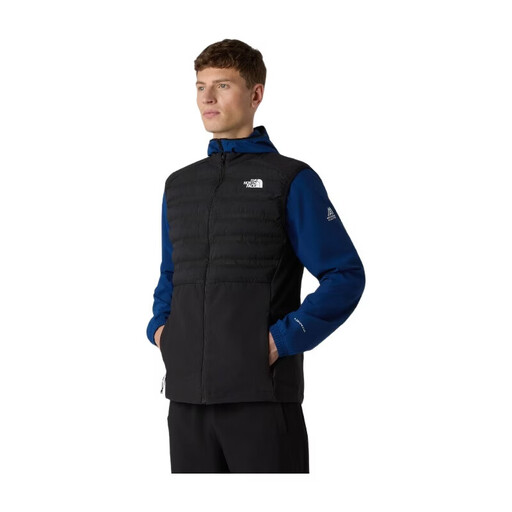
Why it suits this profile: M is a practical starting size for anyone looking for a black men's gilet for walking, commuting and everyday wear. Check your chest measurement in the size chart first.
The product information specifies both Thermoball insulation and breathable side panels, rather than simply making a general claim about warmth.
91% polyester and 9% elastane; black colour; synthetic insulation on the chest and back.
Why it suits this profile: L provides room for layers and is suitable for longer walks, travelling and everyday wear in colder conditions, provided the chest and hip measurements are right.
The stretchy outer fabric helps prevent a restrictive fit. The DWR finish is clearly described as protection against light moisture, rather than complete waterproofing.
Sizes XS to 3XL; Thermoball insulation; non-PFC DWR according to the product description.
Why it suits this profile: XL is intended for users who need extra room for layers, training or a broader chest. Measure yourself rather than relying solely on your usual clothing size.
The product description mentions FlashDry fabric, side panels and 9% elastane. These provide more specific guidance for active use than simply calling it an outdoor men's gilet.
XL chest measurement 44.5–48 according to the chart; synthetic insulation; stretch in the woven outer fabric.
We have compiled a complete, up-to-date list of products that fully meet these strict selection criteria and the applicable European safety regulations.
Always follow the care label on the garment. For the NF0A8DY6, the product information includes the following:
Frequent washing with harsh products can place unnecessary strain on the fabric and water-repellent finish. Store the gilet in a dry place and avoid compressing the insulation for prolonged periods.
The product description specifies a Non-PFC DWR finish for light moisture. This makes it a water-repellent gilet for limited rainfall, not automatically a fully waterproof garment. A waterproof jacket is required in persistent rain.
Measure your chest and hips and compare both measurements with the size chart on the product page. If you plan to wear it over several layers, do not choose a size that is too tight. If in doubt, your exact body measurements are more important than your usual T-shirt size.
According to the product description, FlashDry fabric, breathable side panels and 9% elastane are intended to support moisture management and freedom of movement. Whether the level of warmth is suitable depends on your exertion and the outdoor temperature. For running or intensive training, a thin base layer may be sufficient; for gentle walking, an additional fleece may be more practical.
