
Map-makers who want a quiet workspace
You’re creating a terrain map in a quiet room and want a keyboard with a quiet key feel. Treat a description such as ‘quiet’ as a product claim, not a sound measurement.


Start with how you work: choose a full-size keyboard if you enter numbers often, or a more compact model if having space for your mouse matters more. Then compare the key feel, layout and connection. Descriptions such as ‘quiet’ are not comparable sound measurements.
You’re creating a terrain map in a quiet room and want a keyboard with a quiet key feel. Treat a description such as ‘quiet’ as a product claim, not a sound measurement.
You regularly enter figures while working on maps and want to weigh up whether a built-in numeric keypad matters more than extra space for your mouse.
You spend long periods working with mapping software and a mouse in a limited workspace. Width, key feel and connection are all worth considering when you choose.
First decide whether quiet keystrokes, number entry or space beside your mouse matters most to you. Then check the layout and connection of the exact model.
| Feature to consider | What should you check? | Who will find this most important? |
|---|---|---|
| Key noise | Compare the key feel and, for a mechanical model, check which switch type you’re choosing. | If I work in a quiet room, I want to know what the keys sound like rather than relying solely on a product claim. Around 36% of consumers prioritise quiet keystrokes above all else. |
| Number entry | Check whether the model has a numeric keypad and how much space the keyboard and mouse take up together. | If I enter figures often, a built-in numeric keypad may be more useful than a narrower keyboard. Around 29% of consumers put number entry first. |
| Workspace and key feel | Compare the width and, where possible, try the key feel to see if it suits your workspace. | If my desk is small, I want to be able to use my mouse comfortably beside the keyboard during longer work sessions. Around 21% of consumers focus mainly on workspace and comfort during extended use. |
| Connection and layout | Check the physical key layout, available connection and any software for customisable keys. | If I want to connect a keyboard or switch between devices, the model needs to suit my computer and the way I work. For around 14% of consumers, connection, layout or switching between devices is the main consideration. |
Trust, CHERRY and Logitech describe certain keys or switch types as quiet, but these product claims are not based on a shared sound measurement that lets you compare models under the same conditions.
For a mechanical keyboard, check the exact switch type. If possible, try the key feel for yourself before choosing based on the description.
A compact model leaves more room for your mouse, but may not have a built-in numeric keypad. If you enter lots of figures for your mapping work, this could make a difference.
Think about how often you type numbers before choosing between a compact and a full-size keyboard.
If you later find that you need a numeric keypad, a separate one can be a practical addition.
The Trust Ody II is available as a standalone keyboard or as a keyboard and mouse set. The Joybuy listing for the standalone keyboard describes it as having a US QWERTY layout.
Compare the full product name, what’s included in the box and the layout shown with what you’re looking for.
That way, you won’t end up with a mouse you don’t need or a layout that doesn’t suit you.
The Ody II is a wireless keyboard with a USB receiver. Trust describes its keys as quiet and its design as low-profile.
The wired STREAM KEYBOARD is an option if you’re looking for a slim keyboard with a scissor mechanism. The STREAM KEYBOARD ULTIMATE is a separate model.
According to Logitech, the MX Keys S has customisable features; the compact MX Mechanical Mini is available with several mechanical switch types.
The Compact Break is designed for a more compact desk set-up and, according to the product description, has a light scissor mechanism and a break indicator.
This selection includes compact keyboards, a model with a numeric keypad and a keyboard and mouse set to suit different desk set-ups.
 No image available
A compact, wired model that leaves room for mouse movement.
TKL size with no numeric keypad; USB connection and US QWERTY layout.
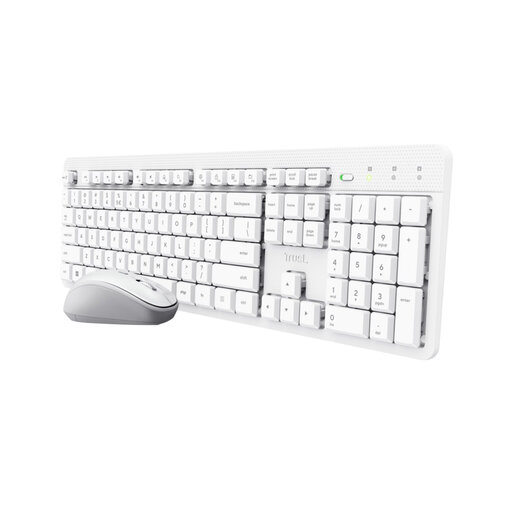 No image available
A wireless set for anyone looking for a mouse as well as a keyboard.
The product description mentions quiet keys, an adjustable typing angle and a single USB receiver. This set includes a mouse and has a US QWERTY layout. The description ‘quiet’ is not a sound measurement.
 No image available
A compact wired model for anyone who wants to keep space free beside the keyboard.
The product description mentions membrane keys and an adjustable stand. TKL size with no numeric keypad; USB connection and US QWERTY layout. ‘Quiet’ keys is a product description, not an independent measurement.
 No image available
A foldable option if you’re looking for a compact keyboard with a built-in touchpad.
63 keys; Bluetooth and a built-in touchpad. The product description says it supports iOS, Android and Windows.
 No image available
A full-size keyboard to consider if you regularly enter figures while working on maps.
Numeric keypad, QWERTY layout and plug-and-play wired connection. The layout described is not a German QWERTZ layout.
No. The QGIS manual describes terrain analysis as a software task using a digital elevation model, not as something that requires a special keyboard. Choose customisable features only if they suit the way you work.
Check the connection and physical key layout of the exact model. According to Trust, the Trust Ody II uses a USB receiver. If the keys produce different characters from the ones you expect, Trust also advises checking your system’s input language.
For eligible online purchases from a business, the Government of the Netherlands says you generally have a 14-day cooling-off period. If a product is faulty, the Government of the Netherlands says the seller is the point of contact for a solution.
Not for every private map-maker. Arboportaal states that for employees who work at a screen for more than 2 hours a day, the screen and keyboard must not be attached to each other. This workplace requirement is not a general product specification for all buyers.