
Vandaag of morgen in huis

Kwaliteit gegarandeerd

Welkomstaanbiedingen ontgrendelen: GRATIS bezorging | Tot 80% korting | Gratis 30 dagen JoyPlus-proefperiode
Download de app
A teppanyaki grill is ideal for cooking meat, fish, vegetables, eggs and pancakes at the table. However, some purchases can be disappointing. The plate may turn out to be too small for four people, fail to heat evenly enough or be difficult to clean because the cooking plate cannot be removed.
The main pitfalls usually lie not in the appearance, but in the combination of size, temperature control, power and coating. Use the points below to compare an electric teppanyaki grill based on practical features rather than marketing claims.
A long teppanyaki cooking plate may look appealing, but the wattage also indicates how quickly the plate heats up and how well it can replenish heat while cooking. With a large surface, low power can result in longer preparation times and less space for cooking several ingredients at once.
Bear in mind that the stated wattage is the maximum electrical power. A 2,300-watt appliance does not necessarily use its full power throughout the entire cooking session. The thermostat switches the heating element on and off.
A grill plate with a non-stick coating will generally prevent ingredients from sticking quickly, but “non-stick” on its own says nothing about the substances used. If you specifically want a PFAS-free grill, check that this is explicitly stated in the product specifications.
PFAS-free is listed as a product specification for the Fritel GT 1075 and GT 1375. For the other models in this article, only a non-stick coating is mentioned. Do not therefore draw any further conclusions from this.
For any coating, it is best to use wooden, silicone or plastic spatulas. Metal utensils can damage the cooking surface.
A fixed cooking plate can be convenient while cooking, but less practical afterwards. Check whether the plate, drip tray or thermostat can be removed. An electric grill plate must never be fully immersed in water. Clean the electrical section with a slightly damp cloth after unplugging the appliance and allowing it to cool down.
For one or two people, a compact grill plate for 2 people is often sufficient. A surface of around 28 × 20 cm takes up less storage space, but you may need to cook ingredients in batches.
A plate measuring approximately 48 × 20 cm offers more working space for two to three people. For a family or larger group, an XXL size of 70 × 22 cm or more makes more sense. Also check the depth of your table and the space around the appliance. A hot table grill should be stable and positioned well away from the edge of the table.
A grill plate with adjustable temperature is more versatile than a model with only on/off control. Five settings are practical for a wide range of ingredients. A continuously variable thermostat offers even finer control, for example when cooking delicate fish or slow-cooking food.
A plancha grill with a smooth surface is suitable for eggs, vegetables, fish and pancakes. A ridged section can create grill marks on meat or vegetables. Some appliances combine both zones, while a traditional teppanyaki is usually completely smooth.
Power is shown in watts. Theoretically, a 1,360-watt appliance uses a maximum of 1.36 kWh per hour when the heating element is active continuously. A 2,300-watt model theoretically uses 2.3 kWh per hour. In practice, consumption is often lower because of the thermostat control.
For regular use, a fast-heating plate, a suitable size and even heat distribution are more important than simply choosing the highest wattage.
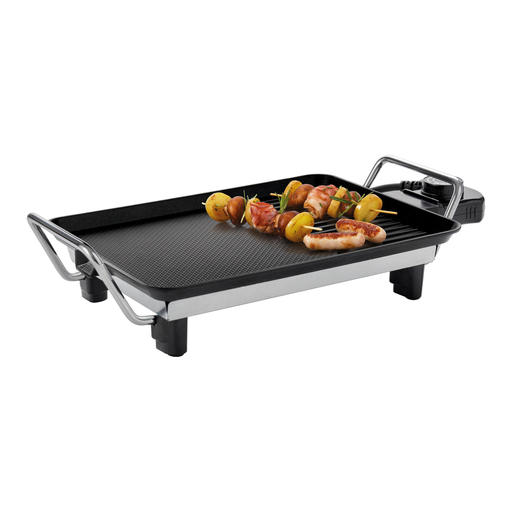
Why it suits this profile: This compact model is designed for one or two people and has a cooking surface of 28 × 20 cm. With 1,000 watts and five temperature settings, it is suitable for simple meals in a small kitchen or when travelling.
The number of users and the size are clearly specified. A PFAS-free cooking plate is also stated, rather than just a general non-stick claim.
Compact size, removable thermostat, five settings and a combination of smooth and ridged zones.
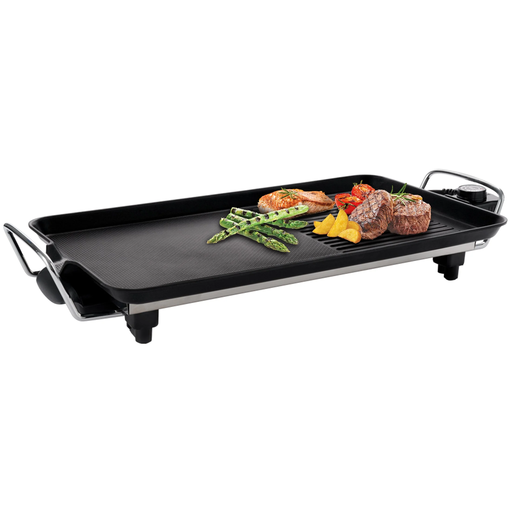
Why it suits this profile: The 48 × 20 cm plate is designed for two to three people. The combination of 1,360 watts, five settings and two cooking zones provides space for different ingredients during a meal.
The surface area, capacity and power are clearly stated. The PFAS-free specification means you do not have to rely solely on the term “premium non-stick coating”.
Two-thirds smooth teppanyaki zone, one-third ridged grill zone, fat drainage and cool-touch handles.
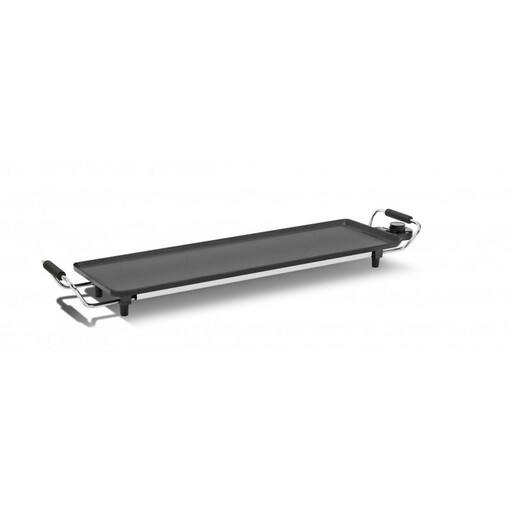
Why it suits this profile: With a cooking surface of 70 × 22 cm, this model is designed for three to six people. It is ideal for families and those who enjoy dining together and want to prepare several ingredients at once.
The generous surface prevents a large group from having to cook in small batches. A removable drip tray makes cleaning easier.
XXL surface, adjustable thermostat, removable drip tray and suitable for indoor and outdoor use.
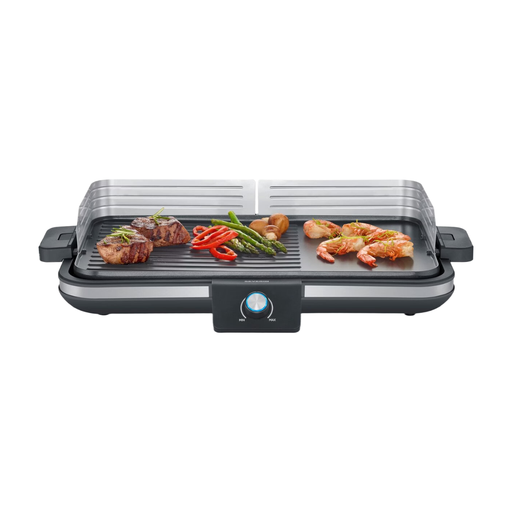
Why it suits this profile: This plancha grill has a surface area of 1,500 cm² and 2,300 watts of power. The continuously variable temperature control up to 230 °C gives you greater control over different cooking methods.
The large surface is combined with a high stated wattage and continuously variable control. The removable plate and drip tray reduce the cleaning required.
Continuously variable temperature up to 230 °C, 2,300 watts, drip tray and parts that are dishwasher-safe according to the product specifications.
We have put together a complete, up-to-date list of products that fully meet these strict selection criteria and the applicable European safety regulations.
An electric teppanyaki is suitable for indoor use when placed on a flat, heat-resistant surface with sufficient ventilation. Keep curtains, paper and tea towels away from the appliance. Outdoors, use it only in dry weather and with a suitable earthed socket. An outdoor socket must also have appropriate protection.
Do not leave the grill unattended while it is switched on. The plate, drip tray and steam can remain hot even after the appliance has been switched off. Unplug it, allow everything to cool down completely, and only then remove the thermostat or cooking plate.
Yes, an electric teppanyaki is generally designed for indoor use, provided you place it on a stable, heat-resistant surface and ensure good ventilation. Cooking fatty meat can produce smells or smoke, so an extractor fan or open window may help.
Its lifespan depends on how it is used, cleaned and stored. Avoid metal spatulas, abrasive sponges and overheating the plate without ingredients on it. Follow the manufacturer’s instructions and replace the appliance when the plate becomes visibly damaged or food keeps sticking to it.
This depends on the wattage, heating time, cooking duration and your electricity tariff. For a 1,360-watt appliance, theoretically allow for a maximum of 1.36 kWh when heating continuously for one hour. Actual consumption is often lower because of the thermostat control. As well as looking at the wattage, consider the preparation time and the size you genuinely need.
