
Vandaag of morgen in huis

Kwaliteit gegarandeerd

Welkomstaanbiedingen ontgrendelen: GRATIS bezorging | Tot 80% korting | Gratis 30 dagen JoyPlus-proefperiode
Download de app
A teppanyaki grill is handy for cooking meat, fish, vegetables, eggs and pancakes without having to fire up a large barbecue. However, electric griddles vary considerably in size, temperature control and ease of cleaning. A compact griddle may be ideal for two people, but impractical for a family dinner. An XXL model, on the other hand, takes up more space and often uses more electricity.
As Joybuy Product Recommendation Officer, I focus on the key product specifications so you can compare marketing claims with features that are actually listed in the product information.
Higher wattage does not automatically mean a griddle is better suited to your needs. The wattage tells you something about its power consumption and heating potential, but not about the usable cooking area or how evenly it distributes heat. For example, an electric teppanyaki grill rated at 2,300 watts may offer plenty of cooking space, while a smaller 1,000-watt model is easier to store and may be enough for two people.
Always check the usable cooking area, not just the overall dimensions. A wide body may still have a relatively small cooking surface. For a couple, a griddle for two is often more efficient. For a family or group, models around 70 to 90 cm wide are more versatile.
Remember to consider storage space, too. A long griddle will not necessarily fit in a kitchen cupboard or on a narrow camping table.
A non-stick griddle is generally easier to clean, but its coating can still be damaged by metal spatulas, knives and scouring pads. Also check whether the griddle, drip tray and thermostat can be removed. A detachable control unit must not get wet or be submerged.
If you are considering a PFAS-free griddle, it is worth checking the exact product listing. “PFAS-free” and “PTFE-free” are not automatically interchangeable. Check the specifications for the individual model rather than relying on a general description of the product category.
Use this practical guide:
A longer griddle is not necessarily more convenient. Check that your table is stable and heat-resistant, and that there is enough clear space around it.
A fixed temperature gives you less control when cooking different ingredients. An adjustable thermostat with several settings is more practical for delicate fish, vegetables and meat, for example. Some models have five settings; others offer stepless adjustment up to a stated maximum temperature.
An electric griddle with a detachable thermostat is also easier to clean, but only if you remove the control unit completely before cleaning.
A smooth teppanyaki griddle is suitable for eggs, fish, vegetables and marinated ingredients. A ridged section can leave grill marks and help fat drain away from certain ingredients. A combination of both surfaces offers more versatility than an entirely ridged griddle.
Also look for a drip tray or pouring spout. This helps prevent fat from collecting around the heating element and makes it easier to empty after use.
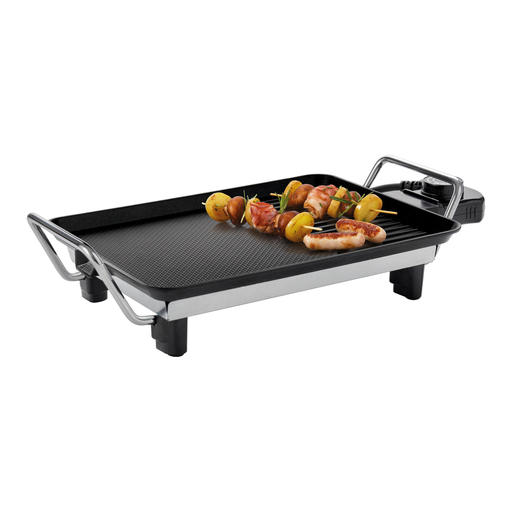
Why it suits this profile: The compact 28 × 20 cm griddle is designed for one to two people and takes up little space on the table or when travelling.
The product specifications list a detachable thermostat with five settings, a PFAS-free label and a pouring spout for fat. This means you can see what you are getting in advance, rather than focusing on wattage alone.
1,000 watts, a 2 mm aluminium griddle, smooth and ridged sections, and handles that remain cool according to the product information.
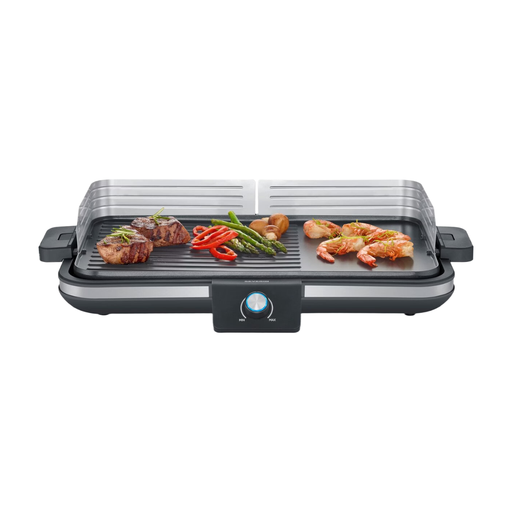
Why it suits this profile: This plancha grill combines a large cooking surface with stepless temperature control and a design geared towards regular use.
The griddle has an integrated drip tray and detachable parts. That makes cleaning more straightforward than with a model where fat ends up on the worktop.
2,300 watts, a 1,500 cm² cooking surface, temperature control up to 230 °C and a ceramic coating, according to the product description.
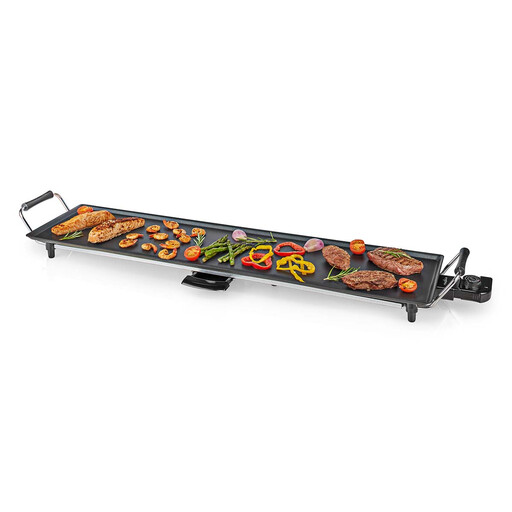
Why it suits this profile: The extra-long griddle is practical for entertaining, serving several courses or cooking ingredients at the same time.
The dimensions and five heat settings are clearly listed. This helps you judge whether the griddle will fit on your table and whether the controls suit the way you cook.
90 × 23 cm cooking surface, 1,800 watts, a detachable drip tray and a removable power cord.
We’ve put together a complete, up-to-date list of products that meet these strict selection criteria and the applicable European safety regulations.
A tabletop grill for indoor and outdoor use should always be placed on a flat, heat-resistant surface. Outdoor use does not automatically mean the appliance is waterproof. Do not use an electric grill in the rain, and check that any outdoor socket is suitable and protected.
If you are camping, pay attention to the wattage. A 2,300-watt model may draw too much power at some campsites or from certain connections. Only use an extension lead suitable for the stated wattage. Do not leave the grill unattended while it is heating up or cooking.
Let the griddle cool completely before moving it. Remove the thermostat or cable as instructed in the manual, and do not use metal utensils on the non-stick coating.
Yes, electric models are generally designed for use on a table or kitchen worktop. Make sure the room is ventilated, keep the grill away from curtains and other flammable materials, and place it on a heat-resistant surface. A grill can still produce smoke or vapour, especially when cooking fatty meat.
It depends on the usable cooking area and the type of food you are preparing. A griddle measuring around 28 × 20 cm is practical for one to two people. Medium-sized models are more convenient for families. A 70 to 90 cm griddle has room for several diners, but also needs more table space.
The cost depends on the wattage, preheating time and actual cooking time. A 2,000-watt appliance theoretically uses 2 kWh if it heats continuously at full power for one hour. In practice, a thermostat often switches the heater on and off. Multiply the energy use in kWh by your current electricity tariff to estimate your own costs.
