
Housemates who regularly have damp tea towels
If you share a kitchen, it helps to have somewhere to hang used towels separately. The Netherlands Nutrition Centre advises using clean hand and tea towels, and washing used ones.


A heated rack is most useful if housemates regularly want to dry several tea towels at once and have a suitable spot with ventilation and a safe electrical connection. For just a few towels, or if energy use and storage space are bigger concerns, a regular rack may be enough. Heating is no substitute for washing or ventilation.
If you share a kitchen, it helps to have somewhere to hang used towels separately. The Netherlands Nutrition Centre advises using clean hand and tea towels, and washing used ones.
If you share a floor area or walkway, it’s important to consider the rack’s dimensions when in use and whether you can put it away afterwards.
If you want to limit heating, consider whether you need an electric rack or whether the towels can dry on a regular rack in a well-ventilated spot. Milieu Centraal highlights the importance of ventilation at home.
First, decide whether you need a heated rack. Then compare how much space it takes up, the ventilation available and how easy it is for housemates to use.
Choose this if: you regularly dry a few towels at once and have limited space.
Consider: heating uses electricity and doesn’t remove the evaporated moisture.
Choose this if: you’ll also use the rack for other laundry and have room to set it up while it’s in use.
Consider: a larger rack may take up more of the shared floor space when unfolded.
Choose this if: the towels can dry without heat and you have somewhere to ventilate the damp air.
Consider: the rack doesn’t need electricity, but drying may take longer.
| What to consider | What to look for | Who is this important for? |
|---|---|---|
| Drying towels separately | Check whether you can hang several towels fully open with space between them; the number of rails alone won’t tell you. | If housemates want to hang used towels separately and replace them before washing, around 25% of consumers consider this their main priority. |
| Space at home | Measure the space with the rack unfolded and check whether you can put it away after use. | If you share a kitchen or walkway, you’ll want to avoid the rack getting in the way; around 20% of consumers put the space needed to set up and store the rack first. |
| Moisture and ventilation | Choose a spot where damp air can be ventilated; heating doesn’t remove moisture from the room. | If drying indoors adds moisture to the air, a well-ventilated spot is important; around 20% of consumers give this top priority. |
| Shared use | Check the controls, cable route and instructions in the manual for the specific model. | If several housemates use the rack, it’s important to agree where to put it and when to switch it on and off; around 20% of consumers prioritise safe, predictable use. |
| Energy use | Compare the stated power rating with how long you plan to use it; a regular rack doesn’t use electricity. | If fast drying isn’t essential, a heated rack may be less appealing than one that doesn’t use electricity; around 15% of consumers place the greatest importance on energy and running costs. |
Drying and washing are two different things. The Netherlands Nutrition Centre advises washing used tea towels.
Agree at home when towels should be replaced and washed; use the rack to hang them up.
Even when you use a heated rack, evaporated moisture enters the indoor air. Milieu Centraal highlights the importance of adequate ventilation.
Before buying, check that the spot where you plan to dry the towels is well ventilated.
The stated power rating doesn’t tell you how quickly tea towels will dry. And when unfolded, a rack may take up more floor space than its folded dimensions suggest.
Compare the dimensions when in use, the hanging space and the cable route with the spot where you plan to put the rack. Follow the manual for the exact model.
The DOMO DO7117DR is a slim heated rack which, according to the manufacturer, can be freestanding or wall-mounted using the supplied kits.
Adler offers folding heated racks, among other products, for anyone who also wants to hang up other laundry.
The model number X25I00F028 appears on a product listing for a folding heated winged airer.
Brabantia also offers unheated drying racks, such as the folding HangOn model.
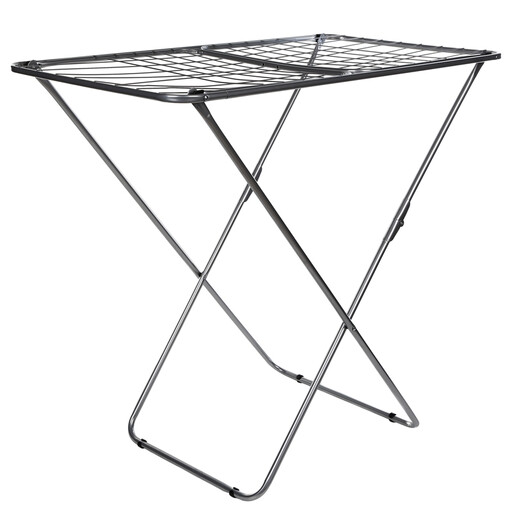
A drying rack for hanging tea towels indoors to air-dry.
 No image available
A drying rack for anyone who wants to hang tea towels indoors and put the rack away after use.
The product description lists 18 m of drying space and says the rack is easy to set up and store away.
No. The Netherlands Nutrition Centre advises using clean hand and tea towels, and washing used ones. A heated rack is no substitute for washing.
Yes. Ventilating damp air is important even when drying indoors. Milieu Centraal points out that inadequate ventilation can contribute to damp problems.
Multiply the power rating in kilowatts by the time in hours. At the constant power rating of 150 W that DOMO lists for the DO7117DR, two hours works out to 0.30 kWh; actual consumption depends on the appliance and how you use it.
Follow the manual for the specific model and keep the cable out of walkways. The Fire Service warns that a coiled cable reel can get hot; also follow the instructions for connecting the appliance.
An electrically heated consumer product offered for sale in the Netherlands must carry the applicable CE marking. The Netherlands Food and Consumer Product Safety Authority (NVWA) states that testing isn’t routinely required for all consumer products; a CE mark alone isn’t proof of an independent product test.