
Household with a pile of kitchen laundry
After a busy school week, you may want to spread out several clean tea towels at once. Look at the number of usable hanging spaces and how much room the airer takes up when fully opened.


A heated airer is worth considering if you want to hang several clean tea towels at once and extra warmth suits your drying space. If you have time and good ventilation, an unheated airer may be enough. A compact towel rail is an option for a few towels, while a folding airer with wings offers more hanging space but takes up more room when in use. Drying doesn’t replace washing or ventilation; if you choose an electric airer, also check the model-specific placement instructions and the applicable CE marking.
After a busy school week, you may want to spread out several clean tea towels at once. Look at the number of usable hanging spaces and how much room the airer takes up when fully opened.
If you usually dry just a few towels, a compact airer may be more practical than a wide model. Check that your chosen set-up fits the floor or wall space you have available.
If your laundry doesn’t need to dry quickly, you can weigh up an unheated airer against an electric model. Milieu Centraal recommends drying laundry on a washing line where possible; when drying indoors, remember to consider ventilation too.
Choose this if: you can spread out your clean tea towels without rushing and have a well-ventilated place to dry them.
Bear in mind: the airer itself doesn’t use electricity, but towels drying indoors release moisture into the air. Milieu Centraal therefore recommends paying attention to ventilation.
Choose this if: you mainly want a dedicated place for a few towels and the freestanding or wall-mounted set-up suits your space.
Bear in mind: it offers less hanging space than a wide winged airer and uses electricity. DOMO lists a timer and 150 W among the specifications for the DO7117DR, but this doesn’t establish a drying time.
Choose this if: you want to spread out several towels at once after the school week and have room for the airer when it’s fully opened.
Bear in mind: the floor space it needs when in use and its electricity consumption. Adler lists 18 heating elements and 220 W for the AD 7821, but that doesn’t determine how long drying will take in your circumstances.
Choose an airer to suit the number of clean towels, the space available and the ventilation in your drying area.
| Concern | What to look for when buying | Who is this most relevant to? |
|---|---|---|
| Spreading out several towels | Check the number of rails and the dimensions when the airer is fully opened. | After a busy week, I want to spread out several clean towels at once without overlapping them. Around 36% of consumers prioritise having room for a pile of kitchen laundry. |
| Drying clean towels | Check whether the towels can hang separately and whether you can spread them out properly after washing. | I want to wash used tea towels and then hang them up clean, ready to use again. Around 29% of consumers put drying clean tea towels at the top of their list. |
| Space while in use and in storage | Compare the dimensions when opened and folded, and check the instructions for your intended placement. | If the airer needs to be put away after use, I want to know whether it fits in my home both while drying and when folded. Available space is the main concern for around 21% of consumers. |
| Electricity use and indoor moisture | Compare the stated wattage and how long you expect to use it; also consider how you can ventilate the room. | When drying indoors, I want to weigh up the extra electricity use against sufficient drying time and ventilation. Around 14% of consumers mainly prioritise electricity use and indoor moisture. |
Drying and washing serve different purposes. Voedingscentrum recommends using clean tea towels, washing used ones and hanging up wet towels.
Wash used tea towels, then use the airer to dry clean ones.
Heat doesn’t automatically remove water vapour. Milieu Centraal warns that excess moisture can cause mould.
Assess the ventilation in your drying area, whether you choose a heated or unheated airer.
Protection ratings and placement instructions vary by model; a rating for one airer doesn’t automatically apply to another.
Follow the instructions for the exact model and check that your intended location meets them.
The stated wattage alone doesn’t tell you how much electricity a drying session will use or how long it will take. An unheated airer doesn’t use electricity itself.
Weigh the wattage against how long you’ll use the airer, and don’t opt for extra heat if your available drying time allows.
Adler offers folding electric airers; the AD 7821 is one option for drying several small items of laundry.
According to DOMO, the DO7117DR can be used freestanding or mounted on a wall.
The MEQ-EL8980/002 is described as a compact electric towel rail for a few towels.
Leifheit also offers unheated airers for those who don’t need active heating.
This product selection includes wall-mounted options and freestanding airers, including models explicitly described as electrically heated. Compare the mounting type, the space available and the instructions for your intended drying area.
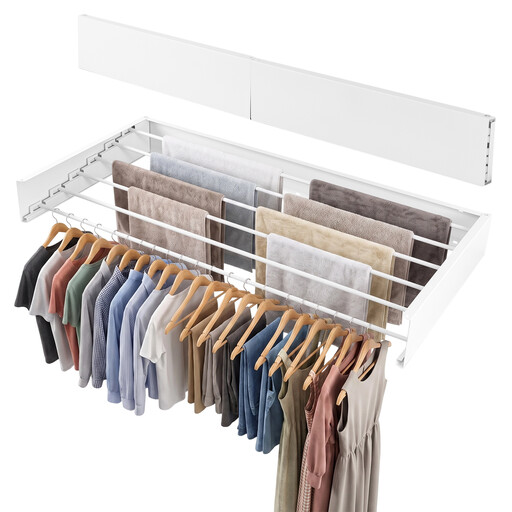 No image available
The six rails provide space to hang several towels at once.
Open: 100 × 50 cm; folded: 3 cm deep. Wall mounting requires drilling.
 No image available
A wall-mounted model that gives your towels a dedicated place.
Dimensions: 58,5 × 55 cm. The description lists touch controls, a digital temperature display and a top shelf. Check that your wall is suitable for mounting.
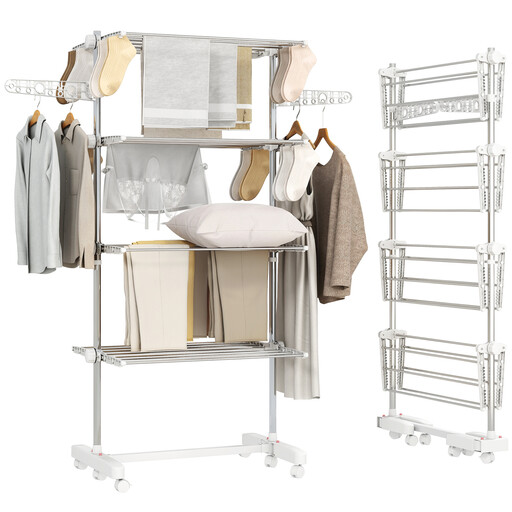 No image available
Four main shelves and two side arms offer a variety of places to spread out your laundry.
The description lists a maximum capacity of 30 kg and a length of 142 cm when opened. Distribute laundry evenly, load each shelf with no more than 6 kg and lock the brakes during use.
 No image available
The side wings provide extra space to spread out several towels at once.
Dimensions when open: 144 × 53 × 91 cm. The recommended maximum load is 10 kg. Use the airer indoors on a stable, level surface with ventilation and at least 31 cm of clearance from walls.
No, drying doesn’t replace washing. Voedingscentrum recommends using clean tea towels, washing used ones and hanging up wet towels.
Yes, even with a heated airer, moisture needs to be removed from the drying area. Milieu Centraal warns that excess moisture can cause mould; a heating element isn’t ventilation.
Multiply the stated power in kilowatts by the number of hours you use it to estimate the electricity used in kilowatt hours, then multiply that by your own rate per kilowatt hour. This doesn’t calculate a measured drying time or actual electricity use for a specific model.
Follow the instructions for the exact model and only use it in an approved location. Brandweer Nederland warns that a coiled extension cable can become hot; don’t use a damaged cable.
Electrical products covered by the applicable requirements must carry a CE marking. The Nederlandse Voedsel- en Warenautoriteit outlines requirements for electrical equipment with a rated AC voltage between 50 and 1.000 V; check the marking and accompanying product information for the specific product.