
Host serving tea in several rounds at once
If you’re making different teas or preparing other things at the same time, you’ll want to track when each one is ready. TFA Dostmann and OXO models offer two and three timer channels respectively.


For one pot of tea at a time, a countdown timer with a freely adjustable setting is usually enough. If you’re making different teas or preparing other things at the same time, independent timers are more useful. Preset tea times are quick to start, but limit your choice, and the alarm and battery requirements vary by model.
If you’re making different teas or preparing other things at the same time, you’ll want to track when each one is ready. TFA Dostmann and OXO models offer two and three timer channels respectively.
If you often make the same tea, preset steeping times can be handy, provided one of them matches the time you want to use. The TFA CUBE TIMER 38.2035.04 has settings of 3, 4, 5 and 6 minutes.
If the conversation around the table carries on, being able to adjust the end signal may matter. For the models reviewed, TFA Dostmann lists adjustable sound or light signals; OXO says the volume on the Triple Task Kitchen Timer can be adjusted.
Best for: one pot at a time, or starting the next round only when the previous one is ready.
Bear in mind: you’ll need a second timer to track two different steeping times at once.
Best for: recurring steeping times of 3, 4, 5 or 6 minutes on the TFA CUBE TIMER 38.2035.04.
Bear in mind: a different time is not a confirmed setting on this model.
Best for: different teas, or a tea and kitchen task that need to finish at different times. TFA Dostmann lists two channels for the 38.2025; OXO lists three timers for the Triple Task Kitchen Timer.
Bear in mind: choose the number of channels to suit the tasks you’ll be timing at once, not the number of guests.
When serving tea during a celebratory meal, your choice mainly comes down to overlapping steeping times, how much control you want over the settings, and whether the end signal suits the place where the timer will sit.
| What to consider | What to look for | Most useful for |
|---|---|---|
| Steeping times at once | Check how many independent timers there are and how you can tell which channel is finishing. TFA Dostmann lists two channels for the 38.2025; OXO lists three for the Triple Task Kitchen Timer. | If I want different pots to finish at different times, I need separate countdowns. Around 36% of consumers say timing several rounds of tea at once is their main need. |
| Freely adjustable steeping time | Compare preset settings with the option to set minutes and seconds. The TFA CUBE TIMER 38.2035.04 offers four preset times; according to its instructions, the HEMA 80841225 can count down from up to 99 minutes and 59 seconds. | If my teas need different steeping times, I don’t want to be limited to a few presets. Around 29% of consumers prioritise being able to set the time freely. |
| End signal | Check whether the volume is adjustable on each model and whether it has a visible signal. TFA Dostmann lists three volume levels and an LED alert for the 38.2025. | If a loud sound could interrupt conversation around the table, I want to be able to adjust or see the signal. Around 21% of consumers say an adjustable end signal matters most. |
| Controls and battery | Check how to set the time and which type of battery is needed; also check whether it’s included. The HEMA 80841225 uses one AAA/LR03 battery, which is not included. | If I want to use the timer straight away, I need to know in advance which battery it takes and how to set it. Around 14% of consumers prioritise easy controls and knowing which battery is needed. |
The TFA CUBE TIMER 38.2035.04 has settings of 3, 4, 5 and 6 minutes. A different steeping time is not confirmed for this model.
Compare the available settings with the steeping times you want to use. If they don’t match, choose a timer that lets you set the minutes and seconds yourself.
An audible or visible signal is only useful if you notice it and it suits the place where the timer is positioned.
Check the alarm settings for the specific model. Place a timer with a visual signal only somewhere you can see it.
The HEMA 80841225 is supplied without an AAA/LR03 battery; the TFA dual timer 38.2025 needs two AAA batteries, which are not included.
Before buying, check the battery type and whether the required battery is included.
The models reviewed range from preset tea settings to timers with multiple channels or a freely adjustable time.
The Triple Task Kitchen Timer is designed to track three tasks with one device.
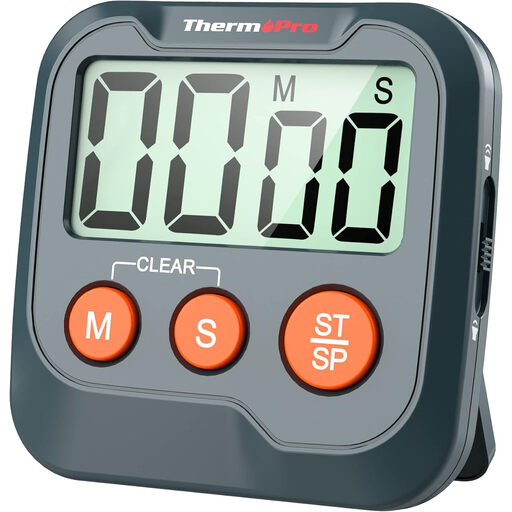
The digital magnetic kitchen timer 80841225 reviewed here can be freely set for one countdown.
The Tasty+ magnetic kitchen timer with rotary dial reviewed here is an option for timing one task.
A digital timer for one countdown, with adjustable volume for use while serving tea.
 No image available
For one countdown while serving tea; the product information lists adjustable volume.
The timer counts down from up to 99 min. 59 sec. and also has a stopwatch function.
The description mentions a magnetic back, a stand and a hanging option.
Yes, if you’re making the pots one after another or they all need to finish at the same time. For different finish times running concurrently, independent channels make it easier to keep track: TFA Dostmann lists two channels for the 38.2025, while OXO lists three for the Triple Task Kitchen Timer.
Start the countdown when you add the tea to the water, then remove the tea when the chosen steeping time is up. TFA Dostmann describes this method for the CUBE TIMER; according to the manufacturer, the right time depends on the type of tea, the leaves and your preference.
First, insert an AAA/LR03 battery, following the polarity markings; it isn’t included. Then set the minutes and seconds and start the countdown with START/STOP, as described in the instructions.
No. ACM ConsuWijzer explains that the statutory guarantee period is not fixed at two years: with normal use, a product must meet what you could reasonably expect from it. Any manufacturer’s warranty is separate; contact the seller if a product is faulty.
According to the Dutch government, a flat battery must not go in the bin; you can return it to shops that sell batteries, among other places. A discarded appliance that needs electricity or batteries can be taken to a local collection point, among other options. When buying a similar new appliance, private customers can use the old-for-new take-back scheme.