
Vandaag of morgen in huis

Kwaliteit gegarandeerd

Welkomstaanbiedingen ontgrendelen: GRATIS bezorging | Tot 80% korting | Gratis 30 dagen JoyPlus-proefperiode
Download de app
A knocked-over drink, muddy paw prints or a stain on the sofa calls for more than just a cloth. The right carpet cleaner can tackle stains on carpets, rugs, sofas, mattresses and car seats. But while many models look similar, there can be big differences in how practical they are.
The right choice depends on more than wattage or a bold claim on the packaging. Pay particular attention to how the machine sprays and extracts water, how easy it is to maintain and whether its size suits the way you plan to use it.
A higher wattage doesn’t automatically mean a machine is better suited to your needs. The power rating mainly indicates how much energy the motor uses. Suction power in kPa gives you an additional indication of extraction performance, but the brush, nozzle, hose and airflow all play a part too.
A compact spot cleaner with 15 or 17 kPa may be practical for a sofa or car seat, while a larger machine with a wider brush may be a better fit for a whole rug.
A steam cleaner for carpets uses heated steam. A carpet cleaning machine or wet-and-dry cleaner usually sprays water mixed with a suitable cleaning solution, then extracts the dirty water. These machines work in different ways.
Check that the model has a clean water tank, a dirty water tank and an extraction function. “Damp” or “warm cleaning” doesn’t automatically mean that moisture is removed thoroughly.
After cleaning, dirty water remains in the tank, and moisture may be left in the hose or nozzle. If you don’t empty, rinse and dry these parts, odours can develop. A machine with a self-cleaning hose can reduce the work involved, but you’ll still need to check the tanks and accessories.
Also consider the capacity. A small, lightweight carpet cleaner is easy to store, but a small clean water tank will need refilling more often when you’re cleaning larger areas.
Compare suction power, motor power and nozzle design together. Products in this range vary from around 10,000 to 18,000 Pa and from 400 to 600 W. These are verifiable product specifications, but they don’t tell you on their own how quickly a surface will dry.
Move slowly in straight lines and, if necessary, make an extra pass with the nozzle without spraying again. This helps extract more moisture from the fabric. Always test on an inconspicuous area first, especially when cleaning delicate upholstery, wool or fabrics with loose dye.
A dual-tank system keeps clean and dirty water separate. This is more hygienic and means you won’t keep going over the fabric with dirty water. Check:
Some models, for example, are listed with 1.2- and 0.6-litre tanks. A larger tank is useful for cleaning a sofa or several car seats, but it can also make the machine heavier.
For cleaning sofas and cleaning car seats, a flexible hose is often more important than a wide floor brush. Check the hose length, power cord and whether a small nozzle is included.
A narrow nozzle is useful for seams, stairs and pet stains. A wide brush works more efficiently on rugs. A corded model provides continuous power, while a cordless version gives you more freedom to move around. However, the runtime and included battery determine how long you can work at a time.
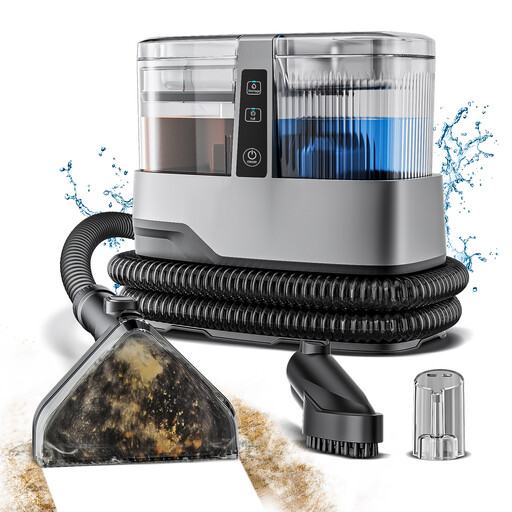
Why it suits this profile: This compact corded model is designed for spot cleaning carpets, fabric furniture and car interiors. Its product specifications list 600 W, 17,000 Pa and a 5-metre power cord.
The separate clean and dirty water tanks make it clear that this is a spray-and-extraction cleaner, not an ordinary vacuum cleaner. The instructions recommend using warm water at a maximum of 40 °C and letting the machine dry completely after use.
17,000 Pa suction power, a dual tank and a handheld design for stairs, sofas and car seats.
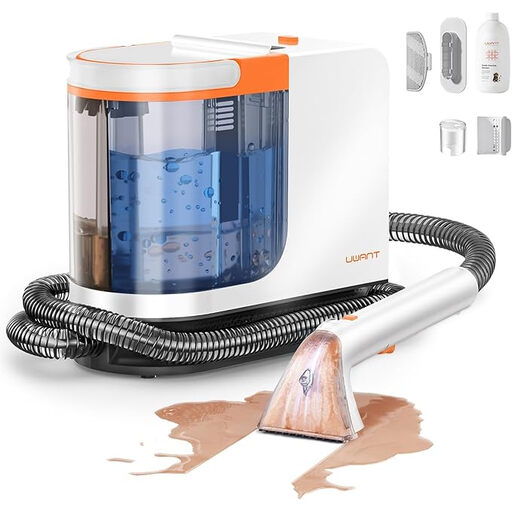
Why it suits this profile: According to the product specifications, this model combines 18,000 Pa suction power, a 14 cm brush and a 600 W motor. Its listed noise level is 75 dB.
As well as suction power, the product specifications list the brush width and a 2-in-1 water tank. This gives you more to consider than just the wattage.
18,000 Pa, a wide brush and separate water compartments for carpets, sofas and cars.
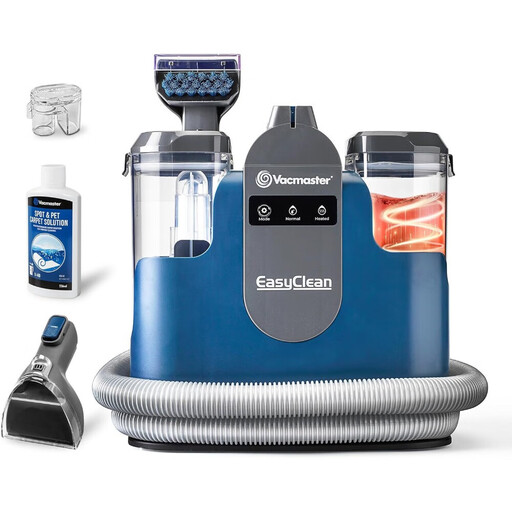
Why it suits this profile: This model is designed for carpets, sofas, stairs and car seats. Its product specifications list a 500 W motor, 1.6- and 0.95-litre tanks and a 1.8-metre hose.
The manufacturer describes the two cleaning modes as normal and heated. Think of this as a feature for different uses, not a guarantee of results on every fabric.
Large water tanks, a heated cleaning function according to the product description, and a self-cleaning hose attachment.
We’ve put together a complete, up-to-date list of products that meet these strict selection criteria and the applicable European safety regulations.
For pet stains, remove any solid residue first and use a product suitable for the material. A cleaner may reduce stains and odours, but the results depend on how old the stain is, the fabric and the solution you use.
It depends on how much water you use, the ventilation, the fabric and how thoroughly you extract the moisture. Open the windows or use ventilation, and don’t walk on the carpet again until it feels completely dry.
You can, as long as the upholstery care code allows wet cleaning. Use a small nozzle, test an inconspicuous area first and avoid soaking the fabric. For delicate materials, professional cleaning may be a better option.
In addition to the purchase price, you’ll pay for electricity, water and, if needed, cleaning solution. Corded models use electricity while cleaning; with battery-powered machines, charging and battery life are also factors. A model with washable tanks and reusable accessories can help keep maintenance costs down.
