
Vandaag of morgen in huis

Kwaliteit gegarandeerd

Welkomstaanbiedingen ontgrendelen: GRATIS bezorging | Tot 80% korting | Gratis 30 dagen JoyPlus-proefperiode
Download de app
A tall cat tree for multiple cats needs to offer more than just height. Cats want to climb, scratch, sleep and sometimes retreat. In a multi-cat household, a cat tree that is too small or wobbly can quickly lead to pushing and shoving, damaged furniture or unused resting spots.
So do not focus only on the number of levels or an attractive product photo. Three common pitfalls are:
A good large cat tree distributes its functions across several levels. This makes it easier for cats to avoid one another and choose their own favourite spot.
A tall cat tree makes use of vertical space while taking up relatively little floor space. This makes a cat tree for small flats an attractive option, provided the base is sufficiently wide and heavy.
Check the following before buying:
A stable cat tree should not move noticeably from side to side after correct assembly. Place the tree on a level surface and use an anti-tip strap if one is supplied. With very active or heavy cats, it is sensible to leave extra space between the tree and windows, cupboards and fragile objects.
A cat tree with sisal posts is only practical when cats can scratch at different heights. Pay attention to the number of sisal-covered posts and how they are distributed along the climbing route.
According to the product descriptions, the products below have eight sisal-covered posts. The 170 cm-high version has 17 support posts in total, eight of which are wrapped in natural sisal. This gives cats several designated scratching areas, but it does not replace checking the sisal connections after assembly and during use.
A cat tree for large cats should have sufficiently wide platforms. Do not look only at the maximum weight capacity; also check the dimensions of the resting platforms, beds and cat houses.
Useful features include:
A product description may state a capacity, but this is not a guarantee for every home or situation. According to the listed specifications, some models are suitable for up to six cats weighing less than 6.8 kg each. Always check your cats’ individual weights and behaviour, and assess the stability after assembly.
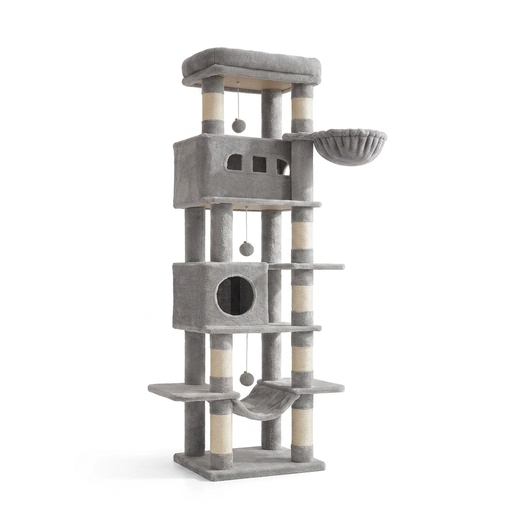
Why it suits this profile: A practical choice for households looking for several resting and play areas without immediately opting for a 212.5 cm cat tree. The tower has six levels, two cat houses and a hammock.
The product description lists 17 support posts, eight sisal posts and a double-reinforced base with an anti-tip feature.
170 cm high, six levels, two cushions and a removable top platform.
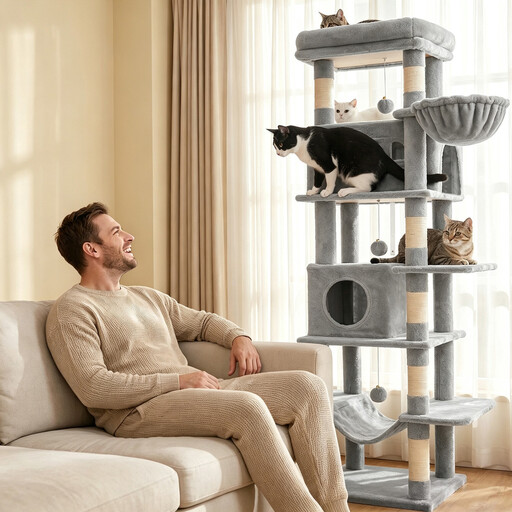
Why it suits this profile: For households with several cats that want to combine a tall climbing structure, a spacious resting area and separate hideaways.
According to the product description, 17 reinforced posts, a double base and a built-in anti-tip lock provide additional support.
212.5 cm high, 65×45 cm platform, two houses, a hammock and eight replaceable toys.
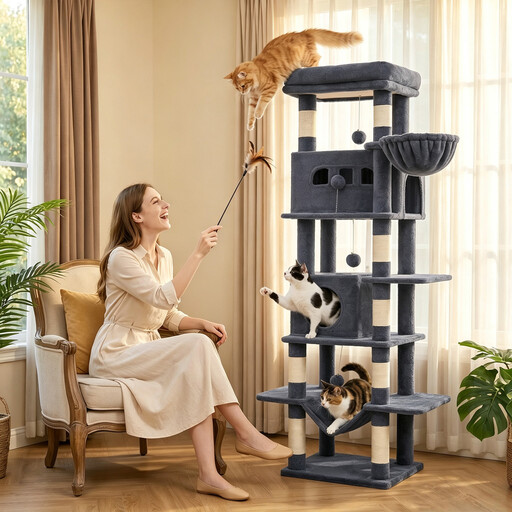
Why it suits this profile: Suitable for active cats and households that want to keep the floor clear. The vertical layout provides climbing space, while two caves, a hammock and a bed add different resting areas.
The listed specifications mention a widened base, reinforced platforms and anti-tip components. After assembly, check that all connections are securely tightened.
60×40 cm platform, removable washable cushions, eight sisal posts and a design that makes particularly good use of height.
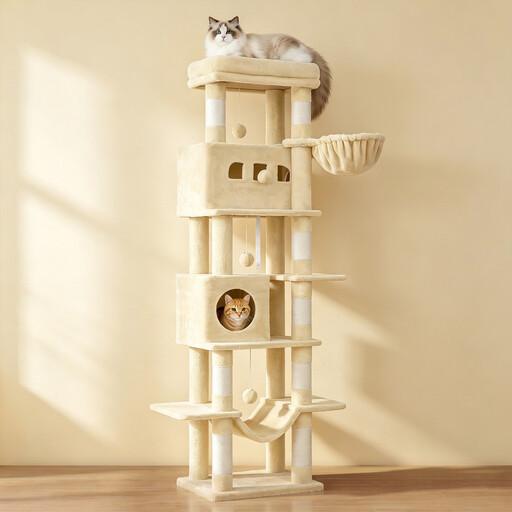
Why it suits this profile: An option for multiple cats that want not only to climb but also have their own place to sleep. The combination of two caves, a bed and a hammock helps divide the available space.
The product information lists six levels, eight sisal posts and several separate resting areas instead of one central resting spot.
212.5 cm high, 65×45 cm platform, two houses, a 30 cm bed and a hammock.
We have put together a complete, up-to-date list of products that fully meet these strict selection criteria and the applicable European safety regulations.
Do not place a tall cat tree directly next to a radiator or somewhere a door could hit the base. A spot by a window may be appealing, but check that the tree cannot topple if a cat jumps towards the windowsill.
Retighten all screws after a few days. Then check regularly for:
Washable cushions and a removable platform make daily maintenance easier. Use a vacuum cleaner or lint roller on plush surfaces, and follow the product instructions for removable components.
Not always. Measure the ceiling height where you want to place the cat tree and allow for any assembly or fixing space. With a low ceiling, a 170 cm model may be more practical.
This depends on the number of cats and their behaviour. Several cat houses, a hammock and a bed give them more choice than a single resting spot. However, no cat tree can guarantee that cats will never compete for a place. You could also put additional freestanding beds in the room.
Its lifespan depends on use, weight, assembly and maintenance. Sisal wears more quickly with intensive scratching. Check the posts regularly, and replace loose toys or damaged parts when necessary. A sturdy cat tree will remain stable only when its screws and fixings are properly maintained.
