What should you look for when choosing?
Start by checking what’s allowed and what’s safe to eat. Then compare the energy content for the same weight and see whether the product variant and packaging suit your needs.
| What to consider |
What should you check? |
Who is this most relevant for? |
| Energy per portion |
Compare the kcal per 100 g for the exact product variant, and calculate the values for the same weighed portion. |
I want to know how much energy my own portion provides, not just what the packaging says per 100 g. Around 36% of consumers prioritise energy per portion. |
| Allergens and school rules |
Check the ingredients and warnings on the packaging, as well as the rules at your child’s school or in their class. |
If I’m packing nuts for school, I want to know first whether they’re allowed and can be eaten safely. Around 29% of consumers prioritise safety and permission from the school. |
| Nutritional quality |
Check the ingredients, salt and any added ingredients separately; ‘unsalted’ on its own tells you nothing about the energy content. |
I’m looking for a snack that fits a child’s nutritional needs, without turning a calorie comparison into a diet goal. Around 21% of consumers prioritise suitable nutritional quality. |
| Portioning and storage |
Check the net weight and storage instructions; if you’re comparing prices, compare the cost for the same quantity. |
I want packaging that’s easy to divide up for school days and can be stored properly once opened. Around 14% of consumers prioritise everyday convenience and cost. |
Brands to consider
The examples below apply to the products or product ranges named. Mentioning a brand doesn’t mean every product from that brand has the same ingredients or is available everywhere.
Duyvis
Worth considering if you’re specifically looking for an unsalted peanut option, such as Duyvis Pinda’s Ongezouten 235 g.
- The product information lists peanuts and sunflower oil. Jumbo states that this variant contains 614 kcal per 100 g.
- This isn’t a low-calorie option. Peanuts are relevant if you have a peanut allergy, and Duyvis also warns that they may pose a choking risk for young children.
Albert Heijn
AH Amandelen ongezouten 190 g is a specific example if you’re looking for almonds with no added salt.
- Albert Heijn lists almonds as an ingredient and states that no salt or sugar is added.
- Albert Heijn states that the product contains 627 kcal per 100 g. The product information also notes that it may contain other nuts and peanuts.
Jumbo
Jumbo Pistachenoten Ongezouten 200 g is a specific pistachio option to assess by weight and ingredients.
- Jumbo states that it contains 594 kcal per 100 g and lists pistachios as an ingredient.
- The product information notes that it may contain other nuts and peanuts. The reference intake shown on the page is for an average adult, not a recommendation for children.
Lidl
The Alesto range includes various nuts, dried fruit and snacks; always check the specific product variant.
- Lidl’s range includes products such as natural cashews.
- The wide range doesn’t have one standard nutritional profile. Check the nutritional information and ingredients on the packaging you choose.
Aldi
The ALDI nut mix mentioned is an option if you’re looking for a single unsalted pack containing several types of nuts.
- ALDI lists almonds, hazelnuts, walnuts and Brazil nuts in Trader Joe’s unsalted mix.
- As it contains a mix of different nuts, it’s important to check the information on the specific pack. The mix isn’t automatically low in calories.
Plus
PLUS Cashewnoten ongezouten ongebrand 200 g is a specific example if you’re looking for unroasted cashews.
- PLUS lists cashews as an ingredient and states that the product contains 598 kcal per 100 g.
- The product information notes that it may contain peanuts. ‘Unroasted’ on its own doesn’t prove that the energy content is significantly different.
Nuts and nut mixes at Joybuy
These unsalted nuts and nut mixes are for anyone who wants to compare ingredients and energy per weighed portion. The energy values listed don’t make these products low in calories.
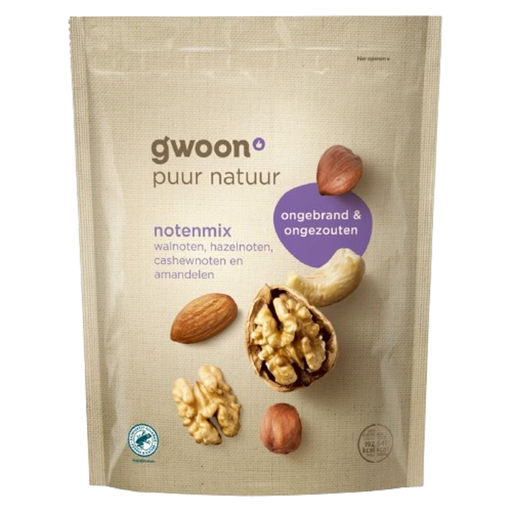 Image unavailable
g'woon Nut Mix Raw & Unsalted, 200 g
An unsalted nut mix you can divide into portions if you’d like to take a selection of nuts with you.
The ingredients list hazelnuts, walnuts, almonds and cashews. The product information states that it contains 0,01 g of salt and may contain traces of other nuts and peanuts.
View at Joybuy
 Image unavailable
g'woon Almonds Raw & Unsalted, 200 g
A raw, unsalted almond option if you’d like to portion out a specific type of nut.
The product information states that it contains 591 kcal and 0,03 g of salt per 100 g. The ingredients list almonds; this isn’t a low-calorie product.
View at Joybuy
 Image unavailable
Anatolia Badem Natural (Almond), 500 gr
An almond option to weigh out if you’re looking for almonds with no added salt.
The product information states that it contains 578 kcal per 100 g and 0 g of salt. The description says it is made from 100% almonds, and the allergen information lists almonds. This isn’t a low-calorie product.
View at Joybuy
 Image unavailable
g'woon Cashew Nuts Roasted & Unsalted, 200 g
A roasted, unsalted cashew option if you’d like to take cashews with you.
The nutritional information states that it contains 596 kcal and 0,067 g of salt per 100 g. The allergen information lists cashews; this isn’t a low-calorie product.
View at Joybuy
 Image unavailable
g'woon Nut Mix Unsalted, 200 g
An unsalted mix to weigh out if you’d like several types of nuts in one pack.
The product information states that it contains 615 kcal per 100 g and lists peanuts, almonds, cashews, Brazil nuts and hazelnuts as ingredients. This isn’t a low-calorie product; check the allergen information for your needs.
View at Joybuy
Frequently asked questions
Are the nuts reviewed really low in calories?
No. For solid foods, the European Commission sets a maximum of 40 kcal per 100 g for a ‘low energy’ claim. The product values reviewed are higher: the variants listed range from 578 to 627 kcal per 100 g. A smaller portion contains less energy from that product, but it doesn’t make the product itself low in calories.
Should I choose the nuts with the fewest calories for my child?
Not on the basis of calories alone. The Netherlands Nutrition Centre advises against putting children on a diet without professional guidance, even if they are overweight. Choose food that supports your child’s growth, and discuss any concerns about their weight with an appropriate healthcare professional.
Can my child take nuts to school?
That depends on the rules at your child’s school or in their class. For example, OBS De Venen describes restrictions for younger classes due to diagnosed allergies. This is the school’s policy, not a rule for all schools in the Netherlands. Ask what rules apply to your child’s class.
Are whole nuts automatically suitable once a child starts school?
No. A child’s age or starting school doesn’t by itself mean they can eat whole nuts safely. Albert Heijn warns that the almonds mentioned may pose a choking risk for young children, as does Duyvis for the peanuts mentioned. Follow the warning on the exact packaging, and don’t give whole nuts to a child who can’t eat them safely.
What should I check on the label if someone has an allergy?
Read the full ingredients list and allergen information on the exact packaging. The NVWA lists peanuts and nuts among the allergens that must be declared on pre-packed products. Since 1 January 2026, the NVWA has also checked during inspections that warnings about possible cross-contamination are declared correctly.


