Start by choosing a camera and lens that let you frame the whole plate from the distance available; then decide whether you need extra magnification for small details. A compact camera keeps your setup simple, while a mirrorless camera with a kit zoom gives you room to adjust the framing. A separate macro lens is most useful when details are your main focus, but it isn’t automatically included with a camera kit.
Who is this choice relevant to?
Photographing a complete table setting
You want to frame plates and surrounding objects from a limited distance. The available working distance and angle of view matter more than maximum magnification. The Consumers’ Association (Consumentenbond) describes compact cameras as having fixed lenses and mirrorless cameras as having interchangeable lenses.
Photographing tableware details
You want to capture glaze, texture or decoration up close. Compare the focusing distance and magnification of the specific lens, rather than looking only at the camera body. Nikon lists 1:1 magnification for the separate NIKKOR Z MC 50mm f/2.8.
Keeping your setup simple
You want to take photos with as few separate components as possible, and decide whether a camera with a fixed lens will do or whether you’d prefer an expandable system. The Consumers’ Association distinguishes compact cameras with a fixed lens from cameras with interchangeable lenses.
What should you look for?
Compact camera with fixed zoom lens
A good fit if: you want to use one camera without changing lenses.
Keep in mind: the lens choice is fixed, so check that you can get the framing you want from your table.
Mirrorless camera with kit zoom
A good fit if: you want to take wide shots and adjust the framing with the zoom.
Keep in mind: a kit zoom isn’t automatically a macro lens; check the magnification of the included lens.
Mirrorless camera with a separate macro lens
A good fit if: small details, such as glaze or decoration, are your main subject.
Keep in mind: the macro lens must fit the camera mount, and you may need more working distance to photograph a whole plate.
| What to consider |
What to look for |
Who should prioritise this? |
| Framing a whole plate |
Measure the available distance and check the angle of view and zoom setting; leave room for the background and lighting. |
If I want to show the whole plate on a small table, I check that the framing is wide enough from my usual shooting position. Around 33% of consumers prioritise complete table settings. |
| Tableware details |
Compare the maximum magnification and minimum focusing distance of the specific lens; check whether it’s included in the kit. |
If I want to make the glaze or decoration fill the frame, I compare lens magnification and check what’s included. Around 27% of consumers give small details top priority. |
| Sharpness in indoor lighting |
Check the lens aperture and available settings; allow room for a stable setup or additional lighting. |
If I’m taking photos indoors and sharpness matters, I also consider the available light and settings, not just the camera. Around 20% of consumers prioritise lighting and sharpness. |
| Keeping your setup simple |
Check exactly what’s included in the kit and whether the screen is practical from your camera position. |
If I want a straightforward, complete setup, I check which lens and accessories are included before choosing a kit. Around 20% of consumers give simplicity and a complete kit top priority. |
Common buying mistakes
-
Assuming the minimum focusing distance means a whole plate will fit in the frame
Being able to focus up close doesn’t automatically mean the angle of view is wide enough for a whole plate. The stated focusing distance for the Sony RX100 VII also varies between the wide-angle and telephoto ends of the zoom.
Test the framing from the distance where you can actually position the camera, using the zoom setting you want.
-
Treating a kit zoom as a 1:1 macro lens
According to Canon, the Canon RF-S 18-45mm achieves maximum magnification of 0.16× at 45 mm with autofocus. That’s not the same as the 1:1 magnification listed by Nikon for the separate NIKKOR Z MC 50mm f/2.8.
Compare the magnification of the specific lens and check which lens is actually included in the camera kit.
A suitable macro lens may need to be bought separately; it isn’t automatically included with a mirrorless camera kit.
-
Comparing only camera bodies or megapixels
For photographing tableware, the lens, available shooting distance and lighting also matter. Looking at the body alone won’t tell you which complete setup is right for your table.
Assess the camera together with the included lens, and check whether your lighting conditions call for extra support or lighting.
Camera brands to consider
Canon
The EOS R50 with RF-S 18-45mm is an example of a mirrorless camera with a kit zoom, giving you flexibility to change the framing.
- Canon specifies maximum magnification of 0.16× for the RF-S 18-45mm at 45 mm with autofocus.
- This kit zoom isn’t a 1:1 macro lens, so assess it as part of the Canon combination described.
Nikon
The Z50II represents an expandable Z system; the NIKKOR Z MC 50mm f/2.8 is a separate lens for detail photography.
- Nikon lists 1:1 magnification for the NIKKOR Z MC 50mm f/2.8 and compatibility with FX- and DX-format Z cameras.
- The macro lens isn’t automatically included in a Z50II zoom kit; check which lens is included and that it fits the camera mount.
Sony
The RX100 VII is a compact camera with a fixed zoom lens; Sony also makes a separate macro lens for compatible E-mount cameras.
- Sony lists a focusing distance of around 8 cm at the wide-angle end and around 100 cm at the telephoto end for the RX100 VII, measured from the front of the lens.
- The FE 50mm F2.8 Macro is a separate lens and can’t be swapped onto the RX100 VII.
Panasonic
The LUMIX G100D kit is a Micro Four Thirds mirrorless camera kit with zoom lenses.
- Panasonic lists a G100D kit combination with 12-32mm and 45-150mm lenses.
- The kit mentioned doesn’t include the separate 30mm F2.8 macro lens from the LUMIX G range; consider that as a separate lens option.
Cameras at Joybuy
This selection includes a compact camera and a mirrorless camera with a kit zoom, for anyone who wants to adjust the framing when photographing tableware on a small table.
 No image available
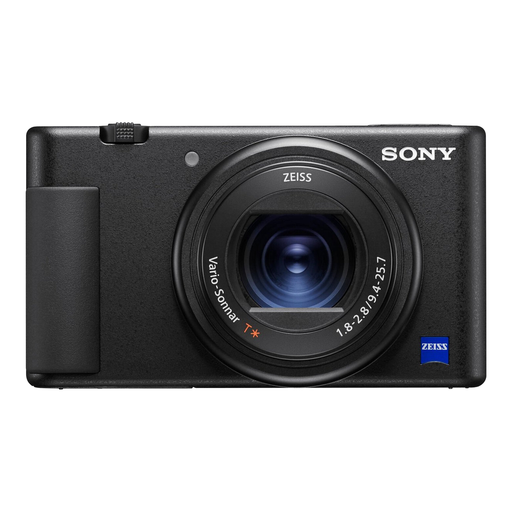
Sony ZV-1 compact camera
A compact camera with a fixed lens, so you can try different framings without changing lenses.
The stated lens has 2,7× optical zoom and a focal length range of 24–70 mm.
View at Joybuy
 No image available
Sony Alpha A6100 + 16-50mm f/3.5-5.6 OSS II
A mirrorless camera with an included zoom lens, for anyone who wants to adjust the framing of a wide shot.
The kit name lists a 16–50mm f/3.5-5.6 OSS II lens.
View at Joybuy
Frequently asked questions
Do I need a macro lens to photograph a whole plate?
Not necessarily. First check whether the plate fits in the frame from the camera distance available to you. A macro lens is most useful when you want to capture small details at a larger scale. The Canon RF-S 18-45mm kit zoom and the separate Nikon NIKKOR Z MC 50mm f/2.8 have different stated magnifications.
How can I avoid having only a small part of the tableware in focus?
For close-ups, pay attention to the plane of focus and depth of field; Canon notes that depth of field can be shallow at close range. Take test shots at different aperture settings and use a stable setup if you need a longer exposure.
Do I need anything else besides the camera?
First, check exactly which lens and accessories are included in the kit, as a separate macro lens isn’t automatically included. Then see whether your table setup needs extra support or lighting; this depends on the kit you choose and the light available.
What are my rights when buying online in the Netherlands?
When you buy remotely from a business, you’ll often have a 14-day cooling-off period, according to the Dutch government (Rijksoverheid). This doesn’t automatically apply when buying from a private seller. Under the legal guarantee, a product must be of satisfactory quality; according to the Dutch government, there’s no fixed statutory time limit.


