
People with a small kitchen
If you only have space on the worktop, measure not only the appliance but also the space needed to open the door and accommodate the hoses. Check the manual for the connections required, too.


A tabletop model with a fixed water supply could suit you if you have dishes to wash every day that will fit in a larger basket, provided you have enough worktop space and the waste-water outlet and electrical connection are suitable. If a fixed water supply isn’t available, a smaller model with a tank could be an option, but bear in mind that you’ll need to fill it by hand, there’ll be less room for dishes and you’ll still need a way to drain the water. Milieu Centraal points out that a larger model, used with a full load, or washing by hand with a small amount of hot water may also be worth considering if reducing consumption is your priority.
If you only have space on the worktop, measure not only the appliance but also the space needed to open the door and accommodate the hoses. Check the manual for the connections required, too.
If you want to wash plates, glasses and cutlery in as few loads as possible, check the basket layout and compare it with your own crockery. The place setting capacity alone won’t tell you whether large plates or cookware will fit.
A model with a fillable water tank could be an option if you don’t have a suitable fixed water supply. You’ll still need a suitable place to drain the waste water and an appropriate electrical connection.
Choose this if: you regularly have dishes to wash, have space for the appliance and can arrange the water supply, drainage and electrical connection in line with the manual.
Bear in mind: the connections required and the space available; also check that your crockery fits in the basket.
Choose this if: a fixed water supply isn’t suitable and a smaller load per cycle is enough.
Bear in mind: you’ll need to fill it by hand and there’ll be less stated capacity; you’ll still need to drain the waste water.
Consider this if: you have room for a larger appliance that you can run with a full load, or you have few dishes to wash and can do so using a small amount of hot water.
Bear in mind: the space and installation needed for a larger appliance. Washing up by hand won’t automatically save energy if you leave the hot tap running.
| What to consider | What should you check? | Who is this important for? |
|---|---|---|
| Space and connections | Measure the available space, including with the door open, and check the manual for the water supply, drainage and electrical socket requirements. | If my kitchen has little spare space, I want to know in advance whether the appliance can be positioned safely and connected properly. For around 33% of consumers, space and installation are the top priorities. |
| Capacity | Measure your largest plate and compare it with the maximum plate diameter and basket layout for the exact model. | If I want to wash my everyday plates, glasses and cutlery in as few loads as possible, I check what will actually fit in the basket. For around 27% of consumers, everyday capacity comes first. |
| Fillable water tank | Check how to fill the exact model, where the drain hose can go and what’s included with that version. | If I don’t have a suitable fixed water supply, I want to know whether a tank will work in my kitchen and how to drain the waste water. For around 20% of consumers, using a water tank is the top priority. |
| Consumption and programme | Compare label figures for the same eco programme and consider whether you can usually run a full load. | If I want to weigh up consumption against the amount of washing up, I look at the eco figures as well as how often I can run the appliance with a full load. For around 20% of consumers, consumption comes first. |
The EU energy label shows, among other things, energy consumption for 100 eco cycles and water consumption per eco cycle. These figures apply to the stated labelling basis; they won’t necessarily reflect every programme or home setup.
A stated capacity doesn’t guarantee that your own crockery will fit. For example, Tomado lists a maximum plate diameter of Ø 25 cm for the TDW5501W.
Measure your largest plates and compare them with the basket layout for the exact model. If large plates or pans don’t fit, you may need to run extra loads or wash them by hand.
A water tank replaces the fixed water supply, but you’ll still need somewhere for the waste water to go. Daan Tech lists a drain hose as part of the specified Bob package.
Check how to fill the exact version, where the hose can drain and which accessories are included.
From a consumption perspective, Milieu Centraal advises against a compact mini dishwasher and points to a standard dishwasher run with a full load as an alternative. Washing up by hand with a small amount of hot water may also be worth considering.
Compare label figures based on the eco programme and think about how many dishes you can usually fit in each load. Bear the available space in mind, too.
The VVW5520 is a tabletop model with a fixed connection and a stated capacity of 6 place settings.
The TDW5501W is a tabletop model with a stated capacity of 6 place settings and a maximum plate diameter.
Bob is a smaller, tank-fed option for anyone who can’t use a fixed water supply.
These products are compact tabletop dishwashers suited to a small kitchen or use with a water tank. Check the capacity and filling and drainage requirements for each version.
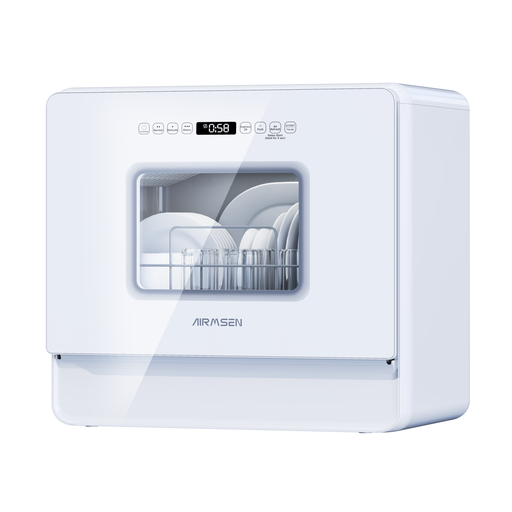 No image available
A good fit if you’re looking for a small capacity and want the option of using either a tank or a tap connection.
The product information lists 3 place settings, a 5-litre water tank, a tap connection and 7 programmes.
 No image available
A compact option to consider if the stated dimensions and tank or tap connection suit your kitchen.
The title lists a 5-litre tank, 9 wash programmes and dimensions of 37 × 50 cm. The product description states a capacity of up to 4 place settings and filling via a tank or tap.
 No image available
A good fit if you’re looking for a small capacity and want to check which water supply options will work in your kitchen.
The product information lists 3 place settings, 7 programmes, 56.3 dB and energy class C. The title says it can be used with or without a water connection.
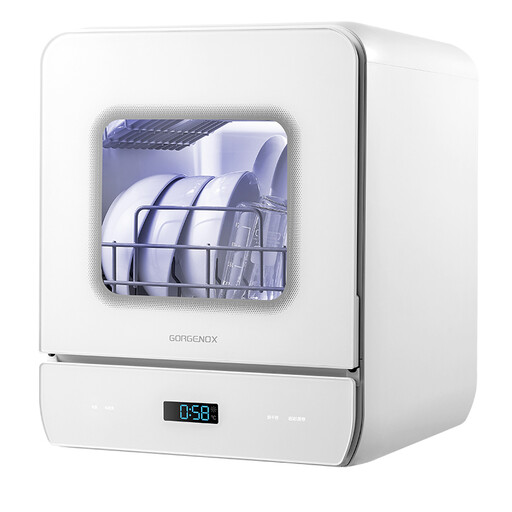 No image available
A compact option if you want to wash a limited amount of crockery per load.
The product information lists a capacity of 3 sets of crockery.
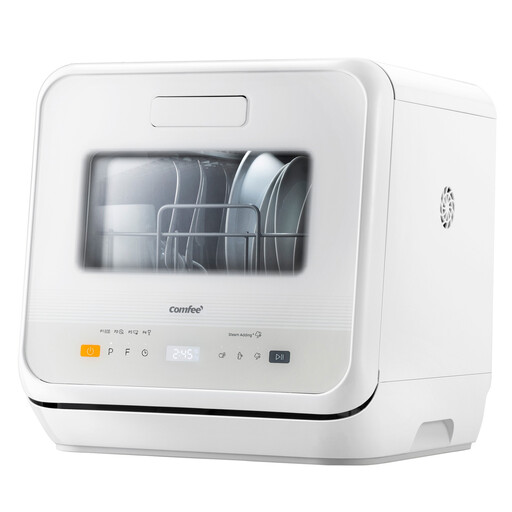 No image available
A good fit if you’re considering a model with a tank and want to check your crockery’s plate size in advance.
The product information lists a built-in 5-litre tank, 6+3 programmes and a maximum plate diameter of 250 mm.
That depends on your crockery and cookware. Check the basket layout and maximum plate diameter for the exact model; for example, Tomado lists Ø 25 cm for the TDW5501W.
Don’t assume it can: a water tank replaces the fixed water supply, not the drain. Check the drainage route and the manual for the version you choose.
You generally don’t need to pre-rinse under the tap. Scrape off any large food scraps and clean the filter regularly. Follow the manual’s guidance on salt and rinse aid, and take your local water hardness into account.
Compare models on the same labelling basis: the EU energy label shows energy consumption for 100 eco cycles and water consumption per eco cycle. Your own consumption will also depend on the programme you choose and how often you use the appliance.