What should you consider when choosing?
When washing cutlery after an evening class, start with the load you actually need to wash and the connections available at the venue. Then check that the programme, drying time and running costs suit your schedule.
Plumbed-in tabletop model
A good fit when: you have suitable water and drainage connections and may want to wash cutlery with crockery.
Trade-off: you need a suitable connection point; a small load may not make good use of the stated capacity.
Tabletop model with a water tank
A good fit when: there is no mains water supply and the amount of washing up fits the basket layout.
Trade-off: you have to fill the tank yourself and direct the wastewater to a suitable drain.
| What to consider |
What should you check? |
Who should prioritise this? |
| Cutlery per load |
Count the cutlery used in a typical class and check that the individual pieces fit in the basket or module without overlapping. |
I want to wash all the loose cutlery in one go after every class. Around 28% of consumers prioritise the amount of cutlery per load. |
| Water supply and drainage |
Check the tap, drain, socket and available space; for a tank model, also check how the drain hose is secured. |
There is no mains water supply at my class venue, or I want a model that can be connected directly. Around 22% of consumers choose connection options as their first consideration. |
| Suitable wash programme |
Read the programme description for the exact model and load the cutlery as instructed, leaving room for the water jets. |
I want to wash used cutlery on a programme suited to how dirty it is. Around 22% of consumers prioritise their cleaning needs. |
| Wash and drying time |
Compare the duration of your chosen programme and check whether it includes a drying phase if you need to put the cutlery away that same evening. |
After a late class, I want to know whether the cutlery will be ready to put away in time. Around 17% of consumers prioritise finishing that same evening. |
| Running costs and maintenance |
Compare energy label figures on the same basis, including kWh per 100 eco cycles and water per eco cycle, and check how to clean the filter. |
I expect to use the machine regularly and want to take running costs and maintenance into account. Around 11% of consumers prioritise running costs and maintenance. |
Since 1 March 2021, the European Commission has used an EU energy label scale from A to G for household dishwashers. Compare the consumption figures on the label against the load you actually expect to wash.
Joybuy products
These Joybuy products are tabletop dishwashers with a built-in water tank, for use without a mains water supply. The wastewater from these models still needs to be directed to a suitable drain.
 No image available
AIRMSEN tabletop dishwasher, 5+1 wash programmes, 5 l water tank
The built-in tank is an option if a mains water supply is not available.
The product name lists 5+1 wash programmes and a 5-litre water tank.
The drain hose needs to lead to a suitable drain or collection container.
View at Joybuy
 No image available
AIRMSEN tabletop dishwasher, 5 l water tank, 9 wash programmes
The built-in tank may be suitable if there is no mains water supply; check the drainage route beforehand.
The product name lists a 5-litre tank, 9 wash programmes, dimensions of 37 × 50 cm and a D energy rating.
The drain hose must be secured properly to prevent leaks.
View at Joybuy
 No image available
Heinrich's HTG 8855 tabletop dishwasher
The product name says it can be used with or without a water connection; check which connection method suits your venue.
The stated specifications are 3 place settings, 7 programmes, a 24-hour delay start and a C energy rating.
The optional drying function is listed as taking 240 minutes, which may be a long wait if you need the cutlery dry that same evening.
View at Joybuy
 No image available
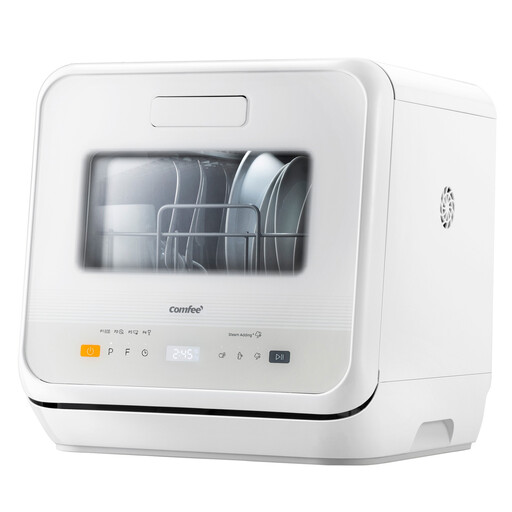
Comfee' CDWMTO201D(W), 5 l water tank
The built-in tank is an option if a mains water supply is not available; remember that you will still need to drain the wastewater.
The product name lists a 5-litre tank, 6+3 programmes and a D energy rating.
The drain hose must be secured properly, and the wastewater must be able to drain away.
View at Joybuy
Frequently asked questions
Does a capacity of six place settings mean there is room for all the cutlery used by six students?
No, six place settings do not tell you how many individual cutlery items will fit in the basket. According to Inventum, a place setting also includes plates, glasses and other crockery, so check the layout and capacity of the cutlery basket on the exact model.
Can a tabletop dishwasher with a water tank work without a drain?
No, you still need somewhere for the wastewater to go. Daan Technologies describes Bob as having a drain hose that leads to a sink or other drainage system; the tank replaces the mains water supply, not the drain.
Will cutlery dry quickly after a short programme?
Not necessarily: according to the Consumentenbond, short programmes often have a shortened or omitted drying phase. Check the programme information for your chosen model if you want to put the cutlery away dry that same evening.
Does a dishwasher used after an evening class need to meet HACCP requirements?
It depends on whether the organisation running the class is subject to the rules for food businesses. According to the Netherlands Food and Consumer Product Safety Authority, businesses that produce, process, sell or distribute food must work with a food safety plan based on HACCP or an approved hygiene code. If this applies to the organisation, it must check that its chosen cleaning method meets the relevant plan; a domestic programme labelled ‘hygiene’ does not in itself prove that it does.
How can I keep the dishwasher clean with regular use?
Scrape large food scraps off the dishes and check the filter regularly, cleaning it when needed. The Consumentenbond points out that running lots of short or cool programmes can encourage grease build-up.


