What should you look for in a dishwasher for mugs?
First, measure the space where you plan to put it, then decide which water connection suits your kitchen. Next, try your own mugs in the rack and only then compare the usage figures.
| Factor to consider |
What should you look for? |
Who should consider this? |
| Space and positioning |
Measure the width, depth and height. Also allow for the door swing, easy access and the route for the hoses. |
If I have limited worktop space, I want to avoid the appliance getting in the way of cooking or access to the worktop. That’s why around 33% of consumers say space is their top priority when choosing. |
| Mug fit |
Compare the height and handles of your mugs with the rack, and check that they sit securely without obstructing the spray arms. |
I want to be able to load my own dishwasher-safe mugs without them touching each other or getting in the way of the water jets. Around 27% of consumers put fit first. |
| Water supply and drainage |
Check how water is supplied and where the drain hose can safely run for the specific model. |
If there’s no fixed water supply, I want to know whether filling the machine by hand will work in my kitchen; a water tank doesn’t remove the need to drain the water. Around 20% of consumers put the connection first. |
| Consumption per cycle |
Compare the same label figures and programmes, and consider how often you collect enough mugs for a load. |
If I’m mainly concerned about running costs, I want to compare consumption on a like-for-like basis and take my usage habits into account. Around 13% of consumers name this as their top priority when choosing. |
| Noise |
Compare the stated dB figures on the same basis, and remember that a manufacturer’s figure isn’t an independent measurement. |
If my kitchen is next to a living room or bedroom, noise may matter more to me than other features. Noise level is the top priority for around 7% of consumers. |
Joybuy product picks
This selection features compact countertop models, with different water supply options depending on the model. Before buying, check the water supply, drainage and rack with your own mugs.
 No image available
AIRMSEN countertop dishwasher, 5+1 programmes, 5-litre tank
A model with a built-in tank to compare if you’d rather not use a fixed water supply; check separately how wastewater is drained.
The product description lists four place settings, five wash programmes, a drying function and dimensions of 45,8 × 42,8 × 42,5 cm.
The safety instructions call for a correctly earthed power supply and warn against using extension leads. Check whether the rack has enough room for your own mugs.
View at Joybuy
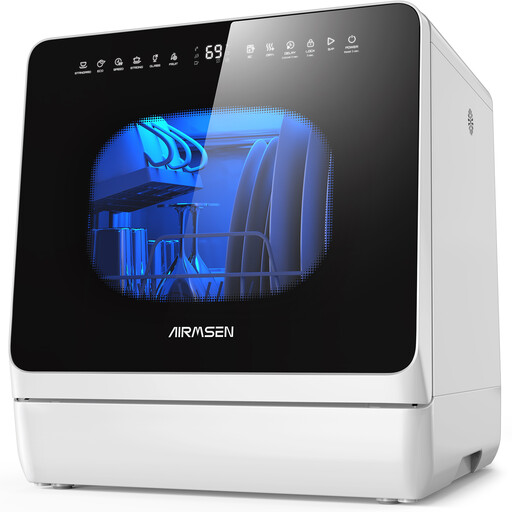 No image available
AIRMSEN countertop dishwasher, 8 wash programmes
A compact countertop model to consider if you want to compare several programme options; check how water is supplied and drained in your setup.
The product description lists space for four place settings, eight wash programmes including a glass programme, and a drying function.
Follow the model-specific instructions for positioning and earthing; the description warns against using extension leads. Place settings don’t guarantee that specific mugs will fit.
View at Joybuy
 No image available
Comfee CDWMTO201D (W), 6+3 programmes, 5-litre tank
The built-in water tank makes this an option to compare if you’d rather not use a fixed water supply; check the drainage route too.
The product description lists dimensions of 420 × 435 × 435 mm and programmes for items including glassware and fruit.
The description requires a correctly earthed 220–240 V socket and warns against using extension leads. Check whether the rack suits the height and handles of your mugs.
View at Joybuy
 No image available
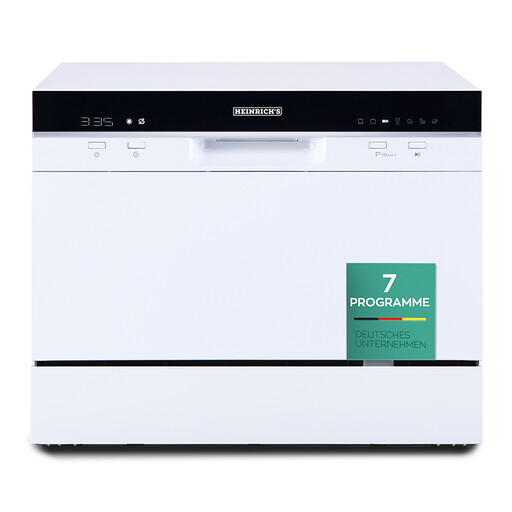
Heinrich's HTG 8840
Compare this tabletop model if you can use a water connection; check whether the connection kit and the routes for the water supply and drainage suit your space.
The product information lists six place settings, seven programmes, water consumption of 6,5 litres per cycle and a noise level of 47 dB.
The place-setting capacity doesn’t tell you how many mugs of your size will fit in the rack. Check the connections required and try the layout with your own mugs.
View at Joybuy
 No image available
Heinrich's HTG 8855
This model offers both a built-in tank and a direct tap connection; compare the two options with the connections available where you plan to put it.
The product information lists three place settings, seven programmes, a 5-litre tank or a tap connection, and a noise level of 56,3 dB.
The description says that an adapter may be needed for the tap connection. Also check whether the rack layout suits your own mugs.
View at Joybuy
Frequently asked questions
Will every dishwasher-safe mug fit in every tabletop model?
No. First check that the mug physically fits in the rack. Compare its height and handle with the space available, and make sure it doesn’t block the water jets; the number of place settings won’t tell you this.
Does a dishwasher with a water tank need no connections at all?
A water tank can remove the need for a fixed water supply, but wastewater still needs to be drained according to the instructions. For the Bob model reviewed, Daan Tech lists a drain pump; check the drainage setup for the model you choose.
How can I keep the machine clean if I often run short cycles for mugs?
Remove food residue and clean the filters and spray arms according to the instructions. Consumentenbond warns that frequent short or cool programmes can cause greasy deposits and recommends running a hotter programme periodically.
What does a dishwasher’s energy label tell you?
The EU energy label lists, among other things, energy consumption per 100 eco cycles, water consumption per cycle, programme duration, capacity and noise. The Dutch Government explains that an energy label is required for products including dishwashers; it won’t tell you whether your specific mug will fit in the rack.
Is the legal guarantee on a new dishwasher always exactly two years?
No. According to the Dutch Government, there’s no fixed statutory guarantee period in the Netherlands. You’re entitled to a product that works properly, and if there’s a fault, the seller is your point of contact; any manufacturer’s guarantee is separate.


