What should you look for when choosing one?
First, check that the machine can be positioned and connected in a practical way. Then compare the usable rack space and programmes with your lunchbox and how you’ll use the machine after class.
| What to consider |
What should you check? |
Who should give this more consideration? |
| Water supply and positioning |
Check whether you need a tank or a fixed water supply, and where the drain hose, plug and machine can be positioned. |
If I don’t have a fixed water supply, I want to know whether I can easily fill the tank and dispose of the wastewater. Around 25% of consumers in this decision prioritise connections and positioning. |
| Temperature and care |
Compare the programme temperature with the instructions for the box, lid, seal and containers. |
If the parts have different care instructions, I don’t want to choose a programme that isn’t suitable. Around 25% of consumers in this decision prioritise material and programme suitability. |
| Usable rack space |
Measure the open lunchbox and separate parts, then compare them with the interior space; use place settings as an initial guide only. |
If I also want to wash other dishes in the evening, the box needs to fit in the rack without me having to rely on place settings alone. Around 20% of consumers in this decision prioritise having enough rack space. |
| Programme and drying |
Check the programme duration, any drying function and the stated noise level for the exact model. |
After a late class, I want to know whether the wash will be finished in time and whether I’ll need to leave the parts to dry separately. Around 15% of consumers in this decision prioritise their evening schedule. |
| Consumption per load |
Compare energy and water figures on the same basis, and consider how often you would run a small load. |
If I usually wash only a few items, I want to weigh ongoing consumption against the amount of washing-up I actually have. Around 15% of consumers in this decision prioritise consumption and running costs. |
Milieu Centraal warns that a compact mini dishwasher isn’t automatically an economical choice and recommends running a full load on the eco programme. Whether that suits you also depends on how often you need to wash a small load of lunchbox items.
Tabletop dishwashers at Joybuy
These Joybuy products are tabletop dishwashers with a range of tank, connection and capacity options. Compare the model with your available space, drainage and lunchbox parts.
 No image available
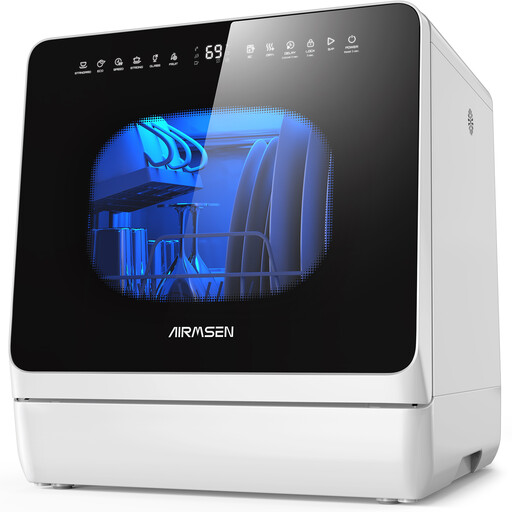
AIRMSEN portable tabletop dishwasher, 5 L, 5+1 programmes
The title mentions a built-in tank and says no fixed water connection is needed; check how you’ll drain the wastewater, though.
The title lists a 5 L tank and 5+1 wash programmes. According to the product information, the programmes described reach 75 °C, so check the temperature guidance for each lunchbox part.
The safety instructions specify indoor use on a flat, stable surface, with an earthed connection and no extension lead.
View at Joybuy
 No image available
AIRMSEN tabletop dishwasher, 8 wash programmes
The product name describes a tabletop dishwasher that doesn’t need a fixed connection; check your chosen set-up and drainage route before deciding.
The title lists 8 wash programmes, an integrated water softener and a delay start.
The safety instructions specify indoor use on a flat, stable surface, with an earthed connection and no extension lead.
View at Joybuy
 No image available
AIRMSEN tabletop dishwasher, 5 L, 9 programmes
The built-in tank and delay start may be useful if you don’t have a fixed water supply and want to schedule a wash; you’ll still need to arrange drainage.
The product name lists a 5 L tank, 9 programmes, dimensions of 37 × 50 cm and a 1–24-hour delay start.
The steam function described reaches 75 °C. Check the temperature instructions for each lunchbox part; the safety instructions specify indoor use on a flat, stable surface, with an earthed connection and no extension lead.
View at Joybuy
 No image available
Heinrich’s HTG 8855 tabletop dishwasher
The product name says this model can be used with or without a water connection; check which set-up and drainage option will work in your kitchen.
The title lists 3 place settings, 7 programmes, a 24-hour delay start, 56,3 dB and energy class C. Place settings don’t tell you whether your lunchbox will fit in the rack.
View at Joybuy
 No image available
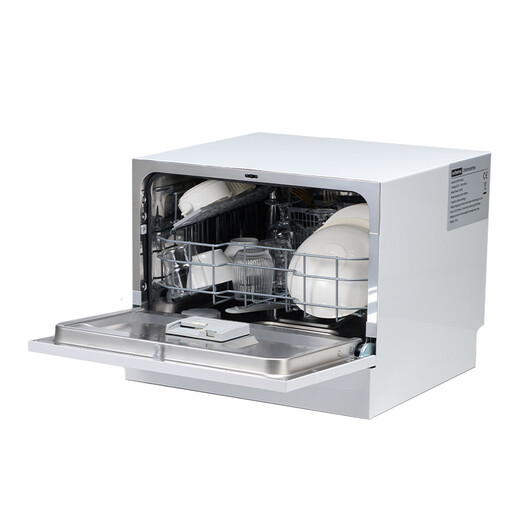
ochama tabletop dishwasher, 6 standard place settings
The stated capacity can help you compare it with other dishwashers, but doesn’t guarantee that a wide lunchbox will fit. Measure the box and its parts before choosing.
The product name lists 6 standard place settings, a 30-minute quick wash, a 24-hour delay start and 8 functions.
View at Joybuy
Frequently asked questions
Can every dishwasher-safe lunchbox go on a hot programme?
No. Check the instructions for your lunchbox and its separate parts. For a Take a Break midi model it assessed, Mepal recommends a maximum dishwasher temperature of 40 °C; this isn’t a general limit for all lunchboxes.
Does a tabletop dishwasher with a water tank also need a drain?
Yes, the used water needs to be drained away. For one version of Bob, Daan Tech describes a drain hose leading to a sink or suitable container. Check the manual for the model you choose.
How can I dry lunchbox parts properly after washing?
Follow the care instructions for your lunchbox and dishwasher. For the lunch products it assessed, Mepal advises storing the lid separately from the box or pot so they can dry; check the filter instructions in your dishwasher manual.
Which consumption figures can I compare?
Compare energy and water figures on the same basis, such as for the eco programme, and consider how often you run a small load. Milieu Centraal recommends running a full load on eco and warns that a compact mini dishwasher isn’t automatically the most economical choice.
What about the statutory guarantee on a dishwasher in the Netherlands?
The Netherlands has a statutory guarantee, but there is no fixed legal guarantee period of two years. The Dutch government says that if a product is faulty, you should contact the seller; what you’re entitled to expect depends, among other things, on the product and the circumstances.


