First, measure the space available and check whether your lunchbox, lid and inserts fit separately in the rack: the number of place settings won’t tell you that. An ultra-compact model with a water tank may suit a small space or a kitchen without a fixed water supply, but it still needs a drain. A larger tabletop model can handle more dishes at once, provided you have enough space and the right connections.
Who is this buying guide for?
Small kitchen, daily lunchbox
You regularly wash a lunchbox and want to use as little worktop space as possible. Start by checking the external dimensions, the space needed to open the door and where the drain will go. Then look at the number of place settings. The Consumers’ Association describes compact freestanding dishwashers as appliances that can sit on a worktop.
Several boxes per wash
You want to put lids, containers and perhaps other dishes in the machine at the same time. Compare the rack layout with the space needed for your separate components: a stated place-setting capacity doesn’t guarantee that wide or flat lunchbox lids will fit.
No fixed tap connection
You’re looking for a tabletop model that can draw water from a tank, but you’ll still need a suitable place to drain the waste water. Daan Tech says its Bob model has a built-in tank and a drain hose.
What should you look for when buying?
| Consideration |
What should you check? |
Who is this important for? |
| Space on and around the worktop |
Measure the width, depth and height, as well as the space in front of the door and the route for the drain hose. Compare these with the model’s installation instructions. |
If your kitchen has little clear worktop space, you’ll want to know whether the machine will still be practical when open and connected. Around 36% of consumers prioritise usable worktop space. |
| Room for the lunchbox, lid and inserts |
Measure the largest separate components and check the rack layout. See whether everything fits without stacking and whether the spray arm can rotate freely. |
If you want to wash several lunchbox components at once, the actual fit matters more than the number of place settings alone. Around 29% of consumers prioritise load capacity and fit. |
| Water supply and drainage |
Check the manual to see how the model gets its water and where the drain hose can discharge. A tank doesn’t remove the need to drain used water. |
If you don’t have a suitable fixed water supply, a model with a tank may be an option, provided you can drain the waste water. Around 21% of consumers start by checking the water supply. |
| Consumption, drying and maintenance |
Compare the energy label figures for consumption per eco cycle and per 100 eco cycles. Follow the instructions for your lunchbox and machine, and check the filter regularly. |
If you use the machine regularly, you’ll also want to know how much attention drying and maintenance require. Around 14% of consumers make consumption and maintenance their top priority. |
Common buying mistakes
-
Assuming place settings guarantee lunchbox capacity
A place setting doesn’t tell you whether a wide lid or a tall insert will fit. Stacked components can also block the water jets.
Measure your largest separate components and check that they fit in the rack without blocking the spray arm. The Consumers’ Association advises against stacking dishes and recommends making sure the spray arms can rotate freely.
A rack that doesn’t suit your needs may mean washing some components separately or having to wash them by hand after all.
-
Assuming a water tank means there’s no drain
Daan Tech says its Bob model has a built-in tank, as well as a drain hose for used water.
Before buying, check where the hose can discharge safely and follow the installation instructions for your chosen model.
When choosing where to put the machine, allow space for it and a suitable route for the drain hose.
-
Looking only at the external dimensions
You’ll also need to be able to open, load and connect the machine. The external dimensions alone don’t show how much space this requires.
Measure the space with the door open and check the installation instructions, including the room needed for hoses and connections.
An awkward setup can take up useful worktop space or make loading difficult.
-
Assuming machine washing is always more economical
Milieu Centraal says that washing dishes by hand is usually better for the environment if you use little hot water. So the comparison also depends on how you wash up.
Compare the options that work best for your dishes and routine. When washing by hand, don’t leave the hot tap running; when using the machine, choose the eco programme when suitable.
Brands to compare
Daan Tech
Bob is designed for anyone looking for a compact tabletop model or without a fixed water supply, but you’ll still need a suitable place to drain the water.
- Daan Tech lists Bob’s dimensions as 34 × 49 × 49 cm, with a built-in 3.9-litre tank and capacity for 3 standard place settings.
- The manufacturer also specifies a drain hose. The stated capacity doesn’t tell you whether your lunchbox components will fit in the rack.
Inventum
The VVW5520 is a tabletop model for anyone with room for a wider appliance who wants to wash several place settings at once.
- Inventum specifies capacity for 6 place settings, an eco programme and an option to set the door to open automatically when the cycle ends.
- The manual describes a cold-water connection. Check the full installation space and whether the separate lunchbox components will fit in the rack.
Tomado
The TDW5501W is a tabletop model for washing several lunchbox components or a mix of dishes, provided you have enough room for the machine and its connections.
- Tomado specifies capacity for 6 place settings and a cutlery basket. The model connects to a fixed water supply and drain.
- Tomado says this model doesn’t have a half-load option. For smaller loads, check the programme and consumption details.
Joybuy products
These tabletop dishwashers are for anyone who wants to wash lunchbox components in a limited space. The models vary in stated capacity and how they get their water.
 No image available
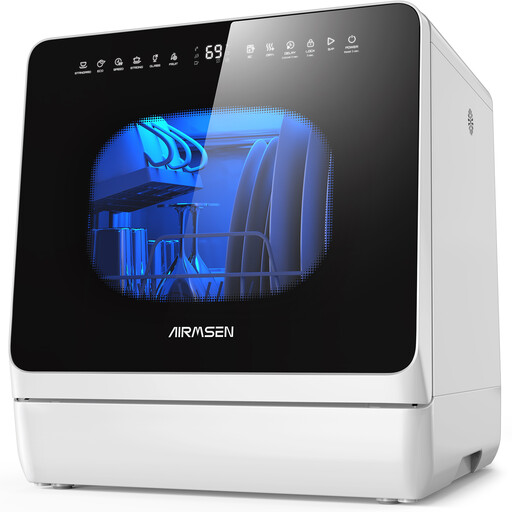
AIRMSEN tabletop dishwasher, 8 wash programmes
Worth considering if you’re looking for a compact tabletop model without a permanent water connection.
The product information lists capacity for 4 place settings, use without a permanent water connection, 8 wash programmes and a delay start.
View at Joybuy
 No image available
AIRMSEN tabletop dishwasher with a 5-litre tank
The tank may be useful if you don’t want to use a fixed water supply; also check where the waste water can drain.
The product information lists a width of 37 cm, a 5-litre tank, capacity for up to 4 place settings and 9 wash programmes. The title states 37 × 50 cm and energy rating D.
View at Joybuy
 No image available
Heinrich’s HTG 8855 mini tabletop dishwasher
Consider this model if you want to wash a small load and choose between a water tank and a direct tap connection.
The product information lists a 5-litre tank, capacity for 3 place settings, 7 programmes and use with or without a direct water connection. The title states energy rating C and a noise level of 56.3 dB.
View at Joybuy
 No image available
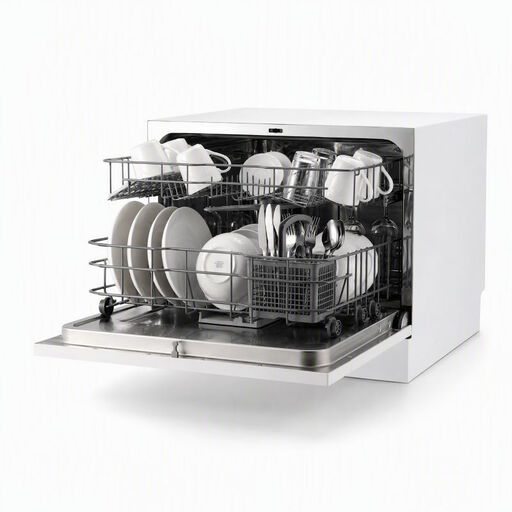
Ochama tabletop dishwasher, 6 standard place settings
The stated capacity may appeal if you want to wash several components at once, but check separately whether your lunchboxes will fit.
The product title lists space for 6 standard place settings, a 30-minute quick wash programme, a 24-hour delay start and 8 functions.
View at Joybuy
Frequently asked questions
Will every dishwasher-safe lunchbox fit in a tabletop dishwasher?
Not necessarily: dishwasher-safe doesn’t mean that a lunchbox will fit in your model’s rack. Follow the instructions for the lunchbox and its separate components, measure the largest pieces and don’t stack them. Make sure the spray arm can rotate freely, too.
Does a model with a water tank mean I don’t need a drain?
You still need one: for its Bob model, Daan Tech specifies a drain hose as well as a built-in tank. Check where the hose can go for your chosen model and follow the manual.
How do I keep the machine and lunchbox components clean and dry?
Keep the spray arm clear, check the filter regularly and follow the machine’s maintenance instructions. Mepal recommends storing the lid and container of its products designed for travel separately so they can dry properly. For other lunchboxes, follow the manufacturer’s instructions.
How do I compare the consumption of two dishwashers?
Compare the stated kWh per 100 eco cycles and litres per eco cycle on the energy labels. The European Commission explains these label figures; your actual consumption will also depend on how often you use the machine and which programme you choose.
Does a dishwasher need an energy label?
Yes. The Government of the Netherlands lists dishwashers as appliances that must have an energy label. The information on the label helps you compare models using their stated consumption figures, but it won’t tell you whether your lunchbox will fit in the rack.


