Who is a tabletop dishwasher suitable for?

Evening student with limited worktop space

Wants to make everyday washing-up easier, while still leaving room for the appliance and its open door. Measure the space available and check that your crockery will fit in the rack. Milieu Centraal, Inventum and Daan Tech describe compact models and the situations they are suited to.

Resident without a fixed water supply

May be looking for a model with a manually filled tank, and will also need to think about where the wastewater can go. Daan Tech describes Bob’s tank and drainage options; in an initial review from 2021, Consumentenbond noted its limited capacity and said filling it was awkward.

Small household that saves up its washing-up

Wants enough rack space for crockery from several meals and pays attention to consumption when the machine is running. Place settings don’t automatically tell you whether large plates or pans will fit. Milieu Centraal, Inventum, Bosch and Tomado provide different capacity and consumption figures for their models.

What should you consider when choosing one?

What to consider What should you check? Who should pay particular attention?
Space and capacity Measure the space where you’ll put it, the door opening and your largest plate; check the rack layout and the maximum plate diameter specified for the model. If I save up my washing-up after an evening class, I want to know whether my largest plate and everyday dishes will fit in the rack. Around 33% of consumers prioritise capacity and available space when buying.
Water supply and drainage Check the manual for the exact model and work out where the tap, drain hose and plug socket can go. Without a fixed water supply, I want to know in advance where the wastewater can go, not just how to fill the machine. Around 27% of consumers prioritise connections and drainage.
Evening use and noise Compare the duration and stated noise level of the programmes you want to use. Bosch lists 49 dB and a programme duration of 3:55 hours for the SKS2ITW00E. If I want to run the machine late in the evening, I want to know when the selected programme will finish and how much noise it is rated to make. Around 20% of consumers prioritise time and noise.
Consumption over repeated washes Compare kWh per 100 eco cycles and litres per eco cycle on the same basis; also consider how many dishes you can actually wash. I want to avoid choosing a model that doesn’t suit the way I use it or the amount of washing-up I have. Around 20% of consumers focus mainly on ongoing electricity and water consumption.

Buying pitfalls to avoid

  • Assuming a model without a fixed water supply doesn’t need drainage

    Even when you fill it by hand, the used water still needs to go somewhere. Check in advance how the drain hose should be positioned according to the instructions.

    Check the drainage route and where the hose will go before choosing a tank model.

    Filling it by hand takes time each time you use it, and you’ll need a suitable place for the wastewater to drain.

  • Assuming place settings cover everything you use for cooking

    A place setting doesn’t automatically include a pan or a large plate. With limited capacity, you may need to wash pans by hand or run extra loads.

    Measure your largest plates and picture your bowls, glasses and any pans in the rack layout.

    If the rack doesn’t offer enough space, you may still need to wash some items by hand or run an extra cycle.

  • Assuming eco-label consumption figures apply to a quick programme

    Consumentenbond explains that published label figures are based on the eco programme with a fully loaded machine. They don’t automatically show how much a shorter programme uses.

    Compare machines using the same label basis and check the figures for the programme you plan to use.

  • Assuming a compact dishwasher is automatically more economical

    Milieu Centraal says that washing by hand with a small amount of hot water is usually better for the environment. Consumentenbond says a standard-sized machine is the most economical option when you can fill it. So these comparisons depend on how you wash up and load the machine.

    Choose based on the amount of washing-up you usually have, and weigh the time saved separately against the space and consumption.

    A capacity that doesn’t suit your dishes and washing frequency could mean unnecessary electricity or water use.

Brands to consider

Inventum

The VVW5520 is a freestanding tabletop model for six place settings, designed for those with fixed connections and space for more crockery.

  • Inventum lists energy class D, an eco and hygiene programme, 47 dB and an adjustable automatic door opening at the end of a cycle.
  • Inventum doesn’t list a half-load option. The specifications describe the model, rather than independently measured cleaning results.

Daan Tech

Bob is a small model with a manually filled water tank, suited to those without a fixed water supply.

  • Daan Tech describes several options for the water supply and drainage.
  • In an initial review from 2021, Consumentenbond noted Bob’s limited capacity and said filling it by hand was awkward. This is a historical assessment of Bob, not a current test of every version.

Tomado

The TDW5501W is a tabletop model for six place settings, with a fixed water supply and drainage.

  • Tomado lists five programmes, a delay start and a stated noise level of 47 dB; the maximum plate diameter is Ø 25 cm.
  • Tomado doesn’t list a half-load option. Check that your own plates fit within the specified diameter.

Bosch

The SKS2ITW00E is a compact freestanding model for six place settings, with eco, quick and glass programmes among its options.

  • Bosch lists energy class E, 55 kWh per 100 eco cycles, 8,0 litres per eco cycle and 49 dB for this model.
  • The stated programme duration of 3:55 hours doesn’t apply to every programme. These specifications don’t automatically apply to other Bosch models.

Klarstein

The Aquatica, article number 10047348, is a model for two place settings which, according to Klarstein, connects directly to a water tap.

  • Klarstein lists three programmes and a maximum noise level of 58 dB.
  • For this version, Klarstein describes a tap connection, not the manually filled tank used by Bob. These are different connection options.

Tabletop dishwashers at Joybuy

This selection includes compact countertop dishwashers: models with a built-in water tank and a tabletop model for six place settings.
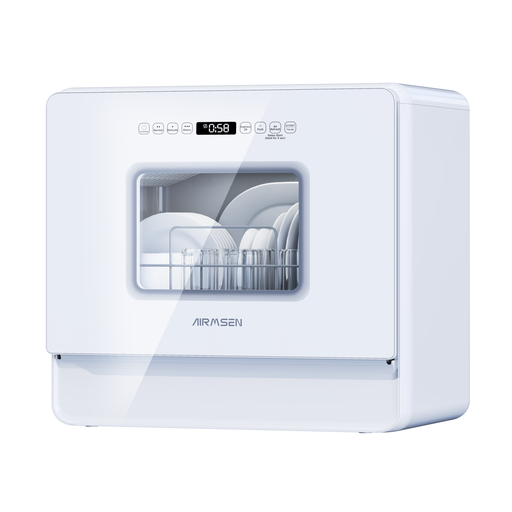
AIRMSEN A01 countertop dishwasher with two-tier rack

AIRMSEN A01 countertop dishwasher with two-tier rack

Suited to anyone looking to wash everyday dishes in a compact machine, with the option of a tank or tap water supply.

Built-in 5 L tank; two-tier rack; three spray arms; delay start of up to 12 hours.

View at Joybuy

AIRMSEN portable countertop dishwasher with 5+1 wash cycles

AIRMSEN portable countertop dishwasher with 5+1 wash cycles

Suited to anyone looking to handle everyday dishes in a compact machine with a built-in water tank.

5+1 wash cycles; built-in 5 L tank; double-tempered glass door.

View at Joybuy
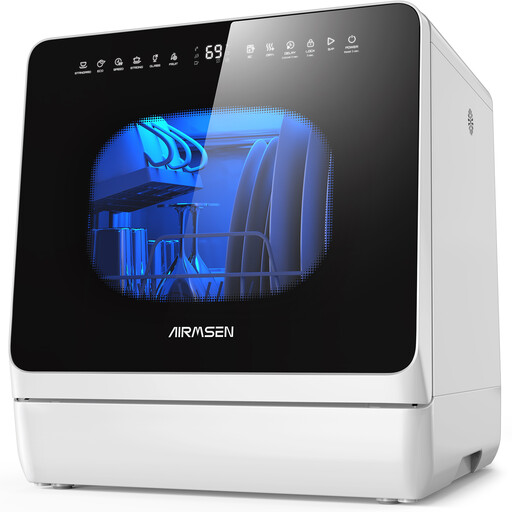
AIRMSEN countertop dishwasher with eight wash programmes

AIRMSEN countertop dishwasher with 8 wash programmes

Suited to anyone looking for a compact countertop model with a choice of programmes.

Eight wash programmes; delayed start; child lock; integrated water softener.

View at Joybuy

AIRMSEN tabletop dishwasher with 5-litre tank and energy class D

AIRMSEN tabletop dishwasher, 37 × 50 cm, energy class D

Suited to anyone looking for a slim countertop model with a built-in water tank.

Built-in 5 L tank; 9 wash programmes; dimensions 37 × 50 cm; 1–24-hour delay start; energy class D.

View at Joybuy
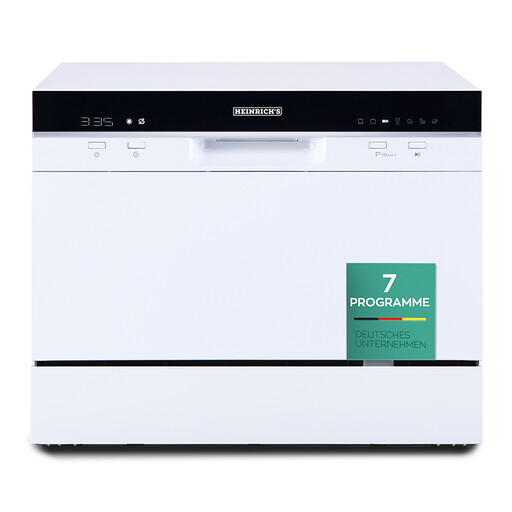
Heinrich’s HTG 8840 Weiss tabletop dishwasher for six place settings

Heinrich’s HTG 8840 Weiss, tabletop dishwasher for 6 place settings

Suited to anyone who wants to wash more crockery in one load after several meals; bear in mind that it needs a water supply and drainage.

6 place settings; 7 programmes; 47 dB; energy class D; delay start of up to 24 hours.

View at Joybuy

Frequently asked questions

Can I use a tabletop dishwasher without a fixed water connection?

It depends on the model. Daan Tech says Bob can be filled by hand, but the water still needs to drain away; Tomado specifies a fixed water supply and drainage for the TDW5501W. Check the instructions for the exact model and make sure you have a suitable drainage route.

How can I keep my dishwasher clean without pre-rinsing unnecessarily?

Remove food scraps and follow the manual’s instructions for cleaning the filter and using dishwasher detergent. Milieu Centraal says pre-rinsing is generally unnecessary and recommends the eco programme for most loads.

Do my rights end when the manufacturer’s guarantee expires?

No. ACM ConsuWijzer explains that your statutory guarantee exists alongside any manufacturer’s or retailer’s guarantee. If a dishwasher breaks down sooner than you could reasonably expect under normal use, the retailer is responsible for providing an appropriate solution free of charge; there is no fixed statutory guarantee period that applies to every dishwasher.

What can I do with my old dishwasher when I replace it in the Netherlands?

According to the Dutch government, when a private individual buys a new appliance, the retailer must take back an old, similar appliance free of charge under the old-for-new scheme. The government outlines separate options if the delivery driver can’t take the appliance away straight away. You can also take an old appliance to your local council recycling centre.

What do energy label figures tell me about a quick programme?

They don’t automatically show the consumption of that programme. According to Consumentenbond, published label figures are based on the eco programme with a fully loaded machine. Ask for model-specific figures if another programme is important to you.
