Start by checking your tablet’s exact model: an Apple Pencil, Samsung S Pen and other styluses aren’t automatically interchangeable. Then choose a pressure-sensitive pen if you want to vary line weight with how firmly you press. For simple sketches and text, app support, charging and somewhere to keep your pen may matter more.
Who is this choice relevant to?
Greeting card illustrator
You draw your own designs and want to control lines and shading with your pen. Which features you can use depends on the combination of tablet, pen and drawing app. Apple, Adonit and Logitech describe different capabilities and limitations for their models.
Card designer with an existing tablet
You want to create designs on the iPad, Galaxy Tab or Lenovo tablet already at the office, without choosing a pen that isn’t right for its exact model. Apple, Samsung and Lenovo publish model-specific information about their pens.
Hybrid worker using a shared desk
You switch between sketching, writing and other work, and want to be able to put your pen away and charge it easily. Apple, Samsung and Logitech describe different ways of attaching and charging their pens.
What should you look for when buying?
First check that the pen is compatible with your tablet, then decide which drawing features and storage and charging options you really need.
| What to consider |
What should you check? |
Who is this important for? |
| Compatibility |
Check the exact tablet model, pen version and any software requirements in the manufacturer’s compatibility information. |
If I want to draw on the office tablet we already have, the pen needs to be an exact match. Around 33% of consumers prioritise compatibility above all else. |
| Line control |
Check pressure and tilt support for both the pen and drawing app; tilt is not the same as pressure sensitivity. |
If I want to control drawn designs and shading, I need to know which input features my app actually uses. Around 27% of consumers put line variation first. |
| Storage and charging |
Check separately how the pen is stored, paired and charged, and whether a case leaves the attachment point accessible. |
If I work at a shared desk, I want to be able to find my pen easily and charge it where there’s space. Around 20% of consumers start by considering storage and charging. |
| Features and upkeep |
Compare pens that are compatible with your tablet, and check app support, the charging accessories required and the availability of replacement tips. |
If I mainly work with text and card layouts, I don’t want to pay for features my tablet or app can’t use. Around 20% of consumers focus on suitable features and upkeep. |
Common mistakes
-
Assuming every pen works with every iPad
Apple lists compatible iPads and software requirements for each Pencil version. So a pen that works with one model won’t necessarily work with another iPad.
Make a note of your tablet’s exact model and check the compatibility information and any software requirements before choosing a version.
-
Confusing tilt sensitivity with pressure sensitivity
Logitech states that the Crayon isn’t pressure-sensitive. Adonit says that the Note⁺ 2’s pressure features depend on pairing it with specific apps.
Decide whether you need pressure-controlled brush strokes, then check that both the pen and your drawing app support this feature.
-
Assuming magnetic storage means magnetic charging
Apple says the Pencil (USB-C) can be stored magnetically, but charges via a USB-C cable.
Check storage, pairing and charging as separate features before deciding where to keep the pen at your desk.
Brands to consider
Apple
The Apple Pencil Pro and Apple Pencil (USB-C) are designed for different, model-specific groups of iPads. Check the compatibility list for your tablet.
- Apple highlights magnetic pairing and charging, as well as additional drawing controls, for the Pencil Pro.
- According to Apple, the Pencil (USB-C) charges via a cable and isn’t an interchangeable Pro version.
Samsung
Samsung S Pens are model-specific. The S Pen reviewed for the Galaxy Tab S11 series is designed for the Tab S11 and S11 Ultra.
- Samsung lists pressure detection, side attachment and a replaceable tip for this pen.
- Compatibility and Bluetooth features vary between S Pens, so don’t assume features based on the product range name alone.
Adonit
Adonit lists the Note⁺ 2 as an alternative for the iPads specified for this pen.
- Adonit lists pressure and tilt support, as well as replaceable tips.
- According to Adonit, pressure sensitivity and shortcut buttons require pairing with specific apps. The listed 2024 models don’t have magnetic attachment.
Logitech
The Crayon (USB-C) is designed for supported iPads and may be worth considering for sketching and writing with tilt-controlled lines.
- Logitech describes how to switch it on for use, palm rejection and USB-C charging.
- Logitech explicitly states that the Crayon isn’t pressure-sensitive.
Lenovo
The Precision Pen 3 is an option for Lenovo systems whose compatibility Lenovo confirms.
- Lenovo specifies 4096 pressure levels, tilt support, and magnetic pairing and charging for this pen.
- Lenovo directs you to a separate compatibility check to match the pen to your device; the number of pressure levels alone doesn’t predict the drawing results.
Styluses at Joybuy
This selection includes styluses for specific iPads and other touchscreen devices. Check that each pen is compatible with your exact tablet and drawing app.
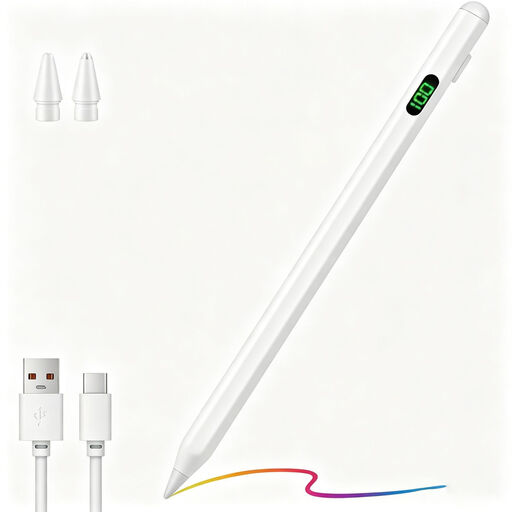 Image unavailable
Universal magnetic touchscreen stylus for Android and iOS
An option to consider if you’re looking for a stylus for sketching on a touchscreen; check that it’s suitable for your device.
The product title mentions fast charging, an LED indicator and magnetic attachment.
Magnetic attachment is listed for compatible iPads.
View at Joybuy
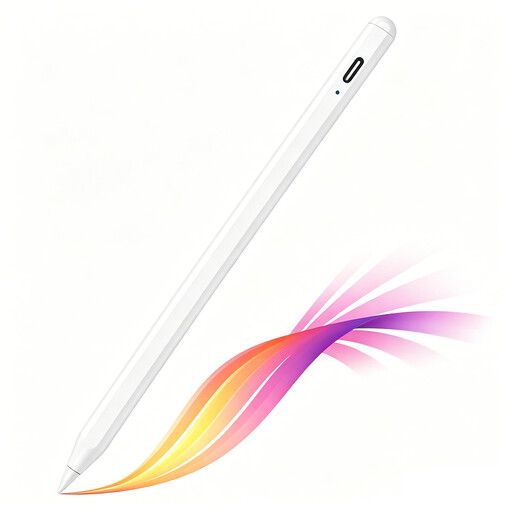 Image unavailable
iPad stylus with USB-C, tilt detection and palm rejection
Worth considering for sketching on a selected iPad if you’re looking for tilt input and palm rejection.
The product title mentions USB-C, tilt detection, palm rejection and magnetic attachment.
The description limits compatibility to selected iPad models; magnetic attachment is for storage, not wireless charging.
View at Joybuy
 Image unavailable
Apple Pencil Pro (2024), for iPad Air and iPad Pro
An option for illustrations with varied brush strokes if you have a compatible iPad.
Apple describes pressure and tilt sensitivity, as well as magnetic pairing and charging, for the Pencil Pro.
Compatibility is limited to specific iPad models; check the list for your tablet.
View at Joybuy
 Image unavailable
Apple Pencil (USB-C), white
An option for simple sketches on a compatible iPad if tilt input suits the way you draw.
Apple describes tilt sensitivity and magnetic storage; the pen charges via a USB-C cable.
View at Joybuy
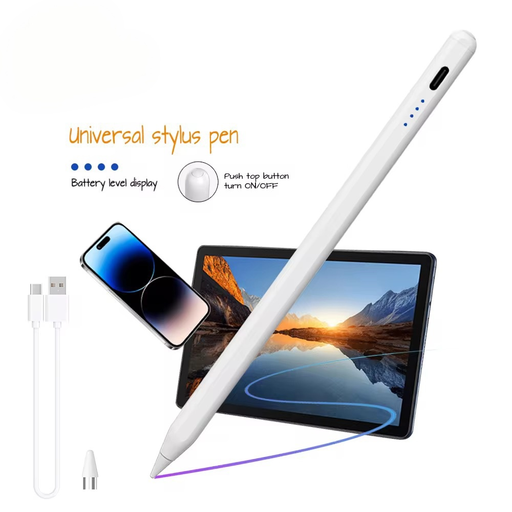 Image unavailable
VoxorAI HL-U05 White active stylus
An option to consider for sketching on a capacitive touchscreen; check that it works with your device and the apps you want to use.
The product title mentions iOS, iPad, Android and Microsoft. A capacitive touchscreen is required.
View at Joybuy
Frequently asked questions
Can I draw with any stylus on the shared office tablet?
No. Check the exact tablet model, pen version and any software requirements with the manufacturer. Your app may also need to support specific drawing features.
Will a pen that attaches magnetically charge automatically?
Not always. Apple describes magnetic pairing and charging for the Pencil Pro; the Pencil (USB-C) can be stored magnetically, but charges via a USB-C cable.
What can I do if the pen tip wears down?
Follow the instructions for your exact pen and check whether replacement tips are available. Samsung describes how to replace the tip on the Tab S11 pen. Logitech recommends replacing a damaged or worn Crayon tip to protect the screen.
What are my rights in the Netherlands if I buy the pen online and don’t like it or it’s faulty?
For eligible consumer purchases made at a distance, you generally have a 14-day cooling-off period, according to the Government of the Netherlands. If a product is faulty, statutory consumer rights apply; the Government of the Netherlands states that there is no fixed statutory guarantee period in the Netherlands. Consumer rules don’t necessarily apply to a purchase made in a company’s name.


