
Vandaag of morgen in huis

Kwaliteit gegarandeerd

Welkomstaanbiedingen ontgrendelen: GRATIS bezorging | Tot 80% korting | Gratis 30 dagen JoyPlus-proefperiode
Download de app
If you run a table tennis club, coach, or play seriously yourself, you know how frustrating it is when your equipment isn't up to par. A basket full of cracked or inconsistent balls can completely disrupt a training session. The search for the right table tennis balls can be overwhelming due to the many options and specifications. This article is designed to help you make a clear choice. We'll discuss the key features to look for and highlight some popular choices for intensive use, without any unnecessary marketing jargon.
The choice of the right ball depends on your objective: training, playing matches, or recreational use. Here are three practical points to help you with your decision.
The quality of table tennis balls is often indicated by a star rating system. Although this is not an official ITTF standard, it provides a good indication of quality.
Virtually all modern ping pong balls are made of plastic, usually ABS. This material replaced the former celluloid due to its fire safety and durability. ABS ping pong balls are harder and last longer, making them a reliable choice for intensive use.
Additionally, you will see the 40+ table tennis balls designation everywhere. This refers to the diameter of the ball, which is slightly larger than the former 40mm balls. This change was implemented to slightly slow down rallies and improve visibility for players and spectators. The 40+ ball is the current standard in the sport.
For an individual, a box of 6 or 12 balls is often sufficient. However, for table tennis clubs, schools, and serious players who train a lot, a bulk pack of table tennis balls is the most logical and economical choice. A stock of 100 or more balls ensures that training sessions are not interrupted and that there are always enough balls for multi-table training or a ball robot.
Based on product specifications and intended use, we have compiled a few recommendations for you. These are popular Joola table tennis balls suitable for various levels and applications.
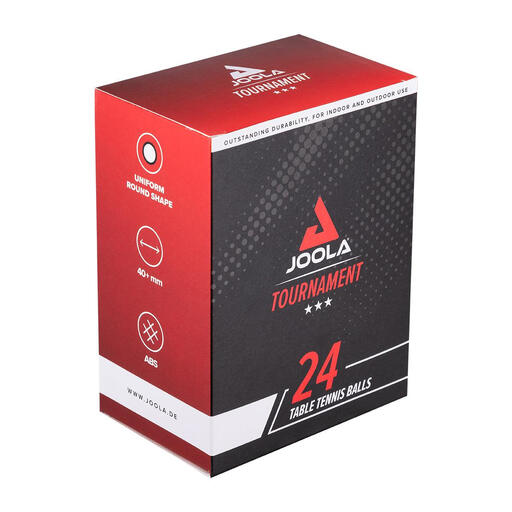
Why It Stands Out: This ball is designed for players who demand consistent performance and durability. The JOOLA TOURNAMENT*** is made of hard ABS plastic, which, according to the manufacturer, ensures reliable roundness and a predictable bounce. This makes the ball suitable for both high-level training and competitions.
Pros:
Who Is It For? Competitive players and clubs looking for high-quality competition table tennis balls for tournaments or serious training sessions. The 24-pack is a practical quantity for team use.
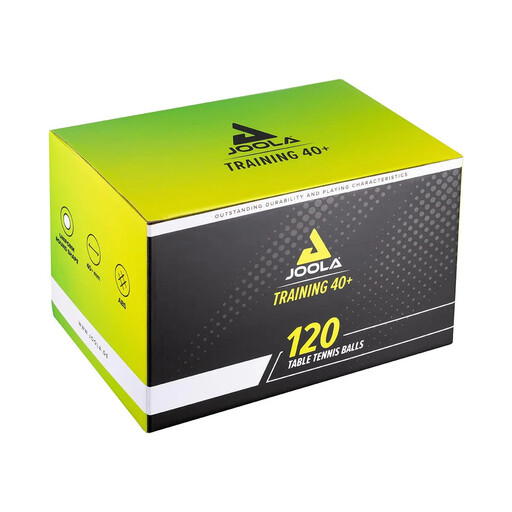
Why It Stands Out: The JOOLA TRAINING 40+ is specifically developed for intensive practice sessions. This ball is made of robust ABS material with a seam, which Joola claims contributes to optimal balance and accuracy. The focus here is on durability, ensuring the balls can withstand demanding training sessions and use in a ball robot.
Pros:
Who Is It For? Table tennis clubs, schools, training centers, and players who need a large, reliable supply of training table tennis balls for group sessions or a ball robot.
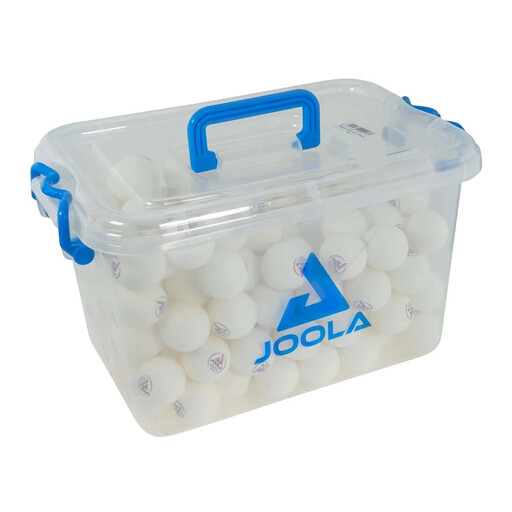
Why It Stands Out: The JOOLA MAGIC ABS 40+ ball is positioned as a training ball with playing characteristics that approach those of a competition ball. According to the manufacturer, this ball is produced using the same technology as their competition balls, resulting in higher hardness and a very consistent bounce.
Pros:
Who Is It For? Serious players and training centers who do not want to compromise on ball quality during training and prefer a ball that feels like a competition ball.
Are you looking for other sports equipment or perhaps something completely different for your home? Check out our TV Stand Risers category.
The 40+ ball is the modern standard and has a diameter that is slightly larger (between 40.0 and 40.6 mm) than the old 40mm ball. This change was introduced to slightly slow down the game and make the ball more visible. All the balls mentioned above are 40+ table tennis balls.
For official competitions, 3-star table tennis balls are used because they meet the highest standards for roundness and consistency. For training, especially in large quantities, 1-star or no-star balls are a great and cost-effective choice. They are designed for longevity.
ABS (Acrylonitrile Butadiene Styrene) is a type of plastic that is more durable and harder than the former celluloid. ABS ping pong balls are less prone to cracking and retain their shape better, leading to a more consistent bounce and a longer lifespan. Furthermore, ABS is not a fire hazard, unlike celluloid.
