Choose taaitaai if you mainly want to share a spiced treat, but don’t assume that standard taaitaai is Fairtrade-certified. If a verifiable Fairtrade claim is essential, choose a product that carries one, such as Fairtrade chocolate as an alternative or an extra. If any of your guests have allergies, always check the current packaging for the exact product variant.
Who is this choice relevant to?
Organisers who put Fairtrade first
You want to be able to verify the Fairtrade claim on the product you choose. Chocolate with its own Fairtrade claim may be a different choice from standard taaitaai; serving chocolate alongside it doesn’t change the status of the taaitaai.
Fans of a spiced treat to share
You’re looking for taaitaai to serve at an informal birthday get-together and want to know how much comes in a pack. Albert Heijn and Jumbo both describe a 500 g pack of taaitaai; also read the ingredients for the variant you buy.
Organisers catering for guests with allergies
Only make your choice after reading the allergen information for each exact variant. The taaitaai described by Albert Heijn and Jumbo contains milk and cereals containing gluten; other allergens may be relevant in a chocolate assortment.
What should you consider when choosing?
First decide whether taaitaai itself or a verifiable Fairtrade claim matters more to you. Then assess each product, taking its allergens and packaging into account, to decide whether you want to serve it to your guests.
Standard taaitaai
Choose this if: you want to share a spiced treat and Fairtrade certification for the taaitaai isn’t essential.
Bear in mind: the Albert Heijn and Jumbo variants described don’t carry a stated Fairtrade claim and contain milk and cereals containing gluten.
Chocolate with a Fairtrade claim
Choose this if: the Fairtrade claim on the product matters more to you than choosing taaitaai.
Bear in mind: chocolate isn’t taaitaai. Fairtrade Netherlands also allows mass balance for cocoa, so a Fairtrade claim alone doesn’t prove that all the cocoa has remained physically separate.
| What to consider |
What to check when buying |
Who is this most important to? |
| Fairtrade claim |
Look for the certification mark and check whether the claim applies to the whole product or specific ingredients. If there’s an arrow next to the logo, read the explanation on the packaging too. |
If Fairtrade is my priority, I want to be able to see what the claim applies to on the product I choose. For around 42% of consumers, this verifiability is their main concern. |
| Allergens and serving |
Read the current ingredients and allergen information for each variant. Decide whether you need to serve snacks separately. |
When guests have food allergies, I want to know which snacks I can serve separately. Around 33% of consumers put allergens and how food is served first. |
| Flavour and quantity |
Compare the pack size with the amount you want to serve, and check shortly before the get-together that your chosen variant is available. |
For an informal get-together, I want enough spiced taaitaai to suit my group. For around 25% of consumers, this practical consideration matters most. |
Common mistakes when choosing
-
Serving Fairtrade chocolate and calling the taaitaai Fairtrade too
A claim on chocolate doesn’t automatically apply to the taaitaai served alongside it. The standard taaitaai described by Albert Heijn and Jumbo doesn’t carry a stated Fairtrade claim.
If Fairtrade certification is essential to your choice, check each product separately.
-
Assuming Fairtrade means the cocoa is physically separated
Fairtrade Netherlands allows mass balance for cocoa. So a Fairtrade claim alone doesn’t tell you whether the cocoa in a particular bar has remained physically separate throughout the supply chain.
If this kind of traceability is important to you, look for a specific explanation for the exact product.
-
Putting out one platter without checking for allergens
The taaitaai variants described contain milk and cereals containing gluten. PLUS says its Fairtrade chocolate assortment includes ingredients such as milk, soya, peanuts and nuts.
Check the current packaging for each variant and, if necessary, use separate, clearly labelled platters.
Brands to compare
These brands offer options to consider for taaitaai or chocolate with a Fairtrade claim. Assess the claim and ingredients for each product rather than relying on the brand name alone.
Albert Heijn
Albert Heijn describes its own-brand taaitaai in a 500 g pack and also sells chocolate with a Fairtrade cocoa claim.
- The taaitaai product information lists ingredients including milk and cereals containing gluten, so you can assess this variant specifically.
- A Fairtrade claim on a chocolate product says nothing about the status of the taaitaai. Check the current packaging for each product separately.
Jumbo
Jumbo describes Sint Taai Taai Figuurtjes in a 500 g pack for anyone looking to share taaitaai.
- The product information lists ingredients and allergens, including milk and cereals containing gluten.
- The taaitaai described doesn’t carry a stated Fairtrade claim; consider any Fairtrade purchase as a separate product.
PLUS
PLUS describes a 225 g Fairtrade chocolate assortment as a chocolate option to share.
- The Fairtrade label applies to the chocolate assortment itself.
- The assortment described includes ingredients such as milk, soya, peanuts and nuts. Check the exact packaging before offering it to guests.
Lidl
Lidl describes Way To Go as a range of Fairtrade-certified chocolate bars.
- The Fairtrade claim is linked to the chocolate range described, not to taaitaai.
- Choose the exact variant only after checking the packaging and ingredients for your guests.
ALDI
ALDI describes 200 g Choceur dark chocolate as a Fairtrade product.
- This product description gives you a specific Fairtrade chocolate option to consider alongside taaitaai.
- Before the get-together, check that your chosen variant is available and read the current packaging information.
Dirk
Dirk lists chocolate as one of the product categories where you may find the Fairtrade mark.
- Dirk explains what Fairtrade logos mean on its information page.
- Don’t let information about the certification mark replace checking the ingredients and claim on the packaging you choose.
Chocolate to serve alongside taaitaai
This chocolate bar could suit a get-together where you’re considering chocolate with a Fairtrade claim as an alternative or an extra. It isn’t taaitaai: check the claim and allergens on the current packaging before deciding what to serve.
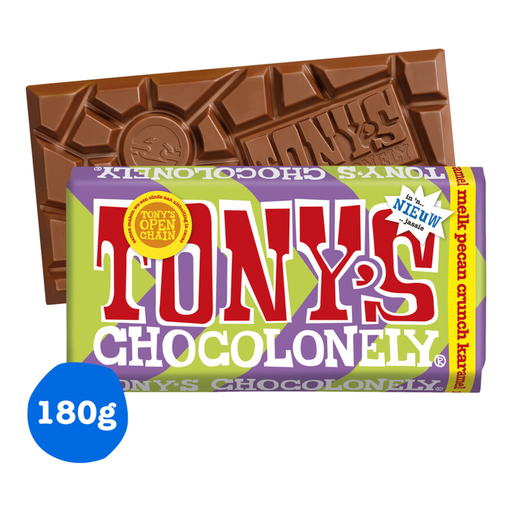 Image unavailable
Tony's Chocolonely Milk Pecan Caramel chocolate bar, 180 g
This bar is a chocolate option to serve alongside taaitaai or instead of it. The product description mentions Fairtrade; check the current packaging to see what the claim applies to, and check the allergen information for your guests.
View on Joybuy
Frequently asked questions
How can I check the Fairtrade claim on chocolate?
Look for the certification mark on the exact packaging. For a composite product, also read the explanation accompanying any arrow. Fairtrade Netherlands says a composite product carrying this label must contain at least 20% Fairtrade ingredients overall; check which ingredients the label refers to.
Is the cocoa in Fairtrade chocolate always kept physically separate?
No, you can’t assume that from the Fairtrade claim alone. Fairtrade Netherlands allows mass balance for cocoa, meaning Fairtrade and non-Fairtrade cocoa may be mixed in the supply chain. If physical separation matters to you, look for a separate traceability claim.
Can I serve standard taaitaai to guests with a gluten or milk allergy?
Don’t assume so without checking the label: the taaitaai variants described by Albert Heijn and Jumbo contain milk and cereals containing gluten. Check the current allergen information for the exact variant and, for guests with a relevant allergy, choose a suitable alternative and serve it separately.
Is a chocolate assortment or a bar easier to share?
You can share either; choose based on how much you want to serve and the ingredients in the exact product. PLUS describes a 225 g Fairtrade chocolate assortment that includes ingredients such as milk, soya, peanuts and nuts. A Fairtrade label doesn’t automatically make a mix suitable for every guest.


