
Seasonal get-together organisers
If you want to share a distinctive aniseed-flavoured biscuit, taai-taai fits the bill. Check how many are in the pack and check the allergens before serving.


Choose taai-taai if you want to share a distinctive aniseed-flavoured biscuit; choose a plain digestive if you’d prefer a wheat biscuit without that strong flavour. Check the nutritional information and allergens on the exact packaging for both. If a guest needs a gluten-free option, choose only a variety explicitly labelled gluten-free and check for other allergens too.
If you want to share a distinctive aniseed-flavoured biscuit, taai-taai fits the bill. Check how many are in the pack and check the allergens before serving.
If you’re looking for something sweet without taai-taai’s strong flavour, you could consider a plain digestive. Compare the nutritional information for the variety you’ve chosen rather than relying on the product name alone.
If a guest needs to avoid gluten, the label on the specific pack is what matters. The standard taai-taai listed by Albert Heijn contains rye and wheat; even if you choose a variety explicitly labelled gluten-free, check for other allergens too.
First decide whether your get-together calls for taai-taai’s aniseed flavour or a biscuit without it. Then check dietary requirements, pack size and the nutritional information for the exact variety.
| What to consider | What to check when buying | Who it matters to |
|---|---|---|
| Aniseed flavour and sharing | Check the flavour description and how many biscuits are in the pack. | If I’m serving a distinctive aniseed-flavoured treat to a group, I want to have enough biscuits to share. For around 37% of consumers, that seasonal flavour would be the main reason for choosing it. |
| Plain biscuit | Choose the exact digestive variety: a chocolate version is different from Original. | I want a biscuit for drinks that doesn’t have taai-taai’s strong flavour. For around 27% of consumers, that preference for a plain digestive would be the main consideration. |
| Gluten-free option | Look for an explicit gluten-free label and read the ingredients and allergen information too. | If a guest needs to avoid gluten, I want to know the biscuit I’ve chosen is suitable before serving it. For around 18% of consumers, this would be the most important requirement. |
| Label and portion | Compare the nutritional information per 100 g and, where provided, per portion; check the portion size too. | If you want to know what’s in each biscuit on the table, the nutritional information is more useful than the name on the front of the pack. For around 18% of consumers, comparing the label and portion size would be the main consideration. |
The product name doesn’t tell you how much energy, sugar, fat or salt a particular variety contains. Joybuy lists McVitie's Digestive Original as containing 483 kcal and 21,3 g of fat per 100 g.
Compare the nutritional information per 100 g for the varieties you’re considering, and check the portion size too.
Albert Heijn lists milk, rye and wheat among the ingredients in its standard taai-taai. The product category alone doesn’t tell you whether a biscuit is suitable for a guest’s dietary requirements.
Read the ingredients and allergen information on every pack. If a gluten-free option is essential, choose only a variety explicitly labelled gluten-free and check for any other relevant allergens too.
Albert Heijn and PLUS state that product information, including ingredients and allergens, can change.
Before serving, check the packaging you actually bought, including the best-before date and storage instructions.
These brands offer different taai-taai and digestive varieties. The details below apply to the specific products listed, not every product from each brand.
Albert Heijn lists its own taai-taai, as well as a gluten-free-labelled taai-taai from Consenza.
PLUS lists both taai-taai and a plain digestive biscuit.
Consenza Taai taai poppetjes is explicitly labelled gluten-free by Albert Heijn.
McVitie's Digestive Original is a wheat biscuit for anyone looking for a digestive rather than taai-taai.
These products suit the digestive side of the choice for Friday afternoon drinks. Original is the variety without the chocolate coating mentioned in the names of the other two products; if you want to serve taai-taai, you’ll need to choose a different type of product.
 Image unavailable
A plain digestive for anyone who doesn’t want taai-taai flavour or a chocolate coating with their drinks.
400 g pack. According to the listed ingredients, this variety contains wheat and cereals containing gluten, and may contain milk. Check the current packaging for allergen information and dietary requirements.
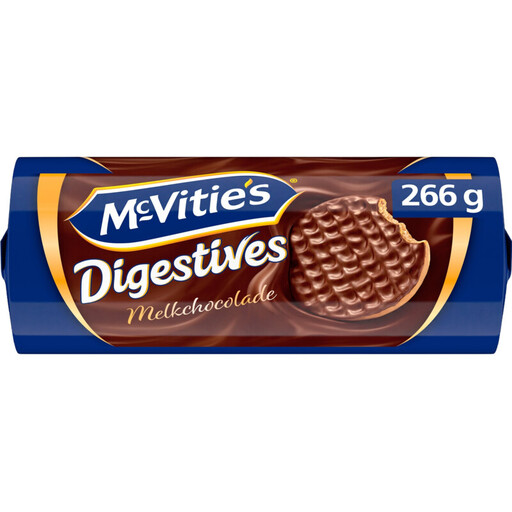 Image unavailable
A digestive with milk chocolate for anyone who deliberately wants to share a chocolate variety rather than the plain Original.
266 g pack. According to the allergen information provided, this variety contains milk, soya and wheat. Check the packaging to see whether the nutritional values are given per 100 g or per portion.
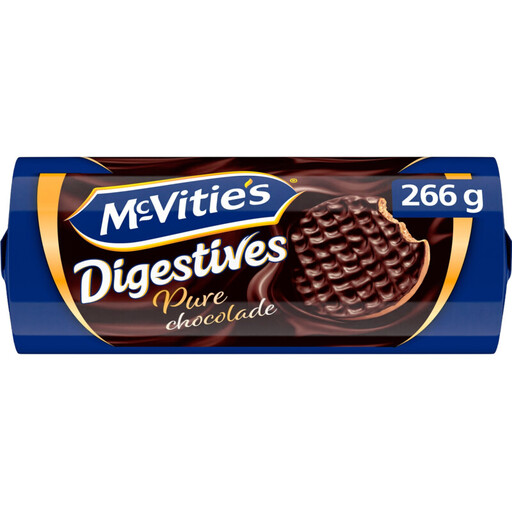 Image unavailable
A digestive with dark chocolate for anyone who wants to share a chocolate variety with their drinks rather than Original.
266 g pack. According to the allergen information provided, this variety contains wheat, milk and soya. Check the packaging to see whether the nutritional values are given per 100 g or per portion.
Don’t assume it is: the AH Taai taai listed by Albert Heijn contains rye and wheat. If a guest needs to avoid gluten, choose a product explicitly labelled gluten-free and check the other allergens on the packaging.
No, the name alone isn’t enough to make that comparison. The Netherlands Nutrition Centre recommends reading the label; compare the nutritional information per 100 g for the exact varieties and check the portion size too.
For AH Taai taai, Albert Heijn recommends storing it in a cool, dark and dry place, and keeping it in a sealed tin once opened. For another variety, follow the storage instructions on its packaging.