
PC gamer looking for a wider view
Plays survival games on PC and wants a wider view of the action, provided the game and desk are suitable for an ultrawide monitor.


A 32-inch 16:9 monitor is right for you if you value a conventional aspect ratio and plenty of detail on a large screen. A 34-inch ultrawide is an option if you want a wider view on PC and your game displays correctly in that format. Also check which resolution and refresh rate your PC or console supports through the connection you plan to use, and measure up to make sure the screen and stand fit on your desk.
Plays survival games on PC and wants a wider view of the action, provided the game and desk are suitable for an ultrawide monitor.
Wants to see landscapes and fine details on a large screen, and checks whether their system can handle the desired output.
Wants to check in advance which resolution and refresh rate are available through their connection and console.
First decide whether you want a conventional 16:9 picture or a wider view on PC. Then compare the output from your gaming device, the panel and the space the monitor will take up.
| What to consider | What should you check? | Who is this important for? |
|---|---|---|
| Wide picture and size | Check that your games support the aspect ratio you want, and measure the space for both the screen and its stand. | If I want to play survival games on PC with a wider view, the game needs to support that format properly and my desk needs to have enough space. Around 36% of consumers prioritise a wide view when gaming. |
| Clarity and dark scenes | Compare the native resolution and panel type. For general HDR or picture-quality claims, also look at independent test results. | If I care about landscapes and detail on a large screen, I compare the resolution and panel before choosing. Around 29% of consumers give detail or contrast top priority. |
| Smoothness and connections | Check the resolution and Hz combination for each port, along with the output settings on your PC or console. | If I want to use my monitor with a console or PC, I want to know which picture mode the device can output through the connection I choose. Around 21% of consumers focus mainly on smoothness and compatibility. |
| Set-up and after-sales support | Measure your desk and read the terms for the exact model. Distinguish between the manufacturer's warranty and your statutory rights. | If I buy a large screen, I want to know in advance whether it will fit and what terms apply to my use. Around 14% of consumers prioritise set-up and after-sales support. |
The picture mode available depends on the connection and the device sending the signal. So a stated maximum does not automatically apply to every port or game.
Check the port specifications for the exact model and the output settings on your own PC or console.
The aspect ratio and desk space required can differ, even when the screen diagonals are similar.
Measure the space available for the screen and stand, and check that your favourite games support the aspect ratio you want.
An additional warranty from the manufacturer or retailer is separate from your statutory rights. If a product is faulty, the retailer is responsible for providing an appropriate solution.
Keep your proof of purchase, read the terms for the exact model and contact the retailer about your statutory rights.
According to Philips Netherlands, the Evnia 34M2C3500L/00 is a 34-inch ultrawide model with a resolution of 3440 × 1440 and a stated maximum refresh rate of 180 Hz.
Dell Netherlands specifies that the AW3425DW is a 34.2-inch QD-OLED ultrawide with a resolution of 3440 × 1440 and a maximum refresh rate of 240 Hz.
AOC describes the AGON PRO AG326UD as a 31.5-inch 4K QD-OLED model with a stated refresh rate of 165 Hz.
This selection includes large 16:9 monitors for anyone looking for detail on a conventional screen, as well as ultrawide models for PC gamers who want a wider view.
 No image available
An option if you want a large, conventional gaming screen.
32 inch; QHD 2560 × 1440; IPS; stated refresh rate of 180 Hz.
The product specifications list G-SYNC and FreeSync support.
 No image available
An option if detail on a large 16:9 screen is important to you.
31.5 inch; 4K UHD; QD-OLED; stated refresh rate of 165 Hz.
The product information states that there are no built-in speakers.
 No image available
An option if you want a wide view on PC and your games support 21:9.
3440 × 1440; 21:9; Fast VA; stated maximum of 180 Hz via DisplayPort and 100 Hz via HDMI.
 No image available
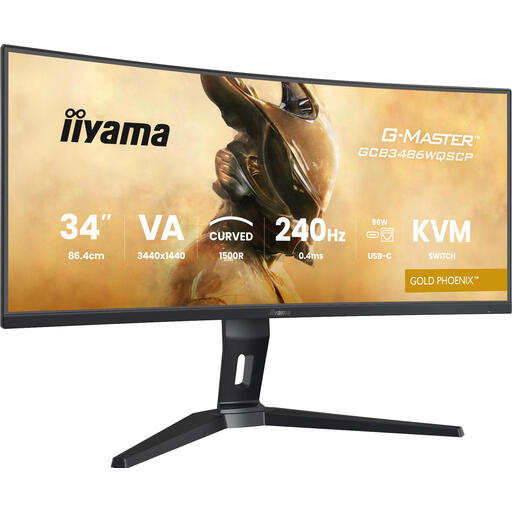
An option if you want a curved ultrawide for games that support the wider aspect ratio.
34 inch; 3440 × 1440; VA; stated refresh rate of 240 Hz.
The product information lists FreeSync Premium and a height-adjustable, tiltable stand.
 No image available
An option if you want a wide PC screen and a QD-OLED panel.
3440 × 1440; 21:9; stated refresh rate of 175 Hz.
The product information lists OLED Care 2.0 and an adjustable stand.
First, measure the space for the screen and stand. Then compare the resolution and refresh rate supported by the monitor port you’re using with the output from your PC or console. On PS5, you can view the resolution settings and signal information under Screen and Video, and test 1440p output there.
No. The device sending the signal must provide a compatible signal, and the available mode also depends on the connection. Sony states that 120 Hz output on PS5 requires a game that supports 120 Hz.
As well as any warranty from the manufacturer or retailer, you have statutory rights. According to ACM ConsuWijzer, the retailer is responsible for providing an appropriate solution if a product is faulty. There is not necessarily one fixed statutory warranty period for every monitor.
According to ACM ConsuWijzer, with a standard online purchase of a product, you generally have a statutory cooling-off period of up to 14 days after delivery, although exceptions apply. Also check the retailer’s returns information in advance.